AHA Home Fraud Risk Score
Property Vulnerability Assessment
Clear. Structured. No pressure.
No login, membership, or payment required. Email is optional.
Want to see how your results are structured? View a sample Home Fraud Risk Report (PDF)
What Is AHA Home Fraud Risk Score?
A calm, structured review of signals that may affect your property’s vulnerability to record fraud.
Built to answer questions many homeowners rarely think to ask:
- Are my property ownership records being monitored?
- Are there signals that could make my home more vulnerable to property fraud?
- When did I last review my ownership records or filing alerts?
Not a fraud detector.
Not a title search service.
Not a scare tactic.
A clearer way to understand potential vulnerabilities and what to do next.
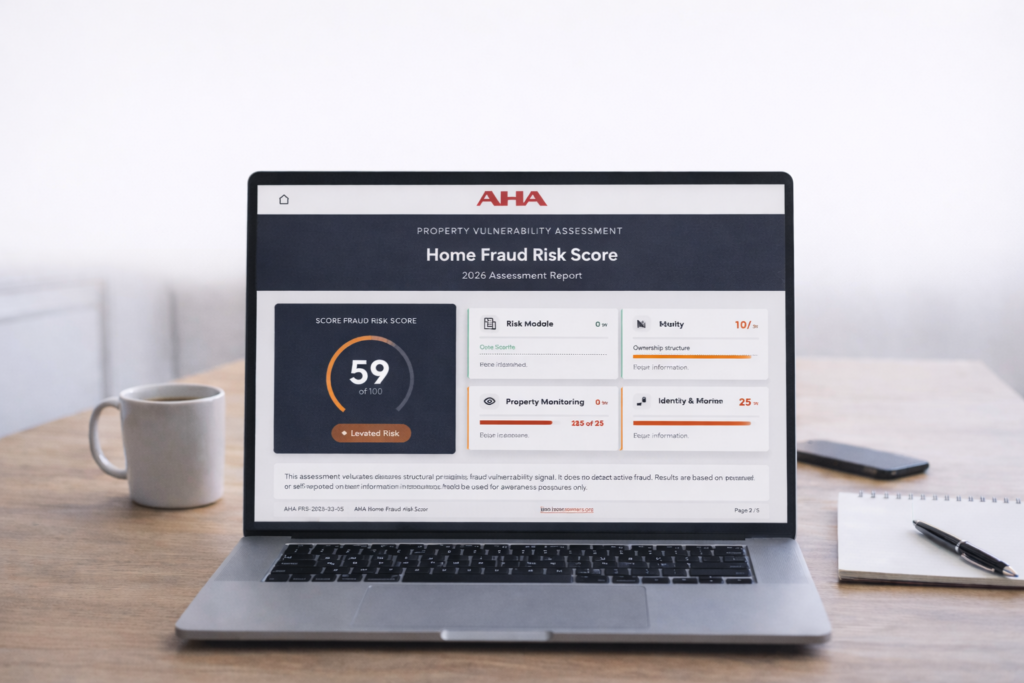
- How Home Fraud Risk Score Works
Step 1: Share Basic Property Context
Provide basic property information and a few details about ownership, mortgage status, and recent property activity.
No Social Security number, financial account information, date of birth, or document upload is requested.
Step 2: Answer 15 Protection Questions
Answer multiple-choice questions about ownership, equity, monitoring habits, identity exposure, and transaction activity.
Estimates and “not sure” responses are acceptable where available.
Step 3: Review Your Fraud Risk Report
You’ll receive:
Home Fraud Risk Score — A 0–100 vulnerability score
Risk Band — Low, Moderate, Elevated, or High
Module Breakdown — Ownership, Equity, Monitoring, and Identity Exposure
Fraud Difficulty Level — A separate contextual indicator
What to Do Next — Prioritized protection steps
Clear signals. Practical next steps.
How the score is calculated
The 0–100 score is based on four areas: Ownership, Equity, Monitoring, and Identity Exposure. Each contributes up to 25 points. Higher scores indicate greater potential vulnerability.
A separate Transaction Exposure section considers recent sale, refinance or HELOC activity, vacancy, rental use, or second-home use. It provides additional context but does not change the core score.
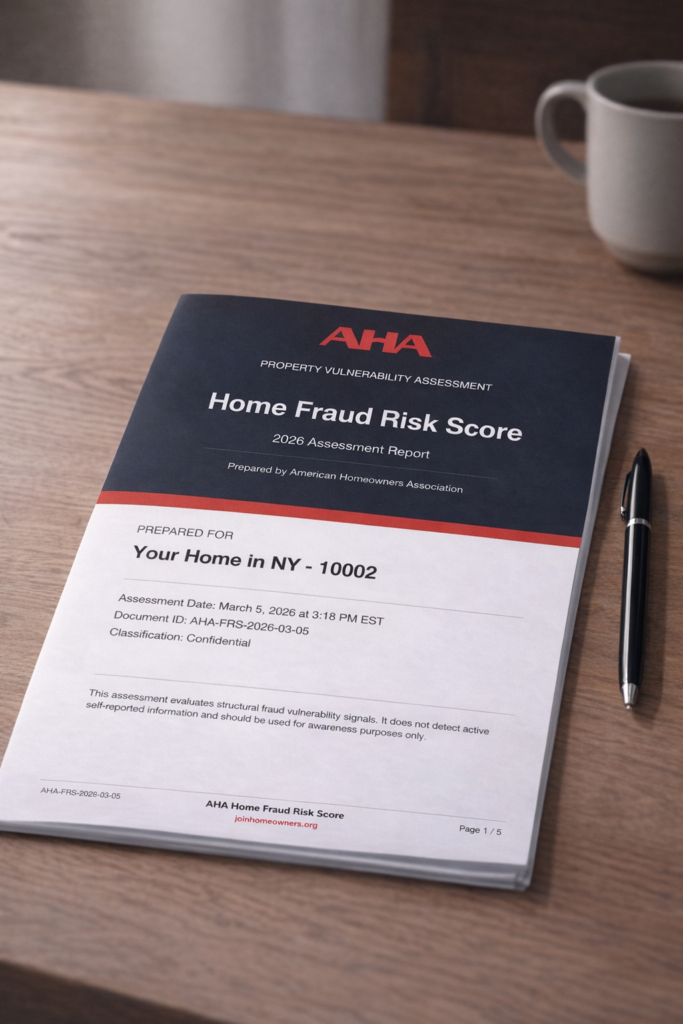
Why it matters: property fraud vulnerabilities can develop quietly when ownership records, filing activity, and identity-related signals are not reviewed. Home Fraud Risk Score helps you understand where exposure may exist and what practical steps to consider next.
What you get with Home Fraud Risk Score review:
Every Home Fraud Risk Score review provides a structured view of potential vulnerability — showing where risk signals may be present, where monitoring appears stronger, and where additional attention may be useful.
Built around the Home Fraud Risk Score™ model, the review organizes signals across Ownership, Equity, Monitoring, and Identity Exposure into a clear summary, then provides practical next steps based on the results.
- Home Fraud Risk Score — A structured 0–100 measure of property fraud vulnerability signals.
- Risk Band — A Low, Moderate, Elevated, or High result based on the overall score and pattern of risk signals.
- Module Breakdown — A clear view of results across Ownership, Equity, Monitoring, and Identity Exposure.
- Primary Risk Signals — The factors that contributed most to the assessment result.
- Fraud Difficulty Level — A separate contextual indicator of how difficult a fraudulent property transaction may be to carry out.
- Transaction Exposure — Additional context based on recent sale activity, refinance or HELOC contact, vacancy, rental use, or second-home use.
- What to Do Next — Prioritized actions to strengthen monitoring, reduce vulnerability, and address the most relevant concerns.
- Complete Report — Immediate on-screen results with options to download a PDF or email yourself a copy.
Educational use only
This assessment provides general educational information. It is not a prediction or confirmation of fraud and is not legal, title, financial, insurance, or law-enforcement advice. It does not replace professional guidance, official property-record monitoring, or reporting suspicious activity to the appropriate authority.
Understand Your Home’s Protection Profile.

Built by AHA
AHA is the national membership that guides and protects homeowners.
Home Fraud Risk Score supports that mission by helping homeowners understand potential property-fraud vulnerabilities and the practical steps they can take next.
Your information stays private. AHA does not sell your data or use scare tactics.
Housing organizations, lenders, title companies, housing counselors, and community organizations may share this free public resource with homeowners. For questions about educational distribution or working with AHA, contact contact@ahateam.org.