

You loved the kitchen, pictured your furniture in the living room, and started imagining move-in day. Then the home inspection report arrived: pages of photos, observations, recommendations, and things you never noticed during the showing.
That report can make a house you loved yesterday suddenly feel like a stack of problems. That reaction is normal, but most findings do not deserve the same urgency—or the same share of your repair budget. When you are deciding what to do after a home inspection, treat the report as evidence to interpret, not a flat repair order. AHA can help you separate what matters now from what can wait until you know the home better.
The AHA 30-60-90 approach uses the Protect–Prevent–Improve (PPI) Framework™ to make that sorting easier. It is an ownership-planning tool, not a real-estate deadline. Your purchase agreement and applicable state and local requirements control inspection, negotiation, closing, and possession dates.
The short answer: Start with findings that could affect safety, active damage, water, structure, insurance, financing, or your decision to buy. Get the right unanswered questions diagnosed before collecting repair prices. Once you have possession, schedule preventive work and give yourself time before spending heavily on optional improvements.
Your Inspection Report Is Not a Repair Order
A detailed report does not necessarily mean you are buying a bad house. Inspectors document what they can observe. That may include a missing outlet cover, an aging component, a maintenance item, a cosmetic defect, or a condition that needs more specialized evaluation.
Those observations do not all carry the same weight. A missing cover and a moisture stain beneath an upstairs bathroom both belong in the report. But the stain raises a more important question: is water still getting where it should not, and if so, why?
That is why the first useful move is not to price every line. It is to sort the report into questions that could change your decision, work that should be planned, and things that can wait.
Sort Findings With Protect–Prevent–Improve
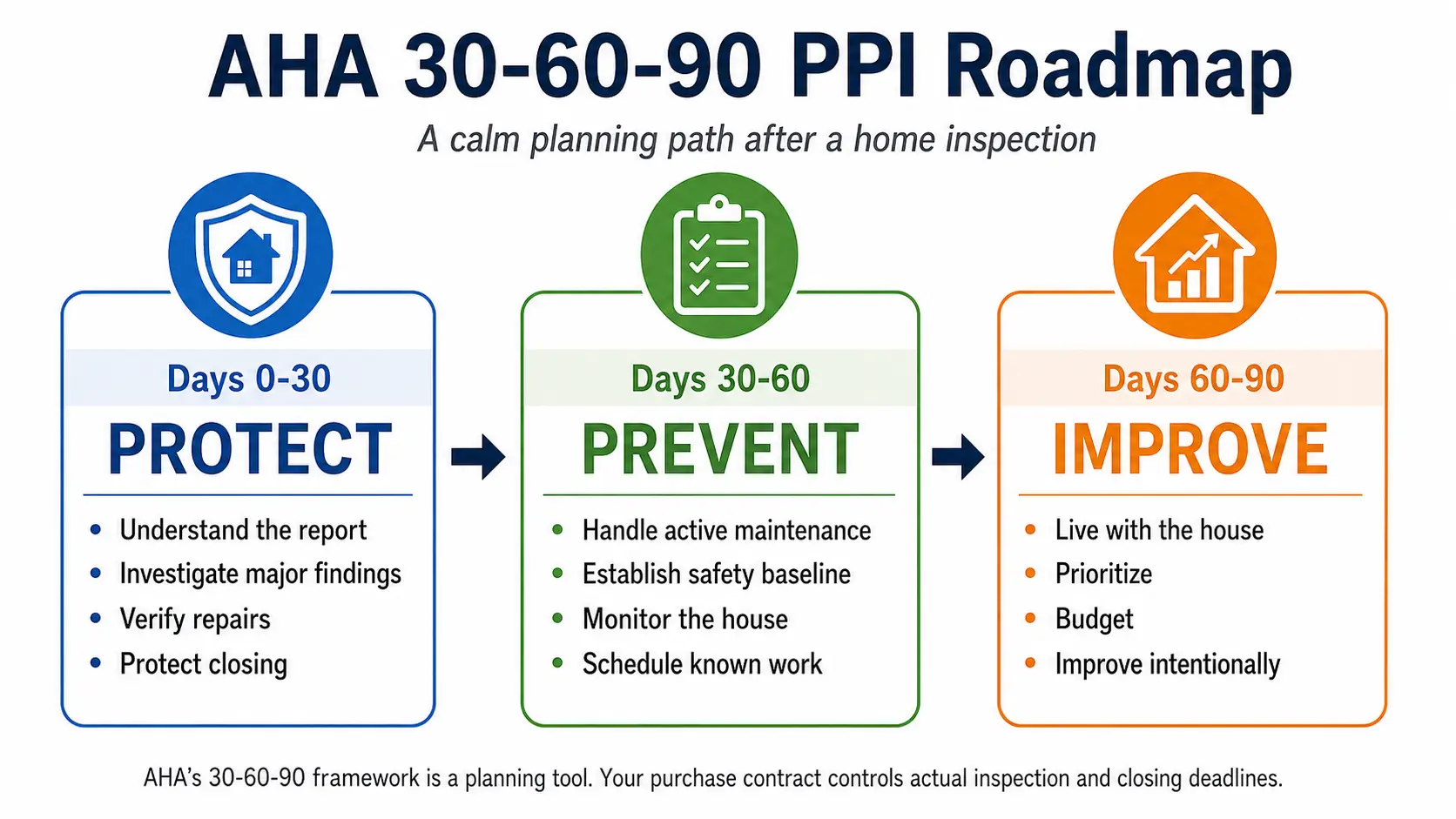
PPI is a practical way to lower the volume on a long inspection report without ignoring what matters.
Protect — deal with the risk or unanswered question now. These are findings involving a meaningful safety concern, active water or other damage, a potentially significant structural issue, or a condition that could affect your transaction. “Protect” does not always mean “repair this yourself before closing.” It often means learn enough to protect your options.
Prevent — put it on a real schedule. These items may not be emergencies, but monitoring or addressing them can help stop a manageable issue from becoming a costly one. Deferred maintenance, drainage concerns, aging components, and known defects often belong here.
Improve — make a deliberate choice later. Cosmetic changes, comfort upgrades, and projects that mainly reflect your preferences can usually wait until you have lived in the house.
The point is not to give every finding a perfect label. It is to stop treating the report as one long emergency.
AHA Pro Tip: Start with water, structural, and safety questions before older finishes or optional upgrades. Protecting the house and protecting your choices usually deserve the first share of attention.
Before Closing: Protect Your Options
Before the house is yours, your biggest job is not fixing it. It is making sure you understand the questions that could affect your decision.
Start with findings that your inspector recommended for further evaluation or that could materially change how you feel about proceeding. The right follow-up depends on this house and this finding. A roof concern may call for a qualified roofing professional; a suspected structural issue may need an appropriately qualified structural professional. Electrical, plumbing, heating and cooling, chimney, pest, sewer, moisture, or drainage concerns may each require a different specialist.
You do not need every specialty inspection available. You need the follow-up that answers an important unresolved question about this house.
Diagnose First. Price Second. Decide Third.
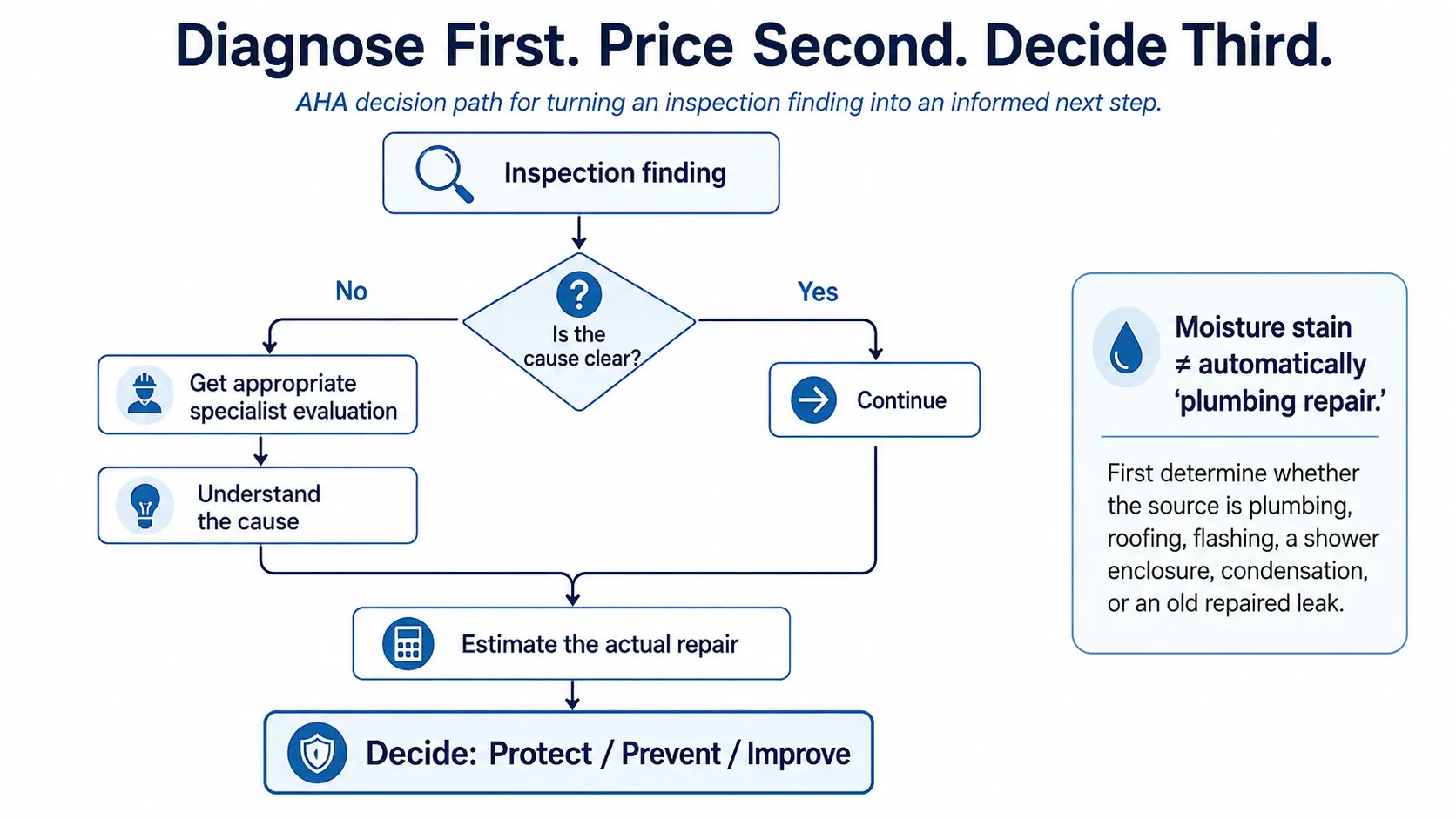
An estimate can be useful, but an estimate is not a diagnosis. AHA Rule: Diagnose first. Define the scope. Price the right work. Then decide. Consider that bathroom moisture stain. One person may assume a plumbing leak; another may suspect a shower enclosure; the condition may also be old and already repaired. Until the cause is understood, a price can create false confidence about both the scope and the urgency.
Use this order:
- Diagnose or verify the condition. What is actually happening, and does it appear active?
- Define the scope. What work, if any, is needed to address the cause rather than only its visible result?
- Price the right work. Seek estimates only after the issue is sufficiently understood.
- Decide. Use your contract, the facts you have learned, and guidance from the appropriate transaction professional to decide what to request, negotiate, monitor, or accept.
This sequence is especially valuable when a finding may be expensive, tied to a major system, or likely to worsen if the diagnosis is wrong.
Keep Contractual Deadlines Separate From the 30-60-90 Plan
An inspection report by itself does not create a universal right to repairs, a universal response period, or a universal answer about whether to proceed. Inspection contingencies, repair requests, credits, access, possession, and related deadlines depend on the purchase agreement and applicable local requirements.
If a finding could change your decision about the home, protect your options before a relevant contractual deadline passes. Your real-estate, legal, lender, insurance, or other appropriate professional can help you understand the role they play in your transaction. The AHA timeline helps you plan ownership; it does not replace those documents or professionals.
Some Homes Need an Extra Test
A standard home inspection cannot answer every question. Radon, for example, requires testing; you cannot see or smell it. Homes built before 1978 may also involve lead-based-paint disclosures and an opportunity for buyers in covered transactions to request testing. The point is not to order every test available, but to answer the questions that still matter before you close.
The U.S. Environmental Protection Agency recommends that buyers know the indoor radon level in a home they are considering. Its Home Buyer’s and Seller’s Guide to Radon explains testing in the time-sensitive context of a real-estate transaction. Whether testing makes sense for you depends on the house, location, planned use of lower levels, contract, and local context.
For many federally covered transactions involving homes built before 1978, buyers have an opportunity to conduct a lead-based-paint inspection or risk assessment—generally 10 days unless the parties agree in writing to a different period or the opportunity is waived. The HUD/EPA guidance on the homebuyer’s option to test explains this rule and its boundaries. Contract language and the specific transaction still matter.
Other specialty evaluations should be driven by the home, its location, the inspector’s observations, and your intended use—not by the idea that every buyer needs every test.
Learn Before You Alter the Property
Before closing, you may be able to arrange permitted follow-up evaluations, obtain estimates, review repair documentation, coordinate insurance and utilities, and plan later work. Access and permissions should follow the purchase agreement and the arrangements made for the property.
Avoid treating the home as though it is already yours. Painting, pulling up flooring, replacing fixtures, repairing wiring, installing equipment, or beginning a renovation should normally wait until ownership and possession transfer unless a specific agreement says otherwise.
There is also one part of the house-buying process you do not want to accidentally knock off course: the closing. If financing is still being finalized, ask your lender before making significant credit or financial changes. For covered mortgage loans, the Consumer Financial Protection Bureau explains when a Closing Disclosure is due: generally at least three business days before closing. Some loan types are excluded, so ask your lender or closing professional about documents and timing that apply to you. Review final documents carefully, confirm insurance and essential utilities for the appropriate possession date, and ask about terms or costs that differ from what you expected.
Verify Agreed Work Without Assuming
If a seller agrees to address a finding, keep a clear record of what was actually agreed. “Repaired” alone does not tell you who did the work, what work was performed, or whether the underlying condition was corrected.
Depending on the repair and agreement, useful records may include invoices, receipts, warranties, permits where required, and information about the person or company that completed the work. Use the final walk-through to confirm that the property appears to be in the expected condition. It is not a substitute for your inspection or a new specialist evaluation.
Watch Out: If a significant repair appears incomplete or different from the agreement, raise it promptly with the appropriate professional in the transaction. A final walk-through is a poor time to improvise a repair plan yourself.
Once the keys are actually yours, the question changes. You are no longer deciding whether to buy the house. Now you are learning how to take care of it.
Your First 30 Days After Possession: Establish the Home’s Protection Baseline
Once ownership and possession have transferred, shift from protecting the transaction to protecting the home. Start with unresolved Protect items and the work that reduces the chance of active damage spreading.
Water deserves early attention. A small roof leak, an exterior sealing gap, a slow plumbing leak, poor drainage, or recurring moisture may not disrupt the first night in the house. But water tends to involve more materials—and more cost—when it keeps moving through a building.
The first week in a new house is a lot less stressful when you know how to shut off the things that can make a small problem bigger. A shutoff valve tucked behind a storage shelf, a breaker panel with handwritten labels, or a filter size you can never remember are small details worth learning while nothing is wrong.
Use the first weeks to learn the controls and the basic behavior of the home:
- Find the main water shutoff and electrical service panel.
- Locate fuel shutoffs where applicable, and identify the heating and cooling filter and its correct replacement type.
- Check smoke and carbon-monoxide alarms as appropriate for the home and applicable requirements.
- Learn the operating basics for property-specific systems such as a sump pump, well, septic system, generator, or fire-suppression equipment.
You do not need to become your own plumber or electrician. You simply do not want your first search for the main water shutoff to happen while water is crossing the floor.
Days 31–60 After Possession: Prevent Small Problems From Growing
The report now begins to work as a maintenance plan. Move Prevent items onto a calendar with enough detail to make them real: what you are monitoring, what question still needs an answer, who may be qualified to help, and when you will revisit it. For a broader annual view of what to maintain and plan for, AHA HomeCheckup can help you organize the next steps.
Living in the house also provides information an inspection cannot always capture in a few hours. After the first real downpour, walk outside once the storm passes. Notice where downspouts empty, whether water ponds near the foundation, and whether a basement or crawlspace area mentioned in the inspection stayed dry, if those features apply to your home.
Pay attention to rooms that run warmer or colder, drains that behave differently, doors and windows that stick, and equipment that cycles in a way you did not expect. You are not looking for trouble all day. You are learning what normal looks like in this house so changes are easier to recognize.
This can also be a practical time to complete work that is disruptive but clearly warranted—such as repairs, cleaning, pest treatment, or projects that are easier before every room is fully furnished. “Easier now,” however, is not the same as “necessary now.” Keep the PPI distinction intact.
Days 61–90 After Possession: Improve With More Information and Less Pressure
By the third month, the report should feel less like a verdict and more like useful history. Some remaining findings will become legitimate future projects. Others will prove to be cosmetic preferences. A few changes that seemed essential during the final walk-through may barely matter once you understand how you actually use the house.
Unless there is a safety, active-damage, financing, insurance, or functional reason to move sooner, give yourself permission to live with the home before approving a major optional upgrade.
This is especially helpful with kitchens, bathrooms, finishes, storage, lighting, and room layouts. Watch where sunlight falls. Learn how the kitchen functions on an ordinary weeknight. Notice the rooms that feel uncomfortable and the storage that actually fails you. That information is better than the urgency of move-in week.
Before changing one system, think about what it may affect elsewhere in the house. Insulation, air sealing, heating and cooling, ventilation, moisture, windows, and related components can interact. You do not need an energy-efficiency project to remember that a change should support the house as a whole, not only the item you are eager to replace.
AHA Pro Tip: Before approving a large non-emergency project, ask what changes if you wait six months. If the main answer is that the room will still look dated, it is probably an Improve decision.
If you are building a reserve for future work, see AHA’s guidance on how much to save for home repairs.
What Can Wait After a Home Inspection?
Older does not automatically mean failed. Dated does not automatically mean urgent. A functioning appliance, worn but serviceable finish, or optional comfort change may deserve a future budget line, not an immediate replacement.
PPI gives you permission to distinguish “this exists” from “this is urgent.” New homeowners are often absorbing closing costs, moving expenses, utilities, furnishings, repairs, and other new ownership costs at once. Leave room for the work that truly deserves attention.
Turn the Report Into Your First Ownership Record
Keeping this record means future-you will not have to reconstruct what the inspector found, what was repaired, or when a system changed. Keep the inspection report with specialist evaluations, seller repair documentation, important closing records, equipment manuals, model and serial numbers, warranties, contractor invoices, permits, and records of major maintenance or replacements.
Take a few baseline photos as you settle in, especially of areas the report identified for monitoring. Over time, a simple home record can help you remember what changed, plan maintenance, document improvements, and provide useful context if you ever need to discuss a repair, insurance claim, or future sale.
Frequently Asked Questions
What happens after a home inspection?
Review the findings that could materially affect the purchase and determine whether any need qualified follow-up. If you are under contract, use the deadlines and rights in your purchase agreement rather than a general internet timeline. After ownership and possession transfer, use PPI to separate immediate protection, scheduled prevention, and optional improvements.
How long do you have to respond to a home inspection?
There is no single national response deadline. Your inspection period and any deadlines for requests, negotiations, or contingencies depend on the purchase agreement and applicable state and local requirements. AHA’s 30-60-90 timeline is a planning framework, not a contractual deadline.
What repairs should be handled before closing?
Start with findings that may materially affect your decision, including meaningful safety concerns, active damage, significant water or structural questions, or conditions that may matter to financing or insurance. What a seller agrees to address depends on the contract and negotiation; an inspection report is not automatically a seller repair list.
Do you have to fix everything on a home inspection report?
No. An inspection report documents observed conditions; it is not automatically a repair checklist. Use AHA’s Protect–Prevent–Improve Framework™ to separate urgent risks from scheduled prevention and optional improvements.
What should you fix first after moving into a new house?
Start with Protect items: meaningful safety concerns, active leaks or water intrusion, structural concerns, electrical hazards, or other conditions where waiting could increase damage or risk. Then move into Prevent work. Cosmetic and discretionary Improve projects can usually come later.
Can you make repairs before you own the house?
Generally, buyers should avoid altering a property before ownership and possession transfer unless a specific agreement permits it. Before closing, focus on understanding the finding, obtaining appropriate estimates, documenting agreed work, and planning what you will do after you are entitled to take possession.
By Day 90, the Report Should Feel Smaller
Not physically. Those pages, photos, and recommendations are still there.
But by now, the important findings should have separated themselves from the noise. Protect issues have been addressed or have a clear plan. Prevent work has a place on the calendar. Improve projects can wait until the need, timing, and budget make sense.
You do not need a perfect house by day 90. You need to understand the house you bought and know what deserves your attention next. That is when an inspection report stops feeling like a list of things wrong with your home and becomes what it was supposed to be: your first roadmap for taking care of it.
Use AHA’s Protect–Prevent–Improve Framework™ to sort your inspection findings into Protect, Prevent, and Improve—and decide what deserves attention now.