


How to Prioritize Home Repairs, Separate Urgent Problems from Normal Maintenance, and Regain Control
A few weeks — or sometimes a few years — into homeownership, something shifts.
You start noticing more.
A slow drain.
An aging water heater.
A crack in the basement block.
Insulation that doesn’t look right.
A stain that suddenly looks bigger than you remember.
The list grows.
And with it, a quiet question:
“Is this normal… or did I make a mistake?”
We’ve seen this pattern over and over again — not just among first-time homeowners, but among seasoned ones too.
The anxiety isn’t rare. In fact, it’s predictable.
Homeowner Regret Is More Common Than You Think

National surveys consistently show that a significant share of homeowners — often 40–50% — report at least one regret about their home purchase. However, those regrets rarely involve catastrophic structural failures.
They’re:
- Underestimating maintenance costs
- Unexpected repair expenses
- Discovering aging systems
- Feeling unprepared for ongoing upkeep
In other words, the regret is rarely about buying a “bad house.”
More often, it reflects underestimating what ownership actually requires.
And that realization often hits suddenly — after move-in, after the first breakdown, or after a string of minor discoveries.
What feels like structural failure is often simply expectation adjustment.
That’s an important distinction.
It’s Not Just New Homeowners
There’s a common assumption that anxiety fades with time.
But experienced homeowners know something different.
Even if you’ve owned for 10 or 20 years, life has a way of compressing stress.
Work intensifies.
Kids’ schedules expand.
A parent needs help.
A job changes.
And then — on a random Tuesday — the water heater fails.
Or the HVAC stops cooling during a heat wave.
Or the sump pump quits during heavy rain.
Psychologists call this stress stacking — when multiple responsibilities converge at once, reducing your emotional margin.
Behavioral research shows that under cognitive load — when you’re busy, tired, or distracted — perceived threats feel larger and more urgent than they objectively are.
It’s a form of modern Murphy’s Law:
The breakdown never happens when you’re calm and well-rested.
It happens when you’re already stretched.
Even seasoned homeowners can spiral in those moments — especially when other responsibilities are already competing for attention.
Not because they lack experience, but because stress narrows perspective.
The Real Problem Isn’t the House. It’s the Lack of a Filter.
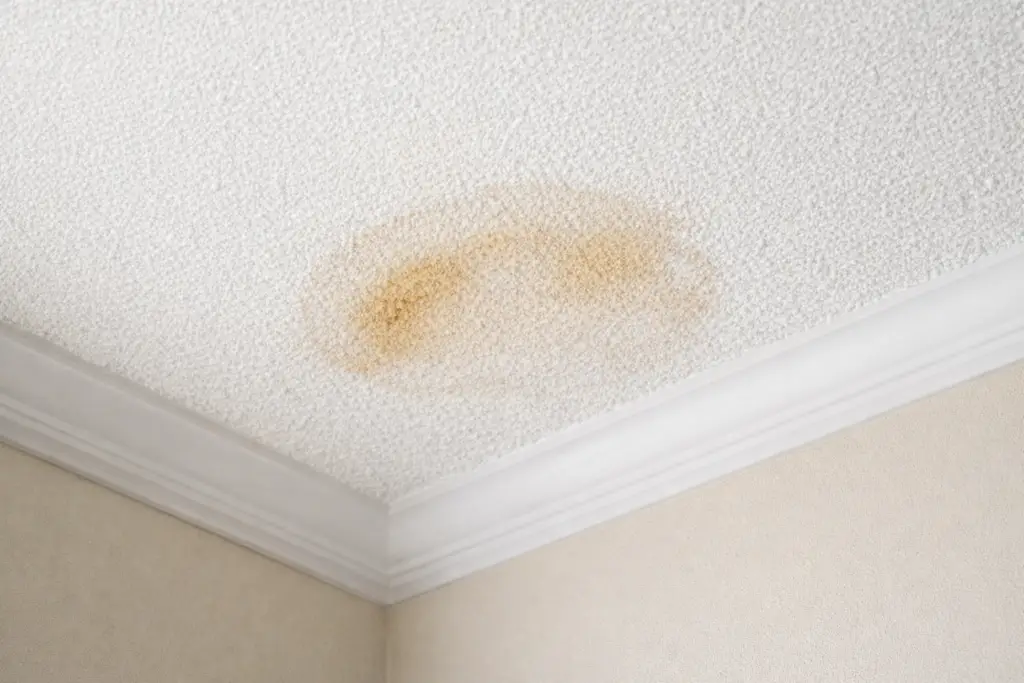
When something breaks or gets discovered, most homeowners don’t lack intelligence.
Instead, what they lack is a decision structure.
Without a framework, every issue can feel equally urgent — even when it isn’t.
A slow drain feels as alarming as structural movement.
A cosmetic crack feels as dangerous as active water intrusion.
As a result, overreaction becomes more likely:
- Replacing instead of repairing
- Upgrading instead of stabilizing
- Approving large bids too quickly
- Selling prematurely
- Assuming catastrophe
We built the AHA Protect–Prevent–Improve (PPI) Framework to solve that exact pattern.
Not as an emergency guide.
But as a clarity system.
The AHA Protect–Prevent–Improve (PPI) Framework
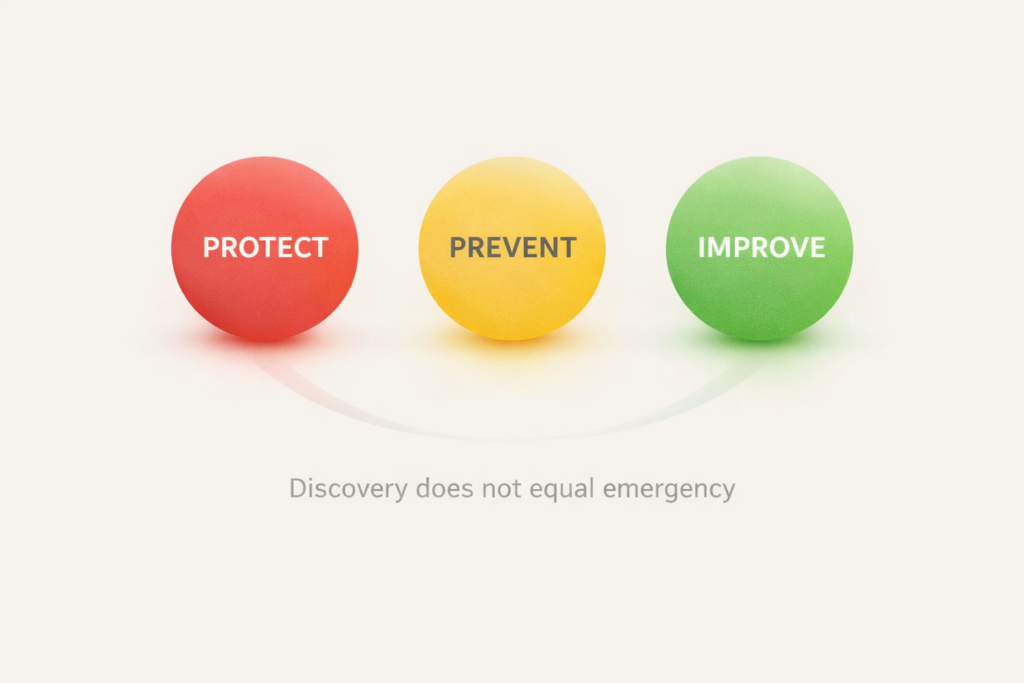
Every home issue falls into one of three categories.
Not ten.
Three.
🔴 Protect
This is active damage.
Water entering the home.
Gas smells.
Electrical burning odors.
Structural shifts.
Sewer backup risk.
These deserve timely stabilization — usually within 24–72 hours.
They are serious. However, they are far rarer than your anxiety suggests.
🟡 Prevent
This is where most homeowner discoveries belong.
A 12-year-old water heater.
A slow but draining pipe.
Minor block foundation gaps.
Uneven heating.
Gutter drainage improvements.
Rodent entry points.
These are not emergencies. Instead, they are maintenance planning items.
They require quotes.
Budgeting.
Scheduling.
Not panic.
🟢 Improve
This is enhancement.
Insulation upgrades.
Energy efficiency improvements.
Cosmetic repairs.
Comfort upgrades.
These may add value. However, they rarely create urgency.
Why This Framework Works Under Stress
When you categorize a problem, your nervous system settles.
While ambiguity fuels anxiety, structure reduces it.
The PPI Framework gives your brain a place to put the issue.
Instead of:
“Everything is wrong.”
You get:
“This is Prevent. I can plan this.”
That mental shift is powerful.
The Contractor Urgency Effect
Most contractors are trained to solve completely.
As a result, they often speak in upgrade language.
An insulation contractor sees opportunity.
An HVAC technician sees replacement timelines.
A foundation specialist sees reinforcement potential.
That doesn’t mean they’re wrong.
But their lens is completion.
By contrast, your lens must be pacing.
Before approving major repairs, ask:
- What happens if I wait 30 days?
- What happens if I wait one year?
- Is this damaging structure — or comfort?
- Is this repair — or upgrade?
If waiting doesn’t increase structural risk, then you likely have time.
Time is leverage.
Normalize the Financial Rhythm of Ownership
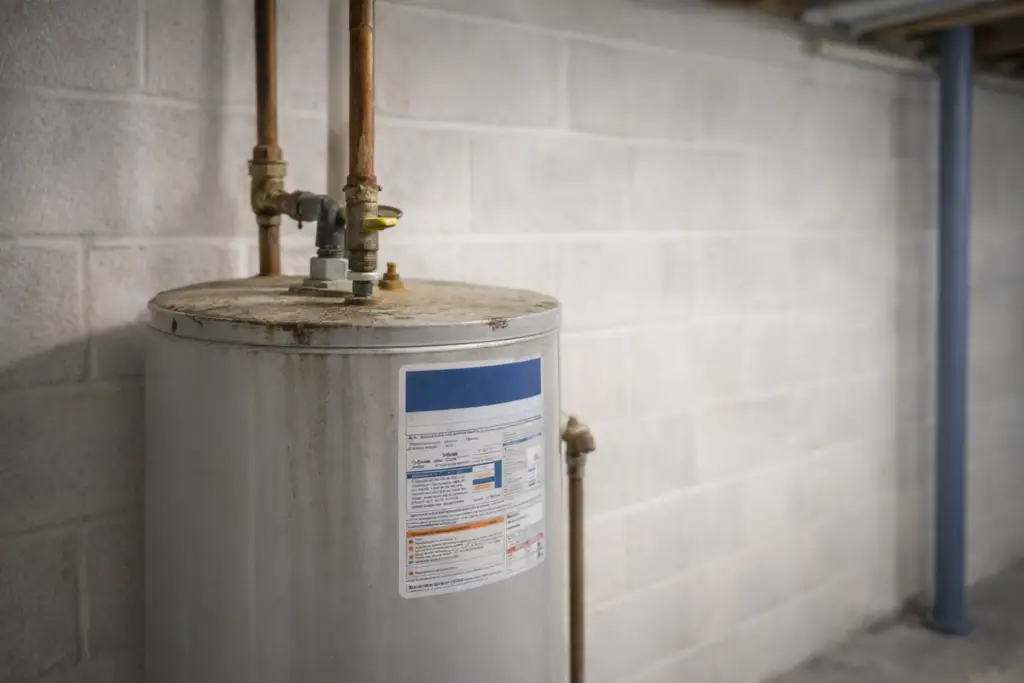
Over time, most homes require:
- 1–2 surprise repairs per year
- Ongoing maintenance reserves
- Equipment replacement every 10–15 years
- Roof replacement every 20–30 years
When something breaks, It does not mean your house is failing. Rather, it means your house is aging.
Ownership is pacing — not perfection.
You Probably Didn’t Make a Mistake
If your growing list includes:
- Minor cracks
- Aging systems
- Cosmetic flaws
- Drain issues
- Insulation questions
That’s backlog — and backlog can be managed.
Catastrophe is different — and far less common.
Why the AHA PPI Framework™ Matters
Without structure, homeownership feels reactive. With structure, however, it becomes strategic.
The PPI Framework™ helps you:
- Reduce anxiety
- Avoid overreaction
- Pace repairs intentionally
- Regain confidence — even during busy seasons
It doesn’t eliminate repairs; instead, it eliminates urgency inflation.
Download the AHA Protect–Prevent–Improve (PPI) Framework™
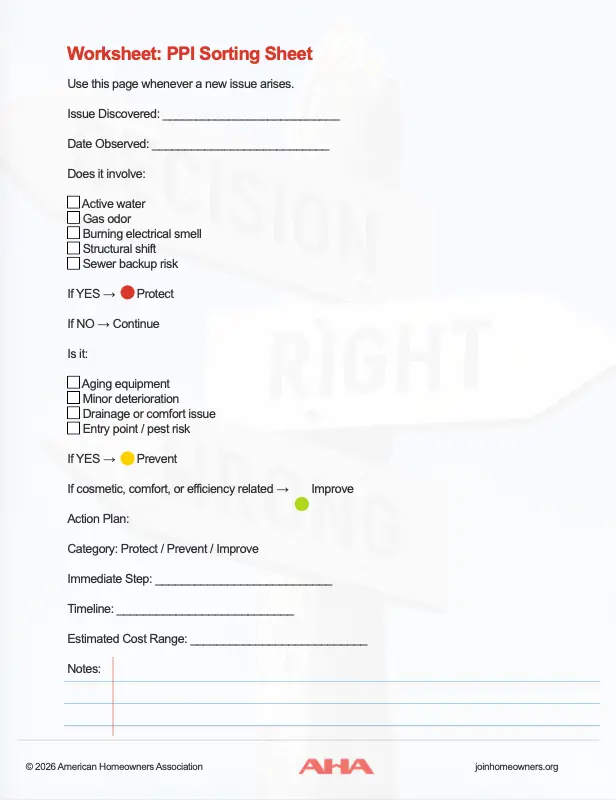
Download and keep it accessible.
Use it when you discover something new.
Use it when life feels busy.
Use it before approving major work.
Because the most important tool in your home isn’t a wrench.
It’s judgment.
And judgment improves when you slow down and sort clearly.