


You get a contractor quote… and your brain does that thing:
“Is this normal… or am I about to overpay by a lot?”
It’s a tough spot. Because unless you’ve hired contractors before, you don’t really have a reference point. And every bid looks a little different… sometimes wildly different.
Here’s the part most people don’t realize:
The problem usually isn’t that a quote is “too high.”
It’s that you’re being asked to compare things that aren’t actually comparable.
Different scopes. Different assumptions. Different levels of detail.
That’s exactly why so many homeowners either overpay… or pick the wrong contractor entirely.
Let’s fix that.
What Makes a Contractor Quote “Too High”?
A quote isn’t too high just because it’s expensive.
It’s too high when:
- It includes costs that don’t match the actual work
- It’s unclear what you’re paying for
- Or it sits far outside other bids without explanation
And here’s the key insight:
👉 Most “overpriced” quotes aren’t obvious — they’re hidden inside vague scopes and inconsistent bids.
That’s why the goal isn’t just price comparison…
It’s apples-to-apples comparison.
Compare At Least 3 Contractor Quotes (This Sets Your Baseline)
This is where things start to feel clearer.
If you only have one quote, it’s almost impossible to know if it’s fair. It might be spot-on… or wildly off… and you’d have no way to tell.
But once you have a few?
Patterns show up.
Usually:
- Two quotes land in a similar range
- One sits noticeably higher or lower
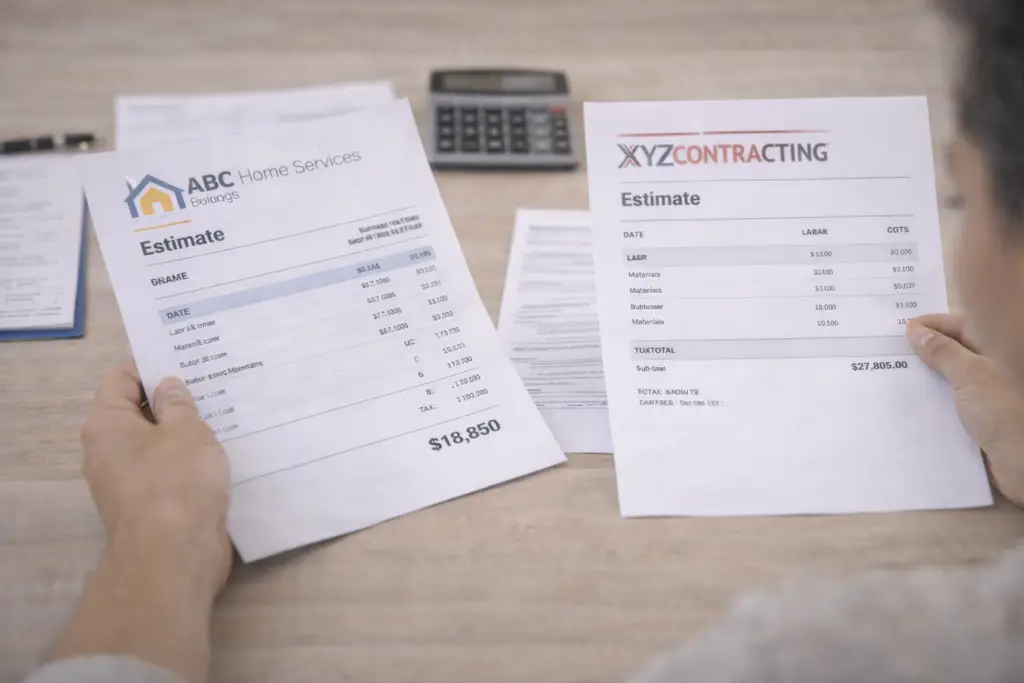
That middle range — that’s your baseline. That’s what “normal” looks like for your project.
And here’s the part most homeowners don’t realize…
If the quotes are all over the place, it’s usually not a pricing problem.
It’s a scope problem.
You’re not comparing prices yet — you’re comparing interpretations of the job.
That’s why the goal isn’t just getting multiple quotes.
It’s making sure they’re all pricing the same work.
💡 Pro Tip
If you want cleaner, more comparable bids, use a simple scope sheet before requesting estimates. It helps contractors quote the same materials, timeline, and expectations — so you’re not guessing what’s included.
Why Most Homeowners Get This Wrong (And It’s Not Your Fault)
Let’s be honest — this process is messy.
You might:
- Explain your project slightly differently to each contractor
- Forget to mention a detail to one of them
- Assume something is “included” when it’s not
So each contractor builds their own version of the job.
Now you’re comparing:
- Different materials
- Different labor assumptions
- Different levels of work
And trying to pick the “best price” from that?
That’s where things go sideways.
Break the Quote Into Pieces (Don’t Trust the Total)
This is where a lot of homeowners get tripped up.
You look at the bottom number… compare it to another quote… and try to decide which one feels “better.”
But that total? It doesn’t tell you much on its own.
A good quote should read more like a grocery list than a mystery.

You should be able to clearly see:
- Labor
- Materials (and what kind)
- Permits and fees
- Timeline or phases
If everything is lumped into one number, you’re being asked to trust what you can’t actually see.
And that’s where overpaying — or under-scoping — happens.
Sometimes a higher quote isn’t more expensive…
…it’s just more complete.
💡 Pro Tip
Ask:
“Can you walk me through what’s included in this price?”
A good contractor will break it down clearly.
A vague answer is usually your first warning sign.
Step 1: Make Sure Every Contractor Is Bidding the Same Job
Before you even look at price, ask yourself:
“Did everyone quote the same exact scope?”
If not, the numbers don’t mean much.
This is where most cost confusion starts — and it’s exactly why AHA built the SmartHire Contractor Hiring Toolkit.
💡 Pro Tip: Use a Scope Sheet (This Changes Everything)
Inside the SmartHire Toolkit, there’s a contractor-ready Scope Sheet that lets you:
- Define materials
- Clarify what’s included
- Set expectations upfront
So every contractor is bidding the same job, not their version of it.
That alone eliminates a huge amount of pricing noise.
Step 2: Use a Comparison Grid (Not Your Memory)
Trying to compare 3–5 quotes in your head? That’s where mistakes creep in.
Instead, lay them side by side.
What to compare:
- Price
- Scope completeness
- Timeline
- Materials
- Communication clarity
The SmartHire Toolkit includes a Contractor Comparison Grid designed specifically for this.
And here’s what happens when you use it:
You stop asking “Which one is cheaper?”
And start seeing “Which one actually makes sense?”
Step 3: Break the Quote Down (No Lump Sums Allowed)
If a quote looks like this:
“Bathroom remodel — $22,000”
That’s not a quote. That’s a placeholder.
You should be able to see:
- Labor
- Materials (specific types)
- Permits
- Timeline
Unclear estimates are one of the biggest reasons homeowners end up paying more than expected later .
Watch the Language (This Is Where Costs Hide)
This is one of those small things that ends up costing a lot.
At first glance, most quotes look similar. But when you slow down and actually read them… certain words start to stand out.
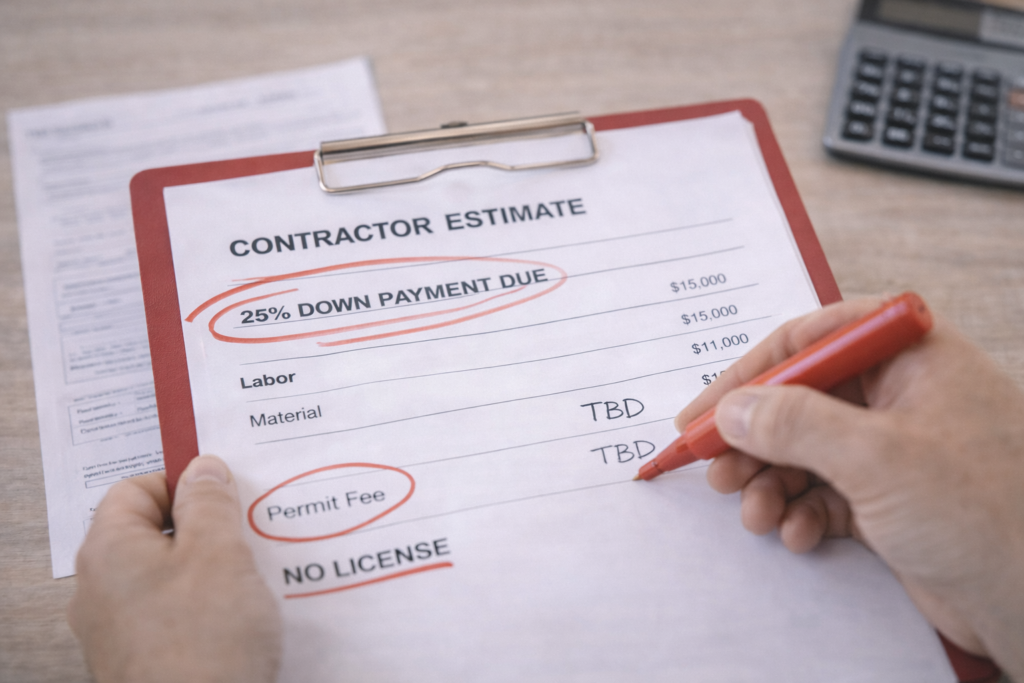
Things like:
- “Allowance”
- “Miscellaneous”
- “To be determined”
These aren’t necessarily bad — but they are placeholders.
And placeholders are where your budget can quietly grow.
Two quotes might look close in price… but if one is packed with vague language, it leaves a lot of room for changes later.
That’s how projects that start at one number slowly drift higher.
💡 Pro Tip
Ask:
“What assumptions are built into this estimate?”
If they can explain it clearly, you’re in good shape.
If not, that’s something to pay attention to.
Step 4: Understand Why Prices Differ
Let’s say you have three bids:
- $18,000
- $19,500
- $27,000
That higher one isn’t automatically wrong.
It might include:
- Code-required upgrades
- Higher-quality materials
- More prep work (the stuff you don’t see… but feel later)
The question isn’t:
“Why is this one so expensive?”
It’s:
“What is this one doing differently?”
Step 5: Watch the Low Bid Just as Closely
This is where a lot of homeowners get burned.
A low bid often means:
- Missing steps
- Cheaper materials
- Future change orders
And those “savings” disappear fast.
Real-world renovation cases show that missed details and poor workmanship often lead to much higher costs later .
Step 6: Ask the Right Questions Before You Decide
This is one of the most powerful (and underused) moves.
Ask every contractor:
- “What’s not included in this price?”
- “What could cause this to increase?”
- “How do you handle change orders?”
The SmartHire Toolkit includes ready-to-use interview questions so you don’t have to guess what to ask.
And honestly… their answers will tell you more than the price ever could.

Step 7: Sanity Check the Bids
Here’s your quick filter:
- Clustered bids (similar range) → likely fair
- High outlier → needs clear justification
- Low outlier → highest risk
If you’ve used a consistent scope and comparison grid, this becomes incredibly clear.
Watch Out 🚩
- High price + vague scope = unclear value
- Low price + missing details = future costs
- No written scope = you’re guessing
Conclusion: The Problem Isn’t Price — It’s Clarity
Once you see this, everything changes.

You don’t need to be an expert in construction.
You just need a clear system to compare bids properly.
That’s exactly what the AHA SmartHire Contractor Hiring Toolkit is built for.
It gives you:
- A structured way to define your project
- Tools to compare contractors side by side
- Checklists to avoid scams and hidden costs
- Templates so you know what a fair agreement looks like
So instead of guessing…
you’re making a confident, informed decision.
Next Step
If you’re reviewing quotes right now, don’t rely on gut instinct alone.
Download the AHA SmartHire Contractor Hiring Toolkit and walk through your bids step by step.
It’s the difference between hoping you picked the right contractor…
and knowing you did.