

Don’t Panic — But Don’t Ignore It Either
A home insurance claim denied letter can make your stomach drop.
After filing, you may have spent days waiting for updates, gathering photos, talking with an adjuster, or getting a contractor’s estimate that made your jaw tighten a little. Then the decision arrives — and instead of answers, it feels like the insurance company just closed the door.
Take a breath.
A denied homeowners insurance claim doesn’t always mean the conversation is over. The insurer may be pointing to an exclusion, asking for stronger documentation, or disagreeing with how the damage happened, what needs to be repaired, or how much the work should cost.
Your next move is not to argue harder. It’s to get organized, understand the reason for the denial, and respond in writing with the clearest evidence you have.
First, Figure Out What Kind of “No” You Received
Not every claim denial means the same thing. That’s why the first step is to sort out what the insurance company is actually saying.
You may be dealing with a full denial, where the insurer says the damage is not covered at all. Or it may be a partial denial, where some parts of the claim are covered and others are not. In other cases, the claim may technically be approved, but the payout feels too low to cover the actual repairs.
There’s also the frustrating “not enough information” kind of response. That one can feel like a denial, but it may be fixable if you provide better documentation.
This distinction matters because your next step depends on the problem. A coverage dispute is different from a pricing dispute. A missing-photo problem is different from a policy exclusion. And a storm damage insurance claim denied because of “wear and tear” needs a different response than one denied because the repair amount is below your deductible.
Read the Insurance Claim Denial Letter Like a Map
Your insurance claim denial letter should explain why the company denied the claim or paid less than you expected. It may cite specific policy language, exclusions, deductibles, inspection findings, or documentation issues.
Read it slowly. Annoying, yes. Worth it, absolutely.
Look for four things:
- What reason does the insurer give?
- What policy section do they cite?
- Are they disputing coverage, cause, cost, or documentation?
- Do they mention a deadline or next step?
Also check the deductible and policy limits. Sometimes a claim isn’t denied because the damage is uncovered; it’s just below the deductible, above a sublimit, or limited by a specific endorsement. That still feels lousy, but it changes the next step.
That letter is your roadmap. Not because it’s always correct, but because it tells you what you need to respond to.
For example, if the insurer says the damage existed before the storm, you’ll need evidence showing when the damage happened. If they say the repair cost is too high, you may need a detailed contractor estimate. If they say the loss is excluded, you’ll want to compare that explanation against your actual policy language.
Ask for a Clear Explanation in Writing
If the denial was explained over the phone, ask for the reasoning in writing.
Phone conversations are useful, but they’re easy to misremember — especially when you’re stressed and trying to take notes with one hand while standing in a half-repaired kitchen. A written explanation gives you something concrete to review, compare against your policy, and respond to.
You can keep the request simple:
“I’d like to better understand the claim decision. Please send me the specific policy language and claim findings used to make this decision.”
That’s not confrontational. It’s reasonable.
AHA’s Homeowners Insurance Claim Toolkit uses the same calm approach in its script for clarifying a coverage denial: ask the insurer to walk you through the policy section and send a written explanation for your records.
Use AHA’s Claim Clarity Method: Sort, Support, Send
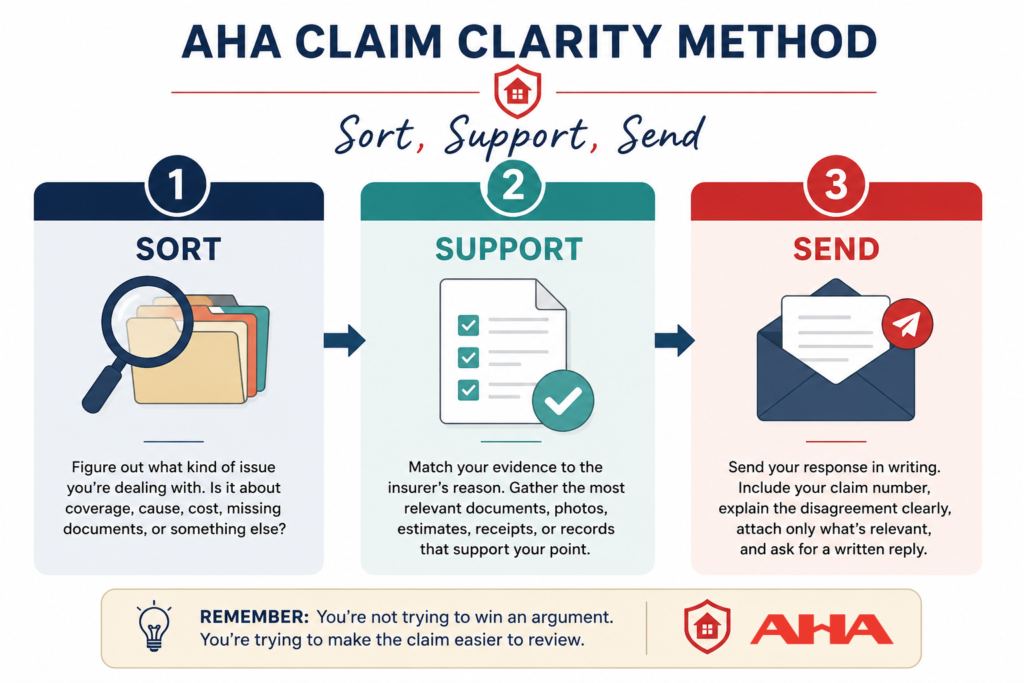
A claim denial can make you want to respond fast. That’s completely normal. But the better move is to respond clearly.
Before you challenge the decision, use AHA’s Claim Clarity Method.
Sort the issue. Figure out what kind of problem you’re dealing with. Is this about coverage, cause of damage, repair cost, depreciation, missing documentation, a supplement, or claim handling?
Support your point. Match your evidence to the insurer’s reason instead of sending everything you have and hoping it helps. For a repair-cost dispute, that might mean an itemized estimate. For a timing issue, it could be dated photos, maintenance records, or storm details. And if the insurer says something is missing, ask them to name exactly what they need in writing.
Send it in writing. Keep your response calm and specific. Include your claim number, explain the disagreement in one or two sentences, attach only the most relevant documents, and ask for a written response.
You’re not trying to win an argument. You’re trying to make the claim easier to review. That’s a different energy — and it usually works better.
What Kind of Claim Problem Do You Actually Have?
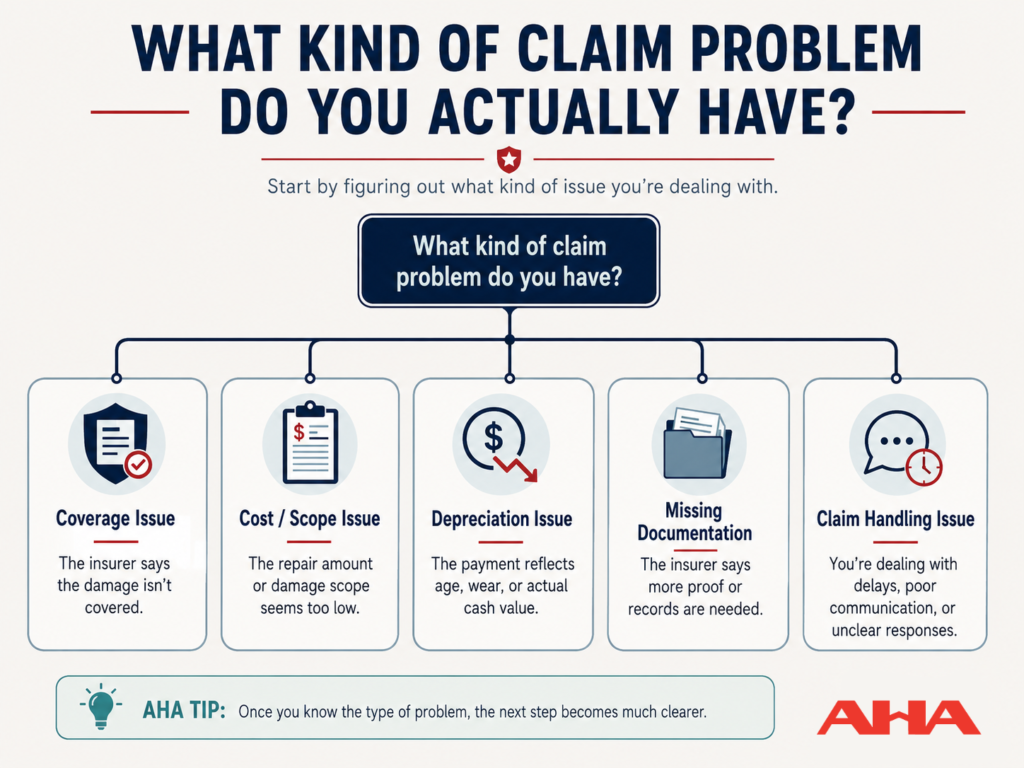
| What It Feels Like | What It Might Actually Be | Better Next Step |
|---|---|---|
| “They denied me.” | Coverage exclusion | Ask for the policy language and written explanation |
| “They lowballed me.” | Scope or pricing dispute | Get an itemized second estimate |
| “They didn’t pay enough.” | Depreciation or actual cash value payment | Ask about recoverable depreciation |
| “They missed damage.” | Supplemental claim issue | Submit added documentation or ask about a supplement |
| “They’re ignoring me.” | Claim-handling or communication issue | Escalate internally or contact your state insurance department |
| “The contractor says it costs more.” | Code upgrade or ordinance issue | Ask about ordinance or law coverage |
| “I don’t know what they want.” | Missing documentation | Ask what’s missing in writing and rebuild your claim file |
Watch for Claim Letter Terms That Sound Scarier Than They Are
Insurance claim letters can sound like they were written by someone trying to win a contest for least comforting language.
A few terms are worth knowing:
Reservation of rights: The insurer is still investigating and preserving its right to deny some or all of the claim later. Don’t ignore it, but don’t assume it means the claim has already been denied. Read what documents or information the insurer is asking for.
Actual cash value: A payment based on the value of the damaged property after age, wear, and depreciation are considered. NAIC explains that actual cash value coverage may not pay enough to fully repair or replace damaged property because depreciation is included in the calculation. (NAIC)
Replacement cost value: Coverage designed to pay toward repair or replacement with similar materials or quality, depending on policy terms. Some policies pay actual cash value first and release additional replacement cost benefits after repairs or replacement are completed. (NAIC)
Recoverable depreciation: Money that may be held back until you repair or replace damaged property and submit proof, if your policy allows recovery.
Proof of loss: A formal statement describing what was damaged and how much you’re claiming. Your insurer may require one depending on the policy and type of claim.
Supplement: A request for the insurer to review additional costs, corrected scope, or newly discovered damage tied to the same claim.
Exclusion: Policy language the insurer says removes coverage for a certain type or cause of damage.
Sublimit: A smaller limit inside the policy for certain property, damage, or expenses.
Check Whether This Is Really a Denial, a Depreciation Issue, or a Missing-Documentation Problem
Sometimes a claim feels “denied” because the payment is much lower than expected. But the reason may be depreciation, not a total denial.
Look for terms like actual cash value, replacement cost value, recoverable depreciation, or replacement cost benefitsin your claim paperwork.
Here’s the everyday version: if your older roof, floor, appliance, or cabinet was damaged, the first check may not be the full replacement amount. Some replacement cost policies require you to complete the repair or replacement and submit proof before the insurer releases additional recoverable depreciation; Triple-I notes that if you don’t replace an item, you may only receive its actual cash value. (III)
That doesn’t mean you should assume the payment is right. It means you should understand what kind of payment you received before deciding how to respond.
Pro Tip: Look at the estimate line by line. If you see “depreciation withheld” or “recoverable depreciation,” ask your insurer what you must do to recover the remaining amount and what deadline applies.
Protect Your Home From More Damage — But Document First
Even while you’re disputing a claim, you may still need to protect your home from getting worse.
That might mean tarping a roof, shutting off water, boarding up a broken window, or drying out a wet area if it’s safe to do so. Most homeowners understand this instinctively: don’t let a bad situation turn into a bigger one while everyone argues over paperwork.
But before you clean up, take photos and videos. Wide shots. Close-ups. The boring stuff too. A wet baseboard may not feel important now, but it might help explain the path of the damage later.
AHA’s toolkit recommends taking photos before touching or cleaning anything, photographing affected areas from wide and close-up angles, tracking temporary repair costs, taking photos after repairs, and saving receipts.
Watch Out: Stick to temporary repairs unless your insurer approves more. Stopping damage is smart. Tearing out drywall, replacing flooring, or starting major repairs before the adjuster sees the damage can create problems if the insurer later says it couldn’t verify the loss.
Rebuild Your Claim File Before You Push Back
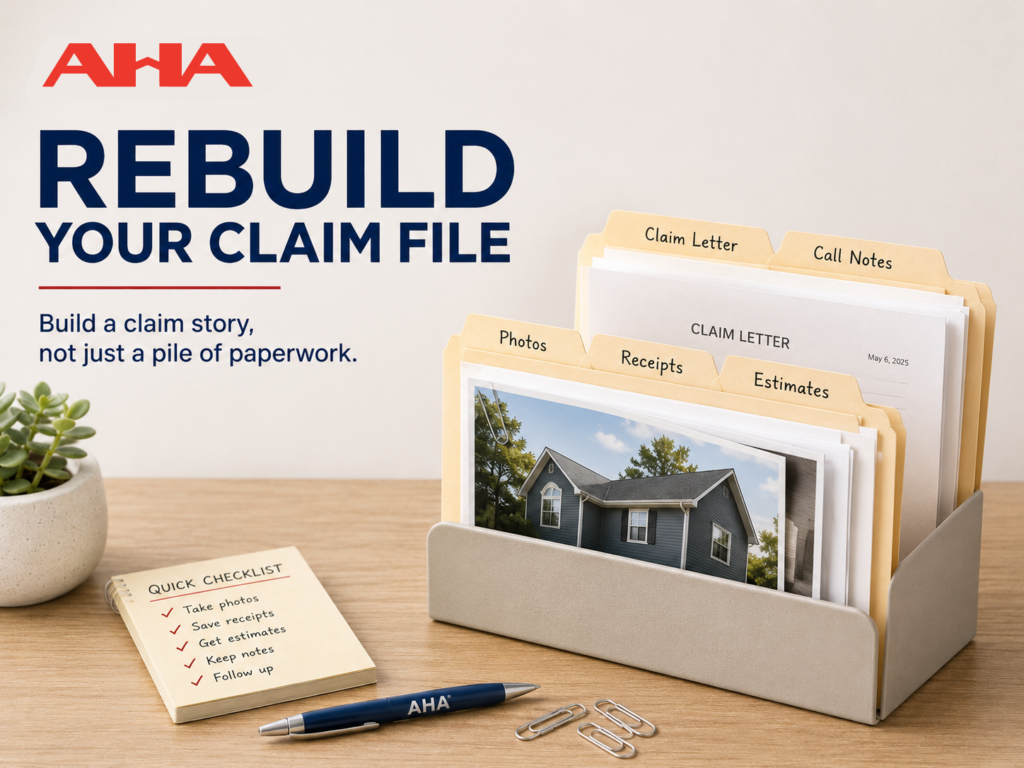
Before you request reconsideration, rebuild your claim file.
That sounds more official than it is. Really, it means putting everything in one place so you’re not hunting through texts, emails, screenshots, and contractor notes every time someone asks a question.
Gather:
- Photos and videos of the damage
- Your original claim number
- The denial letter or claim decision
- Your policy and declarations page
- Adjuster reports or inspection summaries
- Contractor estimates
- Receipts for temporary repairs
- Receipts for hotel, food, or relocation costs if you had to leave your home
- A log of phone calls, emails, and site visits
- Any proof of maintenance, prior repairs, or inspections
- Any weather reports or event details that support when the damage happened
AHA’s claim toolkit is especially useful here because it includes damage documentation logs, communication logs, expense and reimbursement logs, and a claim summary sheet homeowners can use to organize claim details in one place.
AHA Rule of Thumb: Don’t just gather documents. Build a claim story. The easier you make it for someone to understand what happened, what was damaged, what the insurer decided, and what you’re asking them to review, the harder it is for your claim to get lost in the shuffle.
Check for a Proof of Loss Requirement
Some policies or claim types may require a proof of loss form or sworn statement. This is a formal document that lists what was damaged and how much you’re claiming. Allstate describes proof of loss as a legal document explaining what was damaged or stolen and the amount being claimed; whether it is required depends on the loss and insurer instructions. (Allstate)
Don’t assume it’s optional. Don’t assume the insurer will remind you three times, either.
Look through your claim letters, emails, and policy documents for any mention of proof of loss, sworn statement, inventory, or deadline. If you’re not sure, ask the insurer in writing:
“Does my claim require a proof of loss or sworn statement? If so, what is the deadline and required format?”
Small paperwork deadlines can become big problems. This is one of those moments where being a little tedious can save you a lot of stress later.
When It’s Not Really an Appeal: Ask About a Supplement
Homeowners often use the word “appeal” for any disagreement with the insurance company. That’s understandable. But in insurance claim language, you may be dealing with something more specific.
If your contractor finds additional damage after opening up a wall, roof, floor, or ceiling, or if the insurer’s original estimate missed part of the repair scope, ask whether you should submit a supplement.
A supplement is a request for the insurer to review new, corrected, or additional information tied to the same claim. It can be useful when:
- A repair estimate missed part of the damage
- Material or labor costs were too low
- The contractor found hidden damage
- The repair requires code-related work
- Temporary repairs revealed a bigger issue
- The insurer’s scope doesn’t match what’s needed to restore the damaged area
This isn’t about throwing more paper at the wall. The supplement should clearly connect the added cost or added work to the original covered damage.
Ask About Ordinance or Law Coverage if Code Upgrades Are Involved
Sometimes the contractor’s estimate is higher because the repair has to meet current building codes. That can happen with electrical, plumbing, roofing, structural work, windows, or major rebuilding after a loss.
The tricky part: code-required upgrades may not always be fully covered under a standard policy unless you have ordinance or law coverage.
So if your contractor says, “We have to bring this up to code,” ask your insurer:
“Does my policy include ordinance or law coverage for code-required upgrades related to this claim?”
This matters because you may not be arguing about the same thing. The contractor may be pricing the repair as it must legally be done today, while the insurer may be pricing only the damaged item under your policy’s base coverage. That gap can feel like underpayment, but the solution may depend on the coverage you bought.
Get a Second Estimate When the Scope or Cost Seems Off
A second estimate can be helpful if the insurer’s payout doesn’t match what contractors are seeing on-site.
This is especially true when the dispute is about the amount of loss — meaning how much it should cost to repair covered damage. Triple-I recommends contacting your insurance company and explaining why you disagree if you are unhappy with the settlement offer, and it notes that arbitration or appraisal may be options depending on the situation and policy. (III)
A good second estimate should be written, itemized, and specific. “Repair roof: $12,000” is not nearly as useful as a line-by-line estimate that separates labor, materials, removal, permits, code-related work, and related interior damage.
And here’s the part homeowners sometimes miss: the contractor’s estimate should address the insurer’s reason for the denial or low payout. If the denial says the damage was caused by long-term wear, an estimate that only lists repair costs may not be enough. You may need the contractor to explain what they observed and why they believe the damage is related to the covered event.
Before You Escalate, Write Your One-Sentence Dispute
Before you send a reconsideration request, complaint, or appraisal demand, try writing your dispute in one sentence.
Examples:
“The insurer denied roof damage as wear and tear, but my contractor’s report and dated storm photos show new wind-related damage after the April 12 storm.”
“The insurer approved the water damage claim, but the estimate excludes flooring and cabinet removal needed to complete the covered repair.”
“The payment was based on actual cash value, and I need written instructions for recovering depreciation under my replacement cost coverage.”
If you can’t explain the dispute in one sentence yet, you may need more clarity before escalating.
Be Careful With Contractors After a Storm

After major storms, some contractors go door to door offering quick repairs, free inspections, or help “handling the insurance.”
Some are legitimate. Some are absolutely not.
NICB warns that after disasters, “storm chasers” may ask for upfront payment or persuade homeowners to sign over insurance payments, and NICB’s roofing-fraud guidance recommends calling your insurance agent first, getting more than one estimate, and working with licensed and insured contractors. (National Insurance Crime Bureau)
Be especially careful if someone says:
“Just sign here and we’ll handle everything.”
“You don’t need to talk to your insurance company.”
“We can waive your deductible.”
“We don’t need permits.”
“This price is only good today.”
“Pay cash up front and we’ll start immediately.”
AHA’s toolkit recommends asking contractors to confirm licensing, liability coverage, workers’ compensation insurance, insurance-claim experience, written estimates, contracts, payment terms, and warranties before moving forward. It also includes language for pausing work until insurer approval is clear.
Watch Out: Don’t sign away rights, benefits, or control of your claim unless you fully understand the agreement. If a document is confusing, slow down and get advice before signing.
Remember: Your Insurer Handles the Claim, But You Still Manage the Repair Path
This is the quiet part of insurance claims that catches homeowners off guard.
Your insurer may pay covered amounts under the policy, but they usually aren’t your project manager. You may still need to track estimates, vet contractors, handle permits, coordinate with your mortgage company, save receipts, and follow up when paperwork stalls.
It’s not exactly fair. But knowing this early helps you stay in control.
If you have a mortgage, don’t be surprised if a larger claim payment includes your lender’s name on the check. Triple-I explains that repair checks are generally made out to both the homeowner and mortgage lender because lenders are commonly named in the homeowners policy and included in insurance payments related to the structure. (III)
Call your mortgage servicer early and ask what they require to release funds. You may need the insurance estimate, contractor documents, inspection updates, lien waivers, or other paperwork before repair money is released.
If Your Home Isn’t Livable, Ask About Additional Living Expenses
If you had to leave your home because it wasn’t safe or livable, check your policy for loss of use or additional living expenses coverage.
NAIC explains that many homeowners policies pay additional living expenses when you can’t stay in your home after a covered disaster, such as temporary housing while the home is repaired or rebuilt. (NAIC)
Save receipts for hotels, short-term rentals, meals, laundry, pet boarding, mileage, parking, and other extra costs. The key word is extra: this coverage usually applies to additional reasonable costs above your normal living expenses, subject to your policy’s limits and rules. (Travelers)
Request Reconsideration in Writing
If you believe the denial or low payout is wrong, ask for reconsideration in writing.
Keep it boring. Boring is good here.
Your request should include your claim number, the date of loss, a short explanation of what you disagree with, and the documents you want the insurer to review. Attach only what supports your point. Don’t send a messy pile of unrelated photos and hope someone figures it out.
A reconsideration request might include photos, videos, contractor estimates, receipts, inspection notes, maintenance records, weather information, and your communication log.
The AHA toolkit includes a mock “Request for Reconsideration” letter for denied or undervalued claims, with space for the claim outcome, main dispute, requested action, and supporting documentation.
Watch Out: Don’t wait too long. Your policy and state rules may set deadlines for disputes, reconsideration, appraisal, mediation, proof of loss, or complaints. If you’re not sure, ask the insurer in writing what deadline applies.
Know the Difference Between Reconsideration, Appraisal, and a Complaint
These terms get mixed together, but they’re not the same.
Reconsideration means you’re asking the insurance company to review the decision again, usually because you believe information was missed, misunderstood, or not fully considered.
Appraisal is typically used when the insurer and homeowner disagree over the amount of the loss, not whether the damage is covered. The exact appraisal process depends on your policy language and state rules, so don’t assume appraisal can resolve every dispute.
A state insurance complaint is different. That’s when you contact your state insurance department because you believe the insurer mishandled the claim, failed to respond, delayed without explanation, treated you unfairly, or wouldn’t provide a clear answer. NAIC directs consumers with insurance company or agent problems to their state insurance department and provides a state-by-state complaint path. (NAIC)
A complaint is not the same as a lawsuit, and your state insurance department usually won’t act as your personal attorney. But it can require the insurer to respond, create a regulatory record, and help you understand whether the company followed required claim-handling rules.
When to Consider Outside Help
Some claims are simple enough to handle yourself with a calm letter and better documentation.
Others aren’t.
If the damage is large, the facts are complicated, the insurer’s explanation keeps changing, or the payout gap is big enough to affect whether you can repair your home properly, it may be worth getting help.
A public adjuster can help document and negotiate the claim on your behalf. Public adjusters are often paid a percentage of the claim payment, and some states regulate or cap those fees. Ask for the fee agreement in writing and confirm the adjuster is licensed in your state.
An attorney may be appropriate when there’s a serious legal dispute, bad-faith concern, or large denied claim. That doesn’t mean every denied claim needs a lawyer. It just means you shouldn’t ignore the option if the stakes are high.
Your state insurance department may also explain complaint options, mediation programs, or consumer resources available where you live. Insurance is regulated at the state level, so the exact process varies.
Three Clocks May Be Running
After a denial or low payout, three different clocks may be running at the same time.
The policy clock: deadlines for proof of loss, appraisal, replacement cost recovery, complaints, or legal action.
The repair clock: temporary repairs, weather exposure, mold risk, contractor availability, and rising material costs.
The personal clock: stress, displacement, decision fatigue, and family disruption.
That doesn’t mean you need to panic. It means you shouldn’t go silent for weeks. Get the deadlines in writing, then work one step at a time.
Denied Claim Response Checklist
Use this as your calm “what now?” list.
- Save the denial letter or claim decision.
- Find the policy section the insurer cited.
- Write down the exact reason given for the denial or low payout.
- Ask for a written explanation if you don’t already have one.
- Check whether the payment is actual cash value or replacement cost.
- Ask how to recover depreciation, if applicable.
- Look for any proof of loss requirement or deadline.
- Gather photos, videos, estimates, receipts, and adjuster notes.
- Create a timeline of the damage, claim, inspection, decision, and follow-up.
- Make temporary repairs if needed to prevent more damage — and document them.
- Ask about a supplement if new damage or missing repair scope is discovered.
- Ask about ordinance or law coverage if code upgrades are part of the repair.
- Get a second estimate if the scope or repair cost seems wrong.
- Write your one-sentence dispute before escalating.
- Submit a written reconsideration request if you have evidence to support it.
- Check your policy for deadlines, appraisal language, or dispute steps.
- Be cautious with storm-chasing contractors or pressure tactics.
- Call your mortgage servicer if your claim check includes your lender.
- Save receipts for additional living expenses if you had to leave your home.
- Contact your state insurance department if the insurer won’t explain, respond, or handle the claim fairly.
FAQ: Home Insurance Claim Denied
Can I challenge a denied home insurance claim?
Often, yes — but the process may not be called an “appeal.” Depending on the issue, you may request reconsideration, submit additional documentation, ask about a supplement, use appraisal if your policy allows it, or contact your state insurance department.
What should I do first if my home insurance claim is denied?
Save the denial letter, read the reason carefully, and find the policy section the insurer cites. Then gather your photos, estimates, receipts, adjuster notes, and communication records before you respond.
What’s the difference between a denied claim and an underpaid claim?
A denied claim usually means the insurer is saying the damage isn’t covered or hasn’t been proven under the policy. An underpaid claim usually means the insurer agrees some damage is covered but disagrees about the scope, repair cost, depreciation, deductible, or amount owed.
What is a reservation of rights letter?
A reservation of rights letter usually means the insurer is still investigating while preserving its right to deny some or all coverage later. It’s not always a denial, but you should read it carefully and respond to any document requests.
Why did my insurance company subtract depreciation from my claim payment?
Depreciation reflects age, wear, or condition. If your policy pays actual cash value, depreciation may be subtracted from the payment. If you have replacement cost coverage, you may be able to recover additional depreciation after repair or replacement, depending on your policy. (NAIC)
What is a supplemental insurance claim?
A supplement is a request for the insurer to review additional costs, missing scope, or newly discovered damage tied to the same claim. It’s common when a contractor finds hidden damage, higher material costs, code-related repair needs, or work the original estimate didn’t include.
What is a proof of loss?
A proof of loss is a formal statement describing what was damaged and what you’re claiming. Some policies or claim types require it by a specific deadline, so check your insurer’s instructions and your policy. (Allstate)
Should I get a second estimate after a claim denial?
A second estimate can help if the disagreement is about repair cost, damage scope, or whether something was missed. It’s especially useful when the first estimate doesn’t match what contractors are seeing on-site.
Why is my mortgage company listed on the insurance check?
If you have a mortgage, repair checks are often made out to both you and your mortgage lender because the lender has a financial interest in the home. Contact your mortgage servicer early to learn how they release insurance funds for repairs. (III)
What if my home isn’t safe to live in?
Check your policy for loss of use or additional living expenses coverage. Save receipts for hotel stays, meals, laundry, mileage, pet boarding, and other necessary extra costs, but confirm coverage limits and rules with your insurer. (NAIC)
Can I ask my insurance company to explain the denial in writing?
Yes. A written explanation gives you something concrete to review, compare against your policy, and respond to with supporting documentation.
When should I contact my state insurance department?
Consider contacting your state insurance department if the insurer won’t explain the denial, isn’t responding, delays the process without a clear reason, or you believe the claim was handled unfairly. NAIC provides a state-by-state path for finding your insurance department and filing a complaint. (NAIC)
Should I hire a public adjuster or attorney?
For large, complicated, or highly disputed claims, outside help may be worth considering. A public adjuster may help with claim documentation and negotiation, while an attorney may be appropriate if there’s a serious legal dispute. Costs, licensing rules, and options vary by state.
You Don’t Have to Fight Blind

A denied home insurance claim can feel personal, but your response should be practical.
Start with the letter. Find the reason. Ask for the explanation in writing. Then use AHA’s Claim Clarity Method: Sort, Support, Send. Sort what kind of problem you actually have. Support your point with the right evidence. Send a calm written response that makes your request easy to review.
You don’t need to become an insurance expert overnight. You just need to slow the process down enough to make your next move with a clear head.
If your claim already feels scattered, use AHA’s Homeowners Insurance Claim Toolkit to get your file back under control. It helps you organize photos, receipts, call notes, estimates, expenses, and follow-up records in one place — so you can communicate clearly with your insurer and avoid missing the details that matter.