

The envelope arrives from your county or local tax office, and your eye goes straight to the amount due. Then you notice assessed value, taxable value, exemptions, rates, taxing districts, and perhaps a charge you do not remember seeing before.
If your mortgage payment includes escrow, you may have another question: Am I supposed to pay this bill, or is my mortgage servicer handling it?
You do not need to master your local tax code to understand the bill. You only need to follow the values and charges that build the total, check whether the expected information appears, and identify the right place to ask a question.
Quick answer: Start by confirming the property and billing period. Then follow the value used for each tax line, check exemptions or credits, match each rate to its taxing jurisdiction, separate value-based taxes from other charges, and confirm who is responsible for payment.
A complicated property tax bill is not automatically a wrong bill. Decode the bill first. Decide what to do only if a specific value, exemption, rate, charge, or payment detail does not make sense.
How to read the bill from top to bottom
Most bills become easier to read when you follow this sequence:
Confirm the property. Find the taxable value. Check the relief. Match the rates. Separate the add-ons. Confirm payment responsibility.
That sequence matters. Jumping directly to the total may tell you that the bill changed, but it will not tell you why.
Use the exact labels on your bill. Property-tax terms, calculations, office responsibilities, and remedies vary by state and local jurisdiction. Your bill, assessment notice, and current official local instructions are the final authority for your property.
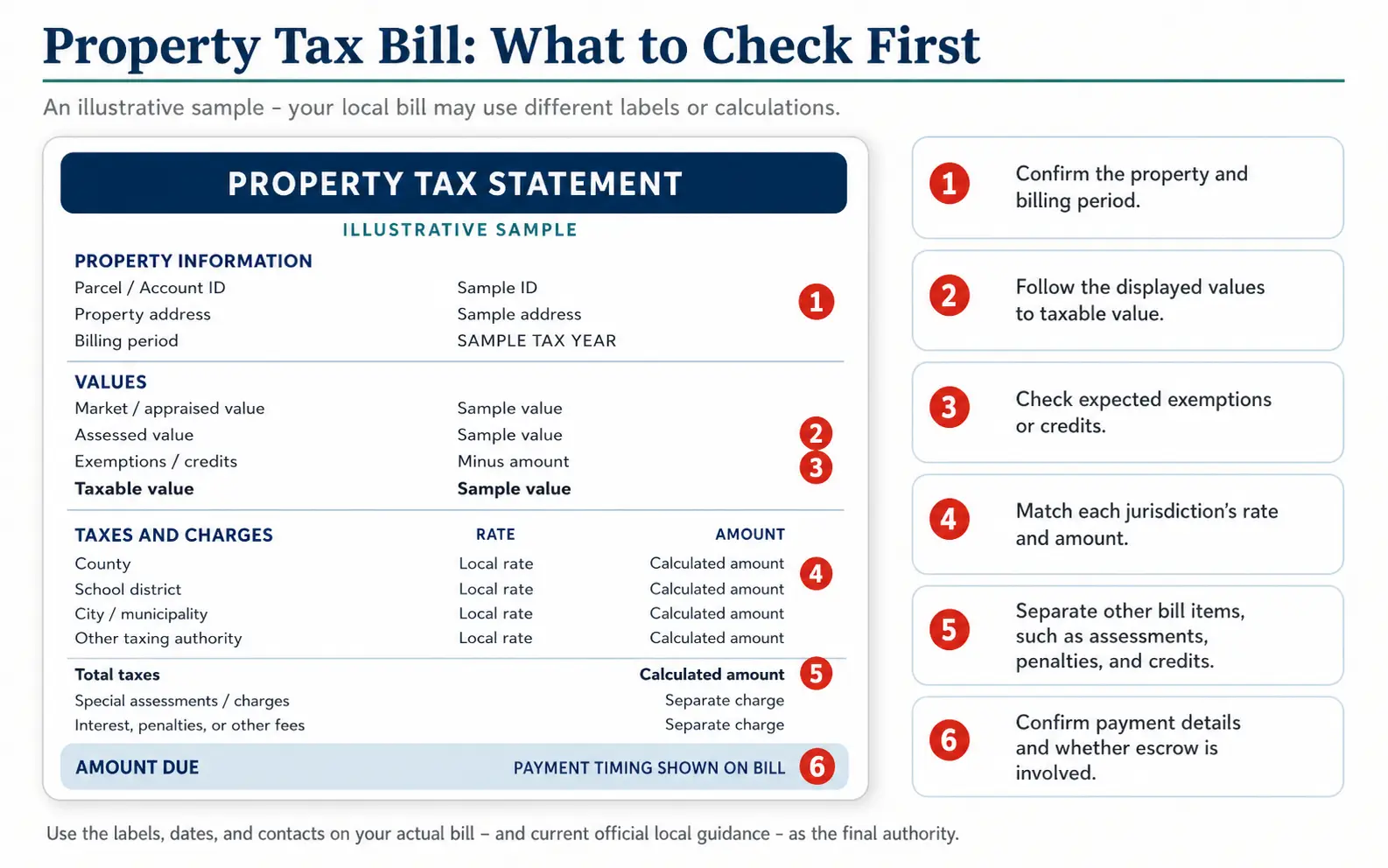
What each line on a property tax bill may mean
| Bill line | What it may mean | What to verify |
|---|---|---|
| Parcel, property index, or account number | The local identifier assigned to the property | Confirm that it matches your property record or a prior bill. |
| Property address and owner information | The property and taxpayer connected to the bill | Look for an incorrect parcel, mailing address, or ownership detail. |
| Tax year or billing period | The period covered by the statement | Confirm that you are looking at the expected bill rather than an older, corrected, or supplemental statement. |
| Market, appraised, or just value | A value determined under local rules | Compare the label and amount with your assessment notice or official property record. |
| Assessed value | A value assigned for property-tax purposes under local assessment rules | Note whether it differs from market value and whether it changed from the prior period. |
| Taxable value | The value used for a particular tax line after applicable adjustments | Check which exemptions or reductions appear and whether different lines use different taxable values. |
| Taxing jurisdictions and rates | The local entities imposing a tax and the rate or unit used by each | Match each rate and taxable value to the correct jurisdiction. |
| Special assessments or direct charges | Separate locally defined charges that may not be based on taxable value | Identify the charge, the responsible office, and whether it is new or unfamiliar. |
| Prior balance, penalty, credit, or adjustment | An amount carried forward, added, or subtracted | Keep it separate from the current value-based tax calculation. |
| Amount due and payment information | What the bill currently shows as payable | Confirm payment status and whether you or a mortgage servicer is responsible. |
Do not worry if your bill uses different labels. A parcel number may also be called a property identification number, account number, or property index number. The goal is to follow the record from the property information to the final amount due.
Pro Tip: Keep the parcel or account number nearby when contacting a local office. It can help the office locate the correct record.
Understand the value labels before checking the total
One of the easiest places to get tripped up is assuming that market value, assessed value, and taxable value are interchangeable. They may be related, but they are not always identical.
Market value, sometimes called appraised value or just value, generally points to what the property may be worth under the definition and method used by the jurisdiction.
Assessed value is the value assigned for property-tax purposes under local assessment rules. Depending on the jurisdiction, it may reflect an assessment ratio, classification, limitation, cap, acquisition-value rule, or another local method.
Taxable value or taxable assessed value is the value used for a particular tax calculation after applicable reductions or adjustments. A bill may show different taxable values for different taxing purposes if local relief applies differently.
In some jurisdictions, the path is fairly easy to see. For example, one official state calculation starts with property value, applies assessment limits, subtracts exemptions, and then applies the appropriate tax rate. Your bill may use a different sequence or different labels.
Think of the values as a path rather than three names for the same number:
A value is established under local rules. Assessment rules are applied. Eligible reductions may affect what becomes taxable for a particular line.
If you check one number first, check the taxable value used for each tax line. A real-estate estimate, an insurance replacement estimate, and a local taxable value can all describe different things.
Check where exemptions, credits, or abatements appear
Exemptions, credits, and abatements are easy to group together, but they may affect the bill in different places.
An exemption may reduce the value subject to a tax. A credit may reduce an amount after a tax is calculated. An abatement may work in another locally defined way. Eligibility, application requirements, renewal rules, and presentation vary by jurisdiction.
The practical question is: Where did this item affect the bill?
Look for whether the relief appears:
- Before a rate is applied, as a reduction in taxable value.
- After a tax is calculated, as a credit or savings line.
- Only for certain jurisdictions or taxing purposes.
- On a separate notice or official account record.
If you expected an exemption or credit and do not see it, identify the missing item before assuming the whole bill is wrong. Compare the bill with any approval notice or official property record, then use the exemption or assessment contact listed by your locality.
Match each rate to the right taxing jurisdiction
Your property may sit inside several overlapping taxing jurisdictions. A bill might include county, municipal, school, library, fire, utility, or other district lines. The exact mix varies.
Each line may have its own rate, taxable value, levy, or calculation method. That is why one property tax bill can look like several smaller bills collected together.
Rates may also appear in different units, such as a percentage, mills or millage, or another locally defined unit of value. Follow the unit and method shown on your own bill or current official local guidance. Do not copy a formula from another state, county, or neighbor’s bill unless the labels and units match your bill.
This also explains why the total can change even when a displayed property value does not. A rate, taxing district, exemption, credit, special charge, prior balance, or adjustment may have changed instead.
Separate value-based taxes from other bill items
Not every charge on a property tax bill is necessarily based on the property’s taxable value.
Some jurisdictions include special assessments, direct charges, district charges, prior balances, penalties, credits, or adjustments on the same statement. A separate charge may be tied to a service, district, improvement, or another locally authorized item. It may not move with the property’s assessed value.
If a line looks unfamiliar, check:
- The exact name of the charge.
- Whether it is calculated from taxable value or shown separately.
- Whether the bill names a department, district, or contact for it.
- Whether the official local website explains that charge category.
This distinction matters because an assessment review or appeal generally concerns assessment or property-record issues. It may not address a tax rate, local budget, payment posting, or every separate charge on the bill.
Trace the bill’s calculation without assuming it is wrong
You do not need to recreate the entire local tax system. You are trying to follow the bill’s own path.
- Find the taxable value for each line. Do not assume the first value on the page is used everywhere.
- Find the rate for that same line. Match it to the jurisdiction or district it belongs to.
- Check the unit. Follow the label and calculation method printed on the bill or supplied in official local guidance.
- Repeat for each taxing jurisdiction. Different lines may use different inputs.
- Account for credits or savings where they appear. Do not apply them twice.
- Add separate charges only after identifying them. Keep them distinct from value-based taxes.
- Compare the traced result with the amount due. Write down the exact line that does not reconcile.
Small differences may come from rounding or presentation. If you still cannot follow the calculation, turn the confusion into a specific question:
- Is the taxable value for this line correct?
- Was an expected exemption applied?
- Which rate and unit were used?
- What is this separate charge?
- Was a payment, credit, or escrow disbursement posted?
Those questions may go to different offices.
Check whether escrow is handling the payment
Receiving a property tax bill does not always mean you should immediately pay it yourself. If your mortgage payment includes escrow, your mortgage servicer may be responsible for paying the tax bill from that account.
Before making a separate payment:
- Check whether your mortgage statement includes an escrow amount.
- Review your latest escrow analysis or annual statement.
- Check the official local tax account for a scheduled or completed payment, when that information is available.
- Contact your mortgage servicer if the payment responsibility or account status is unclear.
Changes in property taxes can also change the escrow portion of your mortgage payment, even when the principal-and-interest portion of a fixed-rate loan stays the same. If that’s the number you’re trying to understand, AHA explains why property taxes can raise your monthly mortgage payment. Federal consumer guidance also confirms that tax and insurance changes can affect an escrowed payment.
The important point is not to assume that receiving a copy means the bill should be paid twice. Confirm who is responsible and whether payment has been made or scheduled.
Match the question to the right contact
Property-tax responsibilities are often split among several offices. The name on the door matters less than the job that office handles, so start with the contact information printed on your bill or assessment notice.
| If your question is about… | Start with the contact that handles… |
|---|---|
| Property description, classification, assessed value, or taxable value | Assessment, appraisal, or property-record questions |
| Missing, changed, or denied exemption | Exemption or assessor-related programs, unless your notice directs you elsewhere |
| Tax rate, levy, or a named jurisdiction line | Tax computation or the named taxing jurisdiction |
| Special assessment, direct charge, or separate line item | The department, district, or contact tied to that charge |
| Amount due, payment posting, receipt, prior balance, or bill mailing | Billing, treasurer, receiver, or tax-collection questions |
| Escrow collection or whether a servicer paid the bill | Your mortgage servicer |
| Assessment review or appeal process | The office or review body named in your assessment notice or local instructions |
Not sure what that division looks like? This official state directory shows one example of how valuation and exemption questions can be handled separately from billing and payment questions.
If your bill or notice calls for action by a stated date, use the contact information on that document promptly. Keep a record of whom you contacted, when you contacted them, and what they told you.
Watch Out: Your tax bill may not be the document that starts the clock on an assessment appeal. Some jurisdictions use a separate assessment notice and deadline. Check the notice you received from your local assessment office before assuming you still have time. See one official state example.
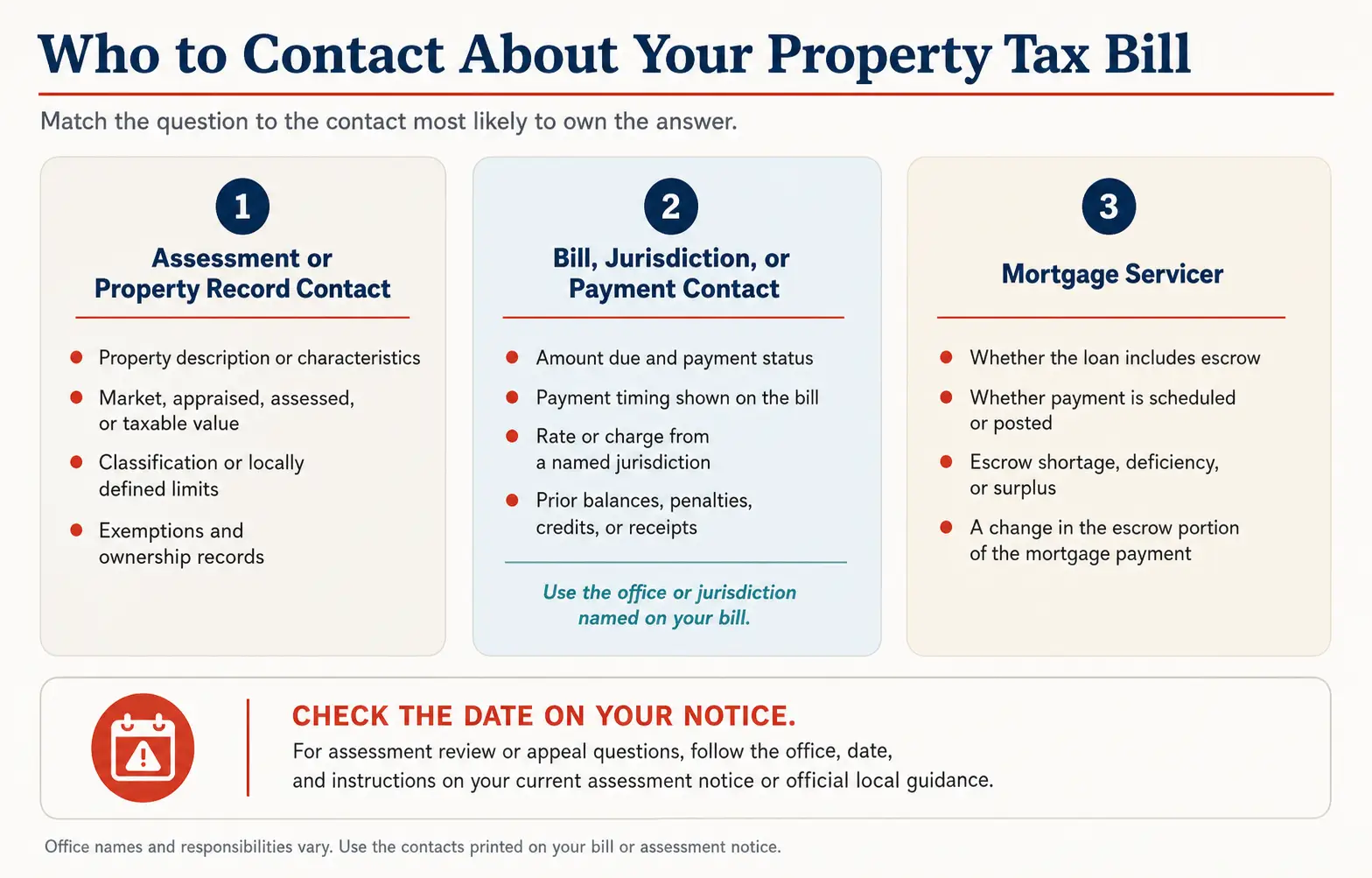
A calm five-minute first pass
You do not need to audit the entire local tax system. Give the bill one focused pass:
- Confirm the property. Check the address, owner information, parcel number, and billing period.
- Follow the values. Identify the market or appraised value, assessed value, and taxable value shown.
- Check the relief. Look for expected exemptions, credits, or abatements.
- Match rates and jurisdictions. Compare each line with the bill’s stated value and unit.
- Separate other items. Identify special assessments, prior balances, penalties, credits, or adjustments.
- Confirm payment responsibility. Determine whether you pay directly or through escrow.
- Name the question. Write down the exact value, rate, charge, or payment detail that needs clarification.
That last step is what turns a confusing bill into a manageable next action.
When to use AHA’s assessment guide or appeal toolkit
AHA’s assessment resources are helpful when decoding the bill reveals a possible assessed-value or property-record issue. They are not the default next step for every confusing bill.
Use AHA’s Homeowner’s Guide to Property Tax Assessments when:
- The assessed value does not match the assessment notice or official record.
- The property facts used for assessment appear incorrect.
- The classification or taxable value needs clarification.
- You need to understand how the assessment relates to the bill.
Use AHA’s DIY Property Tax Appeal Toolkit only after identifying a possible assessment issue and confirming the current local review or appeal process.
If the issue is a tax rate, local budget, separate charge, payment posting, or escrow handling, an assessment appeal may not address it. Start with the contact responsible for that part of the bill.
The bottom line
A property tax bill is easier to understand when you stop treating it as one mystery number and start reading it as a set of inputs.
Confirm the property. Find the taxable value. Check the relief. Match each rate to its jurisdiction. Separate other charges. Confirm payment responsibility. Then decide whether any specific line needs follow-up.
You do not need to understand every local rule before you can ask a useful question. You only need to identify which part of the bill needs an explanation.