

When you first buy a home, home equity probably isn’t what you’re thinking about. You’re thinking about closing costs, monthly payments, and whether the water heater is going to make it another year.
You’re learning the rhythm of the house: what it needs, what breaks, and what it costs to take care of.
Then, quietly in the background, something else begins to change. Your mortgage balance may go down as you make payments. Your home’s value may rise or fall. And eventually, you realize you’ve built home equity.
That can feel like discovering a financial reserve you didn’t quite know was there. But equity isn’t the same as cash—and deciding whether to use it deserves more thought than simply asking how much you have.
What Home Equity Really Is
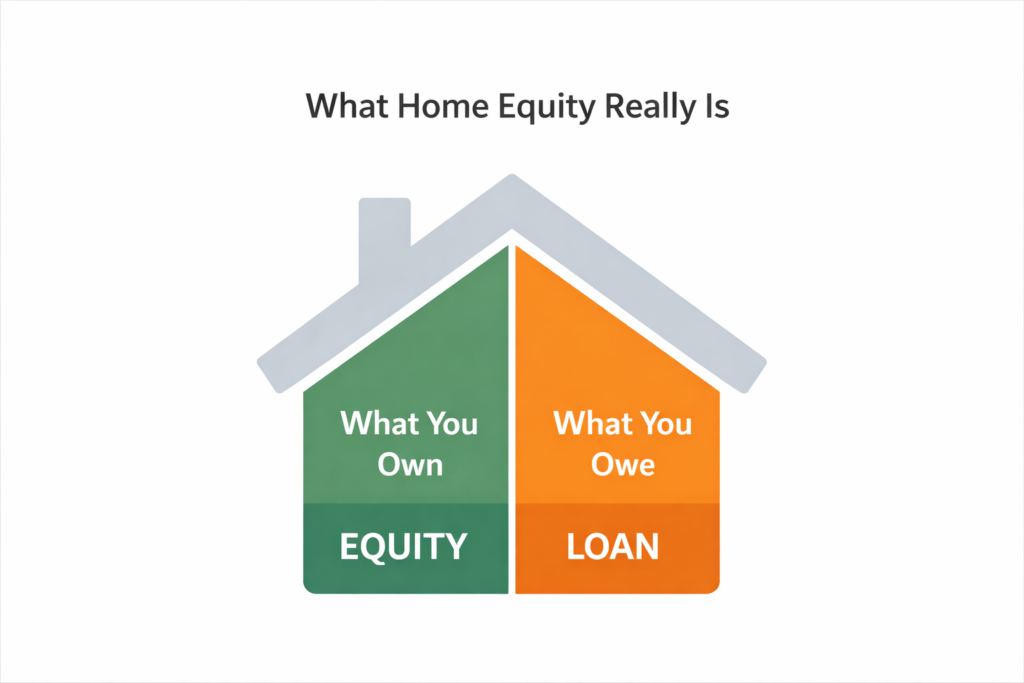
At its simplest, home equity is the difference between what your home is worth and the debt secured by it.
Estimated home value − home-secured debt = estimated home equity
Suppose your home is worth $400,000 and you owe $250,000 on your mortgage, with no other loans secured by the property. Your estimated equity would be $150,000.
That number can change.
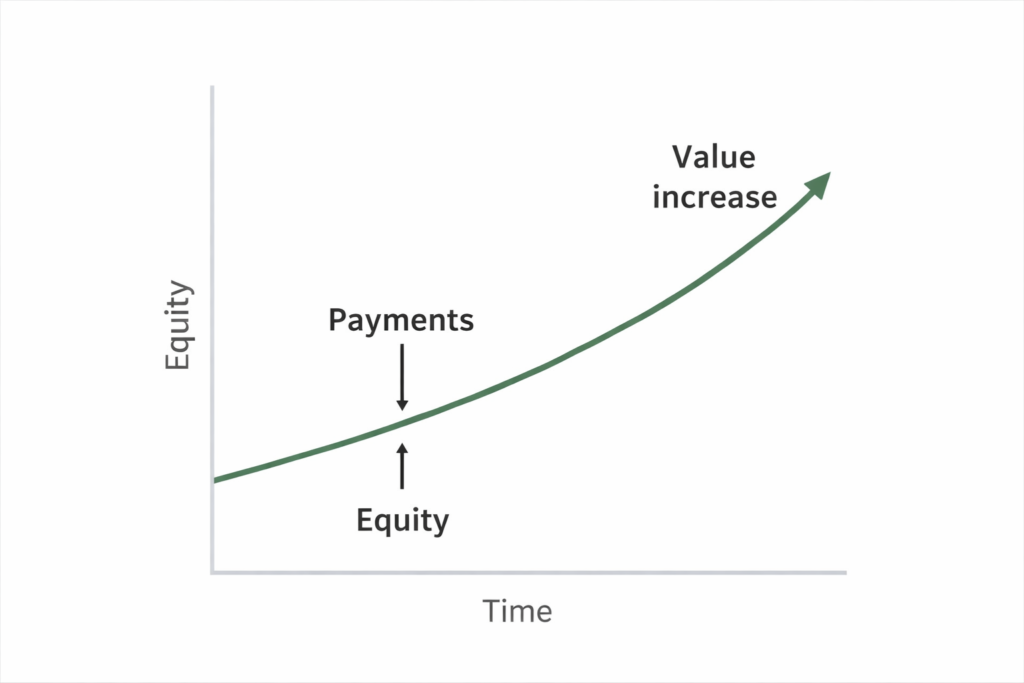
Regular mortgage payments may gradually reduce what you owe. Your home’s value can rise or fall. And if you later add a home equity loan or home equity line of credit, that additional home-secured debt also affects the equity you have remaining.
For a deeper look at what an equity percentage actually tells you—and what it doesn’t—AHA’s Home Equity Percentage guide walks through that calculation in more detail.
Why Equity Feels Like Money but Doesn’t Work Like Cash
This is where a lot of the confusion starts.
Seeing $150,000 in estimated equity can make it feel as though there’s $150,000 sitting somewhere with your name on it.
There isn’t.
Equity is value tied up in the property. You generally turn that value into spendable money by selling the home or borrowing against it. Borrowing doesn’t simply “withdraw” your equity—it creates a new debt obligation secured by your home.
That distinction matters.
A useful way to think about equity is as financial capacity you’ve built, not money you automatically need to spend.
How Much of Your Home Equity Can You Actually Use?
Your estimated equity and your usable equity usually aren’t the same number.
A lender may consider the value it assigns to the property, your existing mortgage and other home-secured debts, your income, credit profile, other debt obligations, and the requirements of the particular loan product.
That means having $150,000 in estimated equity does not necessarily mean a lender will let you borrow $150,000.
It also means an online home-value estimate is best treated as a planning number. When an actual loan is involved, the lender may use its own valuation or appraisal process.
The useful question isn’t simply:
“How much equity do I have?”
It’s:
“How much could I realistically access, what would that cost, and would the resulting payment still fit comfortably into my household budget?”
⚠️ Watch Out: Your Home Is Part of the Deal
A home equity loan, HELOC, or cash-out refinance uses your home as collateral.
If the payments eventually become unaffordable, the consequences can extend beyond a damaged credit score. Falling behind on home-secured borrowing can put the property itself at risk.
That doesn’t mean using equity is automatically a bad idea.
It means the repayment plan matters just as much as the reason you want the money.
What It Costs to Access Home Equity
Equity itself doesn’t charge you interest. Borrowing against it does.
Depending on the product and lender, accessing equity may involve interest, appraisal or valuation costs, title-related charges, closing costs, annual fees, or other expenses. Home equity loans can have upfront costs, while Home Equity Line of Credit (HELOC) agreements can include their own fees and borrowing requirements.
That’s why the monthly payment alone doesn’t tell you whether an option is inexpensive.
Before borrowing, compare the total expected cost, how long you’ll be making payments, whether the rate can change, and how the new obligation fits alongside your mortgage, insurance, property taxes, maintenance, and emergency savings.
When Using Home Equity May Fit the Goal
Homeowners often start thinking about equity when something meaningful changes.
Maybe the roof is approaching replacement. Your HVAC system is aging. A renovation would make the home work better for your family. Or several expensive debts have you wondering whether there’s a more manageable way to structure what you owe.
In situations like these, home equity can become one option among several.
A stronger use case generally has a few things going for it: the need is clearly defined, the benefit is likely to last, the total cost is understood, and the resulting payment remains manageable without depending on everything going perfectly.
The important part is that the expense and the debt make sense together.
Using long-term home-secured debt for a durable roof is a different decision from carrying that debt for years after a short-lived purchase has lost its usefulness.
Uses That Deserve More Caution
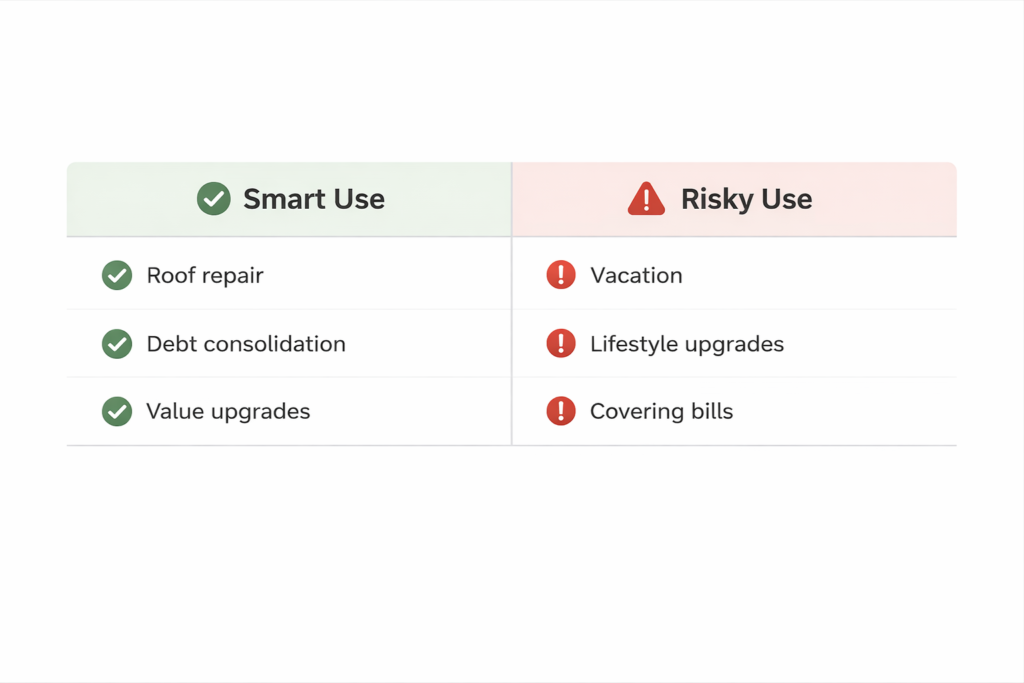
Equity becomes harder to justify when the borrowing is solving a recurring problem rather than a defined one.
Using home equity to cover ordinary monthly expenses, for example, may provide temporary breathing room without fixing the underlying budget gap. Speculative investments deserve similar caution because investment returns are never guaranteed while the loan payment still is.
Debt consolidation also needs a closer look.
A lower borrowing rate can appear attractive, but using home equity to repay credit cards or other unsecured debt changes the nature of the risk: that debt is now tied to your home. If you are considering this path, it’s worth comparing alternatives before borrowing.
The question isn’t whether a particular use is universally “smart” or “bad.”
It’s whether the benefit, cost, repayment period, and household risk all line up.
A Real-Life Way to Think About It
Imagine two homeowners with the same amount of equity.
One is facing a major system replacement and needed insulation work. Before borrowing, they get firm estimates, compare the project cost with available savings, look at several financing options, and make sure the new payment still leaves room for the rest of homeownership.
The second homeowner is considering a cosmetic project that suddenly feels urgent. There’s no clear budget, the benefit is mostly short-term, and the monthly payment only looks comfortable because the debt will be stretched over many years.
The amount of equity is the same.
What changes is the purpose, the repayment plan, and what the homeowner is giving up in exchange for access to that value.
Three Common Ways to Access Home Equity
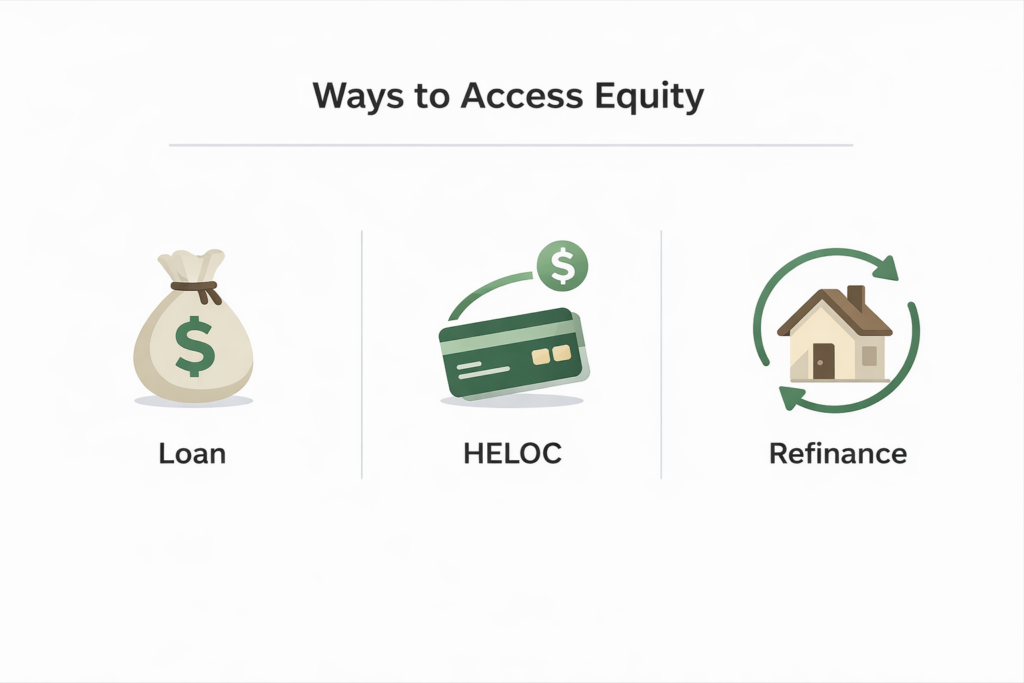
If borrowing does make sense, start with the job you need the financing to do rather than choosing a product first.
| Your Need | Option to Compare | Main Tradeoff |
| One known amount for a defined expense | Home Equity Loan | You receive a lump sum, and the loan usually has a fixed rate and predictable payment. It is generally an additional loan if you already have a mortgage. |
| Costs arriving in stages or an uncertain final total | HELOC | You can draw money repeatedly during the borrowing period, but HELOCs usually have variable rates and payments can change. |
| Replace your existing mortgage while taking additional cash out | Cash-Out Refinance | It replaces the original mortgage, so the new rate, term, balance, and closing costs affect more than just the cash you receive. |
If a HELOC is the option you’re considering, AHA’s HELOC guide goes deeper into draw periods, changing payments, fees, and when the structure may—and may not—fit a project.
And if refinancing is part of the decision, review the Home Refinancing Guide before changing the structure of your entire mortgage.
Five Questions to Ask Before Using Your Equity
Before you borrow, slow the decision down long enough to answer five questions:
- What problem am I actually solving? A defined repair is different from a recurring cash-flow shortage.
- How long will the benefit last? Try not to carry debt long after whatever you bought has stopped helping you.
- What will this cost in total? Include interest, fees, and changes to your existing loan—not only the monthly payment.
- Can I still afford the payment if something changes? Think about income, insurance, taxes, maintenance, and other home expenses.
- Is there a lower-risk way to get the same result? Savings, a smaller project, waiting, or another financing structure may preserve more flexibility.
You don’t have to answer “yes” to using equity just because a lender is willing to offer it.
💡 Pro Tip
Treat your home equity like something you built over years.
Before using it, ask whether the decision creates enough lasting value to justify turning part of that equity into debt.
Building equity can be a meaningful part of owning a home. It can give you choices when a large expense, renovation, refinance, or financial decision arrives.
But there’s no prize for borrowing simply because the equity exists.
Understand the number first. Understand what accessing it will cost. Then decide whether the new obligation makes your home and your finances easier to manage—or adds pressure you don’t need.
If you’re not sure what deserves attention first, the AHA Home Savings Review can help you get a clearer view of potential savings and priorities before you make a larger financial move.