
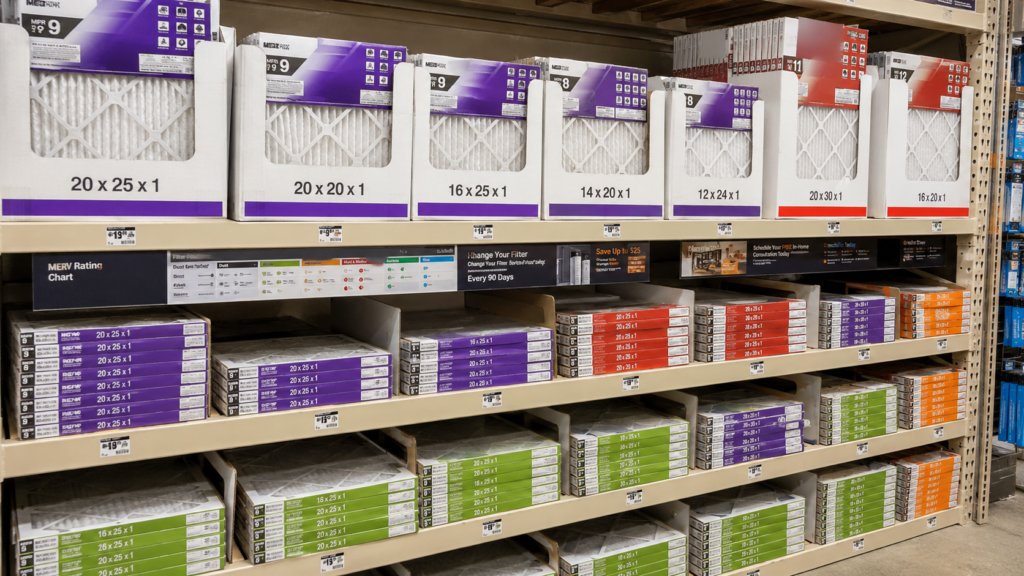
Air filters are one of those purchases that should take about 30 seconds. Then you reach the aisle and find a wall of sizes, MERV numbers, allergen claims, and prices ranging from a few dollars to more than $30. You want cleaner air, but you also don’t want to make your heating and cooling system struggle.
So, is the premium filter really better?
Sometimes—but only when it fits your system and your household’s needs. The best air filter for your home isn’t automatically the most expensive or highest-rated one. It’s the filter that fits correctly, captures the particles you care about, and still allows your heating, ventilation, and air-conditioning system, or HVAC system, to move enough air.
Here’s how to make that choice without turning a routine purchase into an engineering exam.
Is a Premium Air Filter Really Better?
A premium air filter can be worth the extra cost. But the price tag doesn’t tell you whether it’s right for your HVAC system.
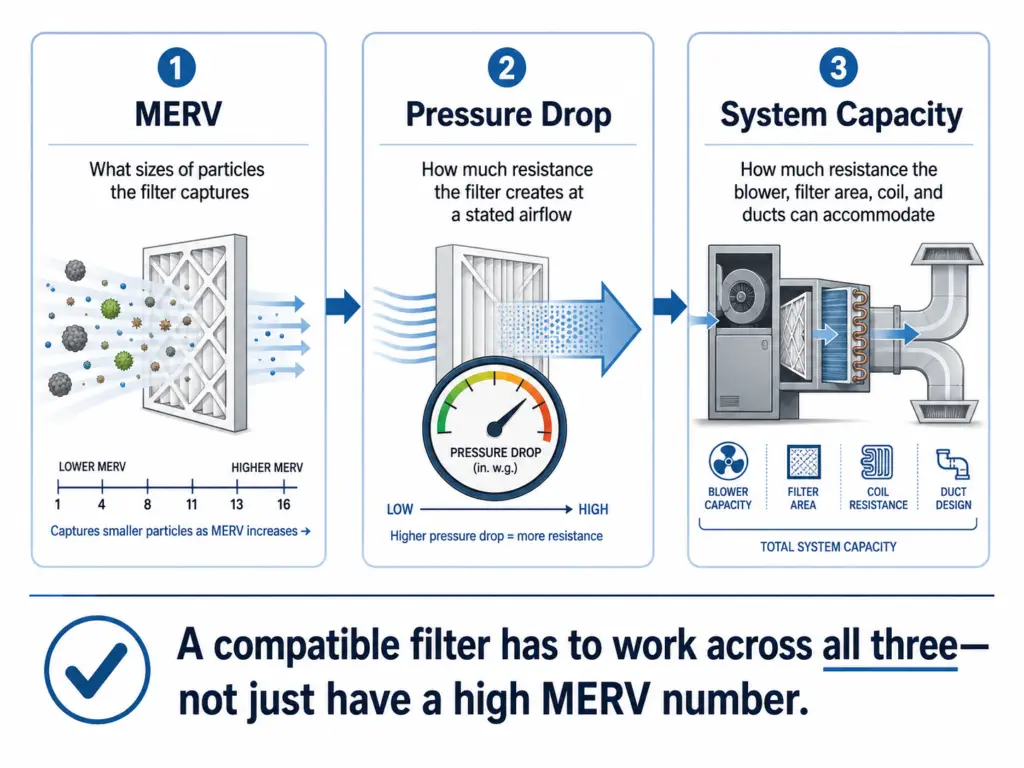
You’re looking for a three-way match: a filter that fits, captures the particles you care about, and still lets your system move enough air.
That last part is where much of the confusion begins. A higher-efficiency filter isn’t automatically harmful, and an inexpensive filter isn’t automatically easier for air to pass through. Filter depth, media surface area, construction, airflow rate, and dust buildup all affect resistance.
That’s why price and MERV rating alone can’t tell you whether a filter is a good match.
The U.S. Environmental Protection Agency recommends MERV 13, or the highest efficiency your system fan and filter slot can accommodate, when upgrading filtration. That doesn’t mean every homeowner should grab a MERV 13 filter without checking. It means better filtration can be worthwhile when the system is designed to support it.
The simple answer: Don’t choose the highest number or the highest price. Choose the best filtration level your system can comfortably support.
MERV Tells You What a Filter Captures
Minimum Efficiency Reporting Value, or MERV, describes how effectively a filter captures airborne particles between 0.3 and 10 microns. In general, a higher MERV rating means better capture of smaller particles.
But MERV doesn’t tell you how much resistance the filter creates in your particular HVAC system.
Think of MERV as the fineness of a fishing net. Pressure drop tells you how difficult it is to move air through that net.
Those are two different measurements, and your HVAC system has to handle both.
A filter can capture smaller particles and still have reasonable airflow characteristics. Another filter with the same MERV rating may create noticeably more resistance because of differences in depth, pleat design, media area, or construction.
You may also see Filter Performance Rating, or FPR, and Microparticle Performance Rating, or MPR, on retail packaging. Those are proprietary rating systems. MERV is based on a standardized test method, which makes it a more useful starting point for comparing filters across brands.
What Actually Matters on the Filter Package
There’s more useful information on the box than the MERV number.
| What to Check | What It Helps You Understand | What to Remember |
| Exact dimensions | Whether the filter will fit correctly | Actual dimensions may differ slightly from the rounded nominal size |
| Filter depth | Whether it fits the cabinet and how much media area it may provide | A deeper filter only works if the cabinet accepts it |
| MERV rating | Particle-capture efficiency | It doesn’t tell you airflow resistance by itself |
| Initial resistance or pressure drop | Resistance created by a clean filter at a stated airflow | Compare products at similar airflow conditions |
| Replacement guidance | Manufacturer’s suggested interval | Your home may need a different schedule |
Start with fit.
A filter that’s too small can allow air to slip around the edges instead of passing through the media. One that’s too large may bow, crush, or fail to seat properly.
That’s also why you shouldn’t rely only on the large rounded size printed on the front of the box. When available, compare the actual dimensions.
Pressure-drop information deserves more attention than it usually gets. If a manufacturer publishes it, check the airflow used for the test. Resistance changes as airflow changes, so a pressure-drop number at 400 cubic feet per minute isn’t directly comparable with one measured at 1,200 cubic feet per minute.
How Can You Tell What Filter Your HVAC System Can Handle?
Sometimes your equipment manual gives you a clear answer. Sometimes it doesn’t.
Most HVAC systems don’t simply have a universal “maximum MERV” number. What matters is whether the system can move the airflow it needs while staying within the manufacturer’s allowable resistance.
Here’s a practical way to narrow it down:
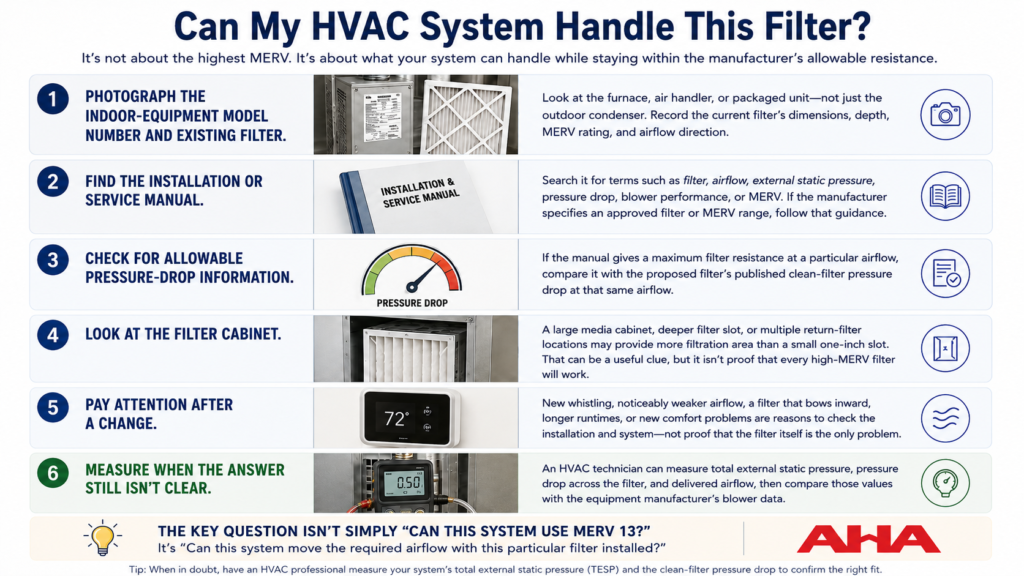
- Photograph the indoor-equipment model number and existing filter. Look at the furnace, air handler, or packaged unit—not just the outdoor condenser. Record the current filter’s dimensions, depth, MERV rating, and airflow direction.
- Find the installation or service manual. Search it for terms such as filter, airflow, external static pressure, pressure drop, blower performance, or MERV. If the manufacturer specifies an approved filter or MERV range, follow that guidance.
- Check for allowable pressure-drop information. If the manual gives a maximum filter resistance at a particular airflow, compare it with the proposed filter’s published clean-filter pressure drop at that same airflow.
- Look at the filter cabinet. A large media cabinet, deeper filter slot, or multiple return-filter locations may provide more filtration area than a small one-inch slot. That can be a useful clue, but it isn’t proof that every high-MERV filter will work.
- Pay attention after a change. New whistling, noticeably weaker airflow, a filter that bows inward, longer runtimes, or new comfort problems are reasons to check the installation and system—not proof that the filter itself is the only problem.
- Measure when the answer still isn’t clear. An HVAC technician can measure total external static pressure, pressure drop across the filter, and delivered airflow, then compare those values with the equipment manufacturer’s blower data.
The Pacific Northwest National Laboratory recommends looking at pressure drop and total system resistance when evaluating higher-efficiency filtration. The key question isn’t simply “Can this system use MERV 13?” It’s “Can this system move the required airflow with this particular filter installed?”
AHA Pro Tip: Create a Filter Passport
During your next HVAC service visit, ask the technician to record your approved filter dimensions, system airflow, clean-filter pressure drop, total external static pressure, and the equipment manufacturer’s allowable limit. Keep that information with your home-maintenance records so future filter purchases become much easier.
Download: AHA HVAC Filter Passport.pdf
The HVAC Tech’s Shortcut: Match Pressure Drop, Not Just MERV
Here’s one of the more useful tricks of the trade.
If your existing filter and a proposed higher-MERV filter both publish pressure-drop data at the same airflow, compare those numbers.
A higher-MERV filter with clean-filter resistance similar to the current filter may be a more promising candidate than another filter that creates substantially more resistance.
American Society of Heating, Refrigerating, and Air-Conditioning Engineers (ASHRAE) likewise advises homeowners considering improved filtration to pay attention to the pressure drop of the replacement filter and whether the system can accommodate it.
That still isn’t a guarantee. The existing filter may not have been selected correctly in the first place, and the rest of the duct system may already be restrictive.
But it’s a much more meaningful comparison than price or MERV alone.
Why a Thicker Filter Can Sometimes Be Less Restrictive
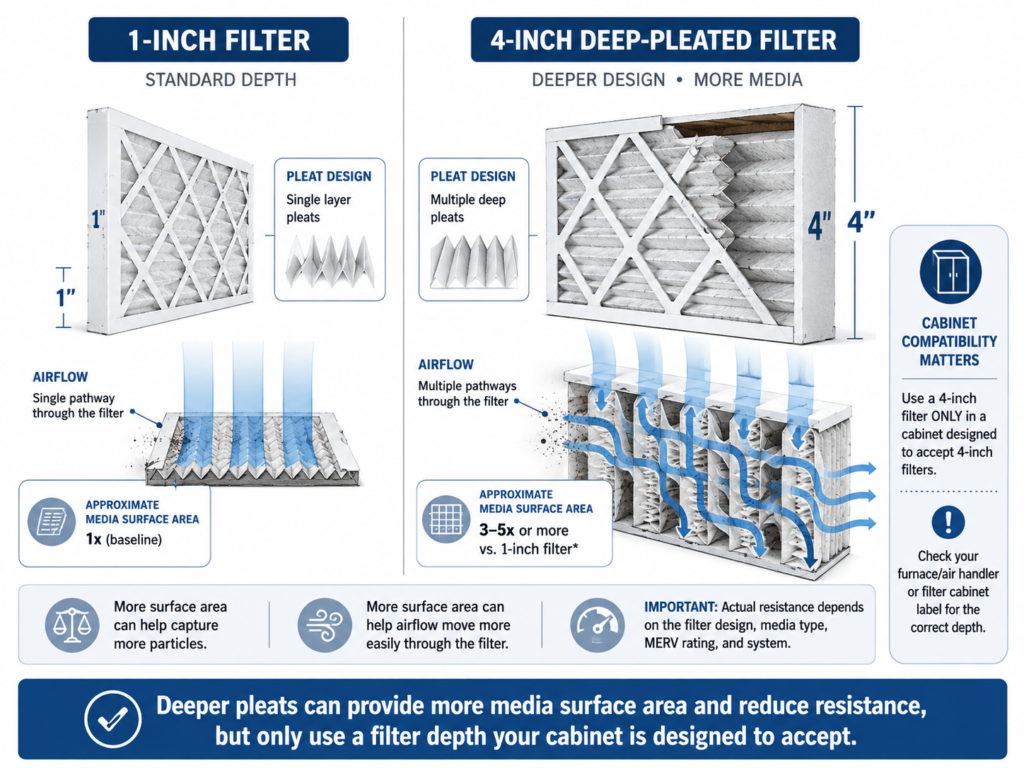
A four-inch filter looks like it should block more air than a one-inch filter. Sometimes the opposite is true.
Deep pleats give the filter more media surface area. Imagine trying to breathe through a small square of fabric compared with a much larger sheet made of the same material. More surface area gives the air more places to pass through.
That’s why a well-designed deeper filter can sometimes provide higher filtration efficiency while creating equal or even lower resistance than a shallow filter.
PNNL notes that higher MERV does not automatically mean higher pressure drop. Filter dimensions, depth, pleat geometry, surface area, and airflow all matter.
The catch is simple: your filter cabinet has to be designed for that depth.
Watch Out: Don’t force, fold, crush, or stack filters to make them fit. A thicker filter only belongs in a cabinet designed to accept it.
A Simpler Way to Shop for Your Next Filter
Before you leave home, photograph the current filter label and the indoor-equipment model number. Check the manual if you have it.
At the store, match the exact size first. Then compare MERV, depth, construction, and clean-filter resistance when the manufacturer provides it.
After installation, make sure the airflow arrow points toward the blower or air handler. Restore the filter cover or grille so air doesn’t bypass the filter opening, and write the installation date on the frame.
Then notice how the system behaves.
A properly chosen filter shouldn’t suddenly make the house feel different.
If the manual is silent and pressure-drop data isn’t available, staying reasonably close to the type of filter the system has already been using is a cautious interim choice until you can verify a larger upgrade.
When Better Filtration May Be Worth Paying For
Maybe you’ve used a basic filter for years, but wildfire smoke has become a regular summer concern. That’s a reasonable time to ask whether your system can support better fine-particle filtration.
You may also value improved filtration if your home regularly deals with pets, renovation dust, outdoor particle pollution, or household members who are sensitive to airborne particles.
A better HVAC filter can reduce particles in the air, but it can’t solve every indoor-air problem. Central filters work only when air is moving through the system, and filtration doesn’t replace controlling pollution sources or using appropriate ventilation.
In some situations, a portable room air cleaner may be a better supplement—especially if the concern is concentrated in a bedroom, office, nursery, or other frequently used space. The EPA’s Guide to Air Cleaners in the Home explains the difference between central filtration and portable air cleaners.
The real question isn’t whether a filter is “good.”
It’s whether it gives you the air-cleaning performance you want without asking more of the HVAC system than it can comfortably deliver.
How Often Should You Check and Replace the Filter?
As a general rule, replace your HVAC filter about every 90 days.
That’s a good starting point for many homes, but your filter may need attention sooner depending on how much your system runs and what’s happening inside and outside your home. Pets, wildfire smoke, renovation dust, heavy heating or cooling use, and a busy household can all cause a filter to load up faster.
It’s still worth taking a quick look at the filter between changes. If it’s heavily coated with dust, damp, damaged, bowing, collapsing, or pulling away from the frame, replace it rather than waiting for the 90-day mark.
Remember, even a well-matched filter becomes more restrictive as it collects dust. Keeping up with replacement helps your HVAC system maintain proper airflow while continuing to filter the air effectively.
Want a more precise reminder? Some newer smart filters and HVAC monitoring devices track airflow, system runtime, or pressure drop across the filter and can alert you when performance suggests it’s time for a change. These can be useful if you want to replace filters based on actual use instead of a fixed calendar. For the most accurate monitoring, pressure drop should be considered along with airflow.
AHA Pro Tip: Write the installation date on the edge of the filter, or save a quick note in your phone. After a few changes, you’ll have a much better sense of whether 90 days is right for your home or whether your filter tends to need replacing sooner.
If you’re building a broader maintenance routine, AHA’s essential home maintenance guide can help you keep filter changes and other high-value tasks from slipping through the cracks.
Signs the Filter and System May Not Be a Good Match
A filter change shouldn’t make your system suddenly sound or feel different.
New whistling around the filter slot, noticeably weaker airflow, a filter that bows toward the blower, uneven temperatures, or longer runtimes are worth investigating.
But don’t assume the filter is automatically the culprit.
Blocked return grilles, dirty coils, duct restrictions, blower settings, equipment problems, and other airflow issues can create similar symptoms.
The same caution applies to a frozen evaporator coil. A dirty or overly restrictive filter can contribute to coil icing, but it isn’t the only possible cause. Refrigerant problems, dirty coils, blocked returns, blower faults, and control issues can also be involved.
If the indoor coil freezes, stop cooling and have the system evaluated rather than repeatedly restarting it.
You can also learn more about how airflow and maintenance affect system life in AHA’s HVAC lifespan guide.
When to Ask an HVAC Professional
You shouldn’t need an HVAC appointment every time you buy a filter.
Professional help is most useful when the equipment manual leaves you guessing, airflow already feels weak, the system has a small one-inch filter slot, you’re considering a major jump in filtration efficiency, or the system has a history of icing or airflow trouble.
Instead of asking only, “Can my system use MERV 13?” ask for measurements.
A useful question is:
“Can you measure the system’s total external static pressure and the pressure drop across this clean filter at normal operating airflow, then verify the airflow against the manufacturer’s blower data?”
You don’t need to understand every number yourself.
You’re asking the technician to base the recommendation on how your system actually operates instead of relying on a rule of thumb.
That’s the dependable way to know whether a filter upgrade is truly compatible.
The Bottom Line: Choose for Fit, Filtration, and Airflow
Standing in the filter aisle, you don’t need to decode every marketing promise or find one filter that’s “best” for every home.
Start with the exact fit. Choose a filtration level that supports your household’s needs. Make sure it’s compatible with the way your system moves air. Then check it regularly, because even a well-chosen filter becomes more restrictive as it collects dust.
A premium filter may be worth the cost. A basic filter may be the smarter match.
The important thing isn’t the price tag.
It’s choosing a filter your home needs and your HVAC system can comfortably use.
Once the filter is handled, AHA HomeCheckup can help you keep the larger maintenance picture in view—so you can see what deserves attention now, what can wait, and what you may want to plan for next.