
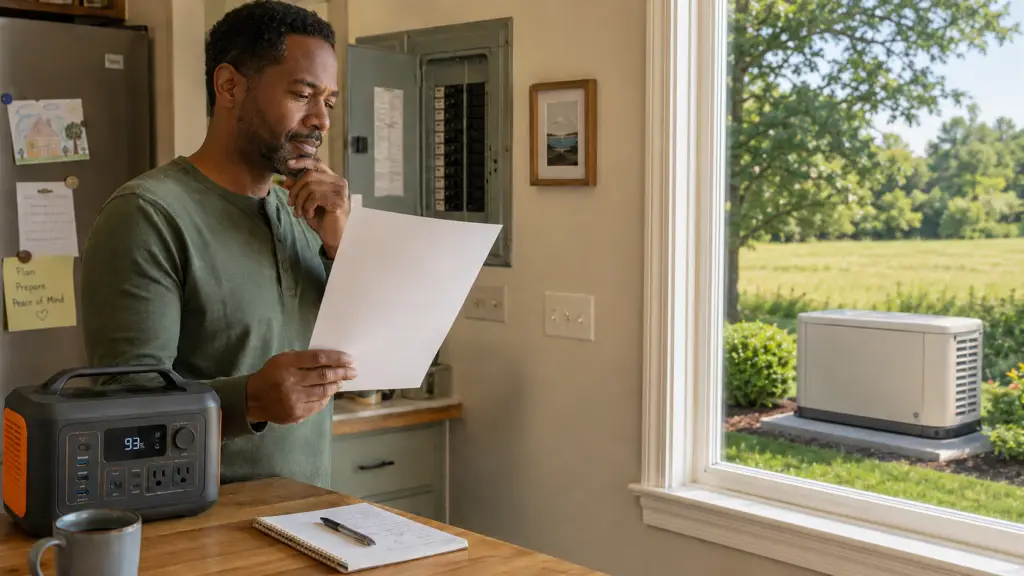
The power goes out. At first, it’s mostly annoying—you find the flashlights, check the utility app, and remind everyone not to keep opening the refrigerator.
Then the bigger questions start. Will the sump pump keep running? What about the well, furnace, medical equipment, or food in the freezer? And is this a two-hour outage… or a two-day one?
That’s usually when homeowners start shopping for generators. But the smartest answer doesn’t begin with a brand name or a wattage number. It begins with what losing power would actually mean in your home.
This guide will help you decide whether you need a portable generator, an automatic standby system, a battery backup, a smaller essentials-only plan—or no major backup system at all.
What Would Losing Power Actually Affect?
Some outages are a flashlight-and-board-games inconvenience. Others put your heat, water supply, basement, medication, or medical equipment at risk.
Start with the outages you’re preparing for:
- How often does your power go out?
- Do outages generally last minutes, hours, or days?
- Do they happen during extreme heat, freezing weather, hurricanes, ice storms, wildfire shutoffs, or heavy rain?
- Could losing electricity damage your home?
- Could everyone in your household remain there safely?
A backup system deserves more serious consideration when an outage could interrupt:
- Medical or accessibility equipment
- Refrigerated medication
- A sump pump
- A private well pump
- A furnace blower or boiler controls
- Essential cooling during dangerous heat
- Security or electronic access equipment
- Necessary home-office equipment
- A large amount of refrigerated or frozen food
A sump pump is a good example. When the power fails during the same storm that sends water toward your foundation, a routine outage can become a basement flood. FEMA guidance recognizes emergency power as an important consideration when a sump pump is part of a home’s flood-protection plan. (FEMA)
On the other hand, a major generator may be difficult to justify when outages are rare, brief, and mostly inconvenient. A smaller battery system or a well-organized emergency kit may cover what you actually need.
Make an Essential-Power List Before You Shop
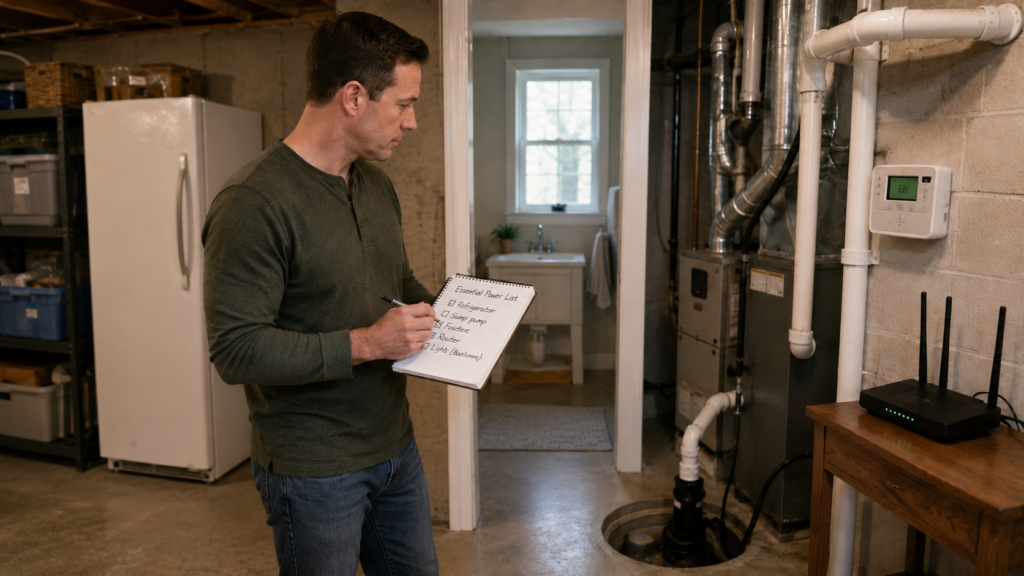
Don’t begin with, “What size generator runs my house?”
Begin with:
What truly has to keep working?
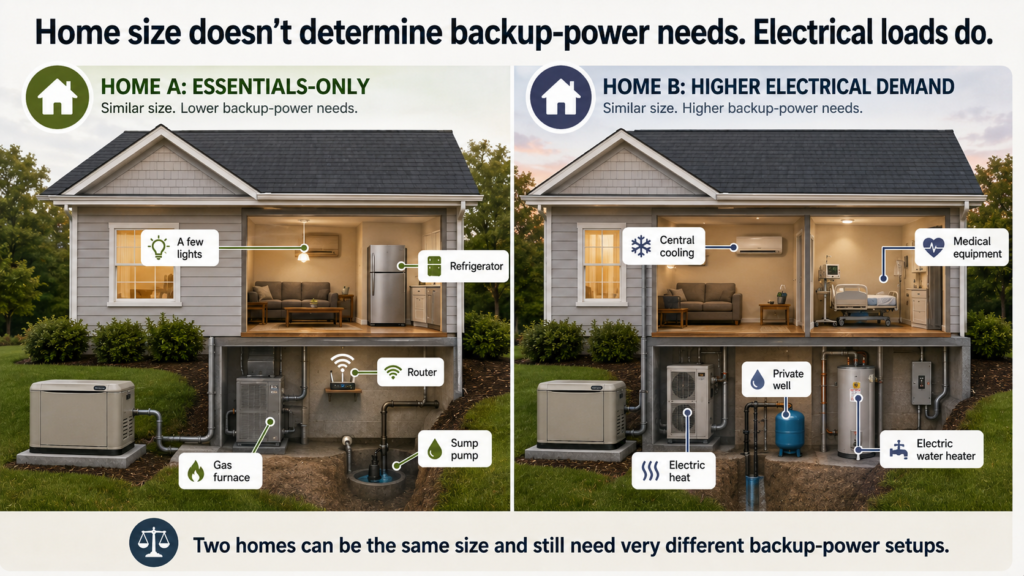
Imagine one homeowner with a refrigerator, gas-furnace blower, sump pump, router, and a few lights. Now imagine a neighbor with electric heat, a private well, central air conditioning, medical equipment, and an electric water heater.
The houses may be the same size. Their backup-power needs are nowhere close.
Divide your equipment into three groups.
Must keep running
This might include medical equipment, a sump pump, well pump, refrigerator, heating controls, accessibility equipment, or refrigerated medication.
Helpful during a longer outage
Think freezer, internet equipment, selected outlets, lights, a microwave, garage-door access, or one small air conditioner.
Can remain off
High-demand loads often include an electric range, clothes dryer, electric water heater, central air-conditioning system, pool equipment, hot tub, and electric-vehicle charger.
This exercise can dramatically reduce the size and cost of the system you need.
Pro Tip: Size your plan around essential loads—not every electrical device in your home. Keeping the basics running is often far more affordable than trying to recreate normal life during an outage.
Understand Running Watts and Starting Watts
Electrical equipment doesn’t always draw power evenly.
Running watts describe the electricity an appliance uses during normal operation.
Starting watts, sometimes called surge watts, describe the brief burst of additional power that motors and compressors may need when they start.
A refrigerator, sump pump, well pump, air conditioner, or furnace blower may run comfortably on a generator once started but temporarily demand considerably more power during startup.
You therefore need to consider:
- Which devices will run at the same time
- Their total running demand
- The largest likely starting demand
- Whether any equipment requires 240-volt power
- Whether load-management controls will be needed
The output advertised most prominently on a generator may be its temporary surge capacity—not the amount it can supply continuously.
Have a qualified electrician or generator professional size any system that connects to household wiring, serves large 240-volt loads, or supports equipment with significant startup requirements.
Compare Your Main Backup-Power Options
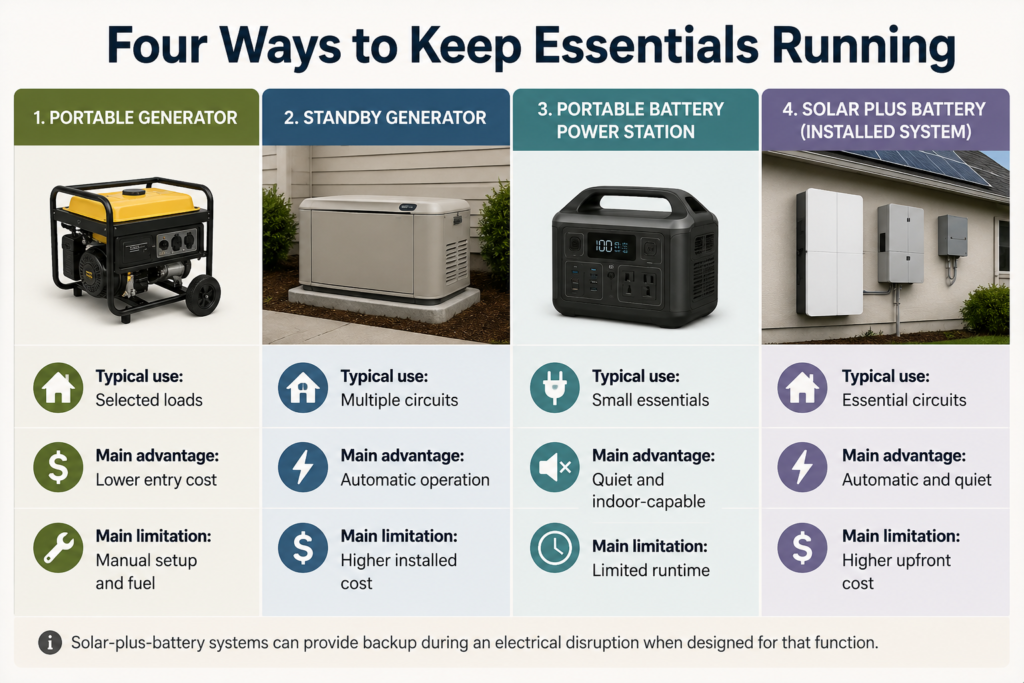
Once you know what must remain powered, the equipment choices become less confusing. You’re no longer shopping for “a generator for the house.” You’re looking for the safest, most practical way to cover a specific group of needs.
| Backup option | Often works best for | Main advantage | Main limitation |
|---|---|---|---|
| Portable generator | Occasional outages and selected loads | Lower initial equipment cost | Manual setup, fuel, exhaust and safety responsibilities |
| Portable inverter generator | Smaller loads and sensitive electronics | Often quieter and more fuel-efficient at lighter loads | Usually less output than a large conventional portable generator |
| Standby generator | Frequent outages or high-consequence needs | Automatic operation may be available | Higher installation and maintenance cost |
| Portable battery power station | Lights, electronics and limited appliances | No engine exhaust; quiet operation | Runtime is limited by stored energy |
| Installed home battery | Essential circuits or broader automatic backup | Quiet and potentially automatic | Significant upfront cost and finite capacity |
| Solar plus battery | Rechargeable backup designed around solar production | Can recharge when conditions allow | Must be designed specifically for outage operation |
Portable Generators
A portable generator can power appliances through properly rated cords or selected household circuits through approved connection equipment.
It offers a relatively accessible path to backup power, but someone still has to move it, position it, start it, connect the loads, monitor it, and refuel it—possibly in bad weather and in the dark.
Portable units may run on gasoline, propane, natural gas, or more than one fuel. Check the continuous output on each fuel because a multi-fuel model may not provide identical power across all fuel sources.
Some newer portable generators include automatic carbon-monoxide shutoff features. These provide another layer of protection, but they do not make a generator safe to operate indoors, in a garage, or close to a building. The Consumer Product Safety Commission recommends looking for models certified to current safety standards. (U.S. CPSC)
Standby Generators
A standby generator is permanently installed outdoors and connected to the home through transfer equipment. Many systems detect an outage and start automatically.
That convenience may matter when:
- Outages happen frequently
- The household is often away
- Someone cannot safely deploy a portable generator
- A pump, medical device, heating system, or well needs dependable power
- Multiple circuits need to remain available
A standby project may require electrical work, gas piping or propane service, an equipment pad, permits, inspections, trenching, and load-management controls.
Get an all-in proposal. The price printed beside the generator itself rarely tells you what the completed project will cost.
Battery Backup
A portable battery power station can be a practical option for phones, lights, internet equipment, laptops, compatible medical devices, and limited appliance use.
Two measurements matter:
- Watts indicate how much power the unit can deliver at one time.
- Watt-hours indicate how much energy it stores.
A battery may have enough output to start an appliance but not enough stored energy to run it for an entire day. Runtime depends on the usable battery capacity and the demand of everything connected to it.
Installed batteries can support selected circuits or a larger portion of the home. They’re quiet and do not produce generator exhaust at your property, but their stored energy remains finite.
What About Solar or Electric-Vehicle Backup?
Grid-connected solar panels generally shouldn’t be assumed to power your home during an outage. A system needs compatible controls, inverter equipment, and often battery storage to disconnect safely from the grid and supply backup loads. The Department of Energy identifies solar-plus-storage and microgrids as resilience options when they are appropriately designed for outage operation. (The Department of Energy’s Energy.gov)
Some electric vehicles and charging systems can export power to devices or a building. However, the vehicle, charger, electrical equipment, utility rules, and installation must all be compatible. Treat vehicle-to-home backup as a site-specific option—not a feature every electric vehicle automatically provides.
What Will Backup Power Really Cost?
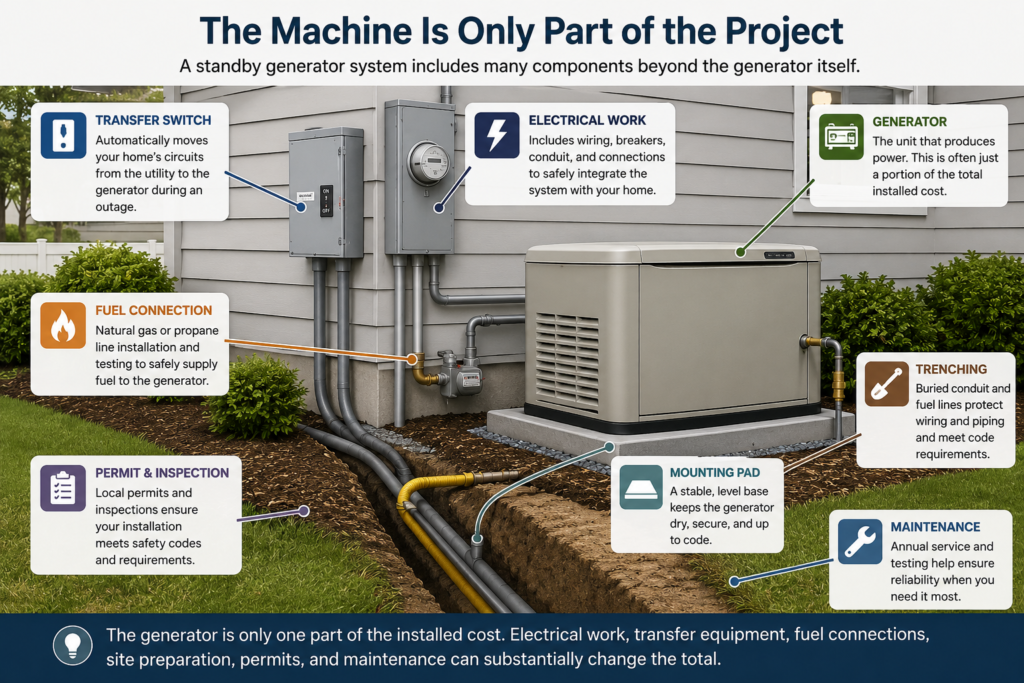
Backup power can mean a portable unit costing several hundred dollars or a five-figure permanent installation. That’s a wide gap… and the equipment price alone doesn’t tell the whole story.
Use the following as early planning ranges, not quotes for your home.
| Backup option | Approximate planning range |
|---|---|
| Small portable generator | $500–$1,500 |
| Larger portable or inverter generator | $1,500–$4,000+ |
| Portable generator with professionally installed home connection | About $2,000–$6,000+ total |
| Installed standby generator | Roughly $8,000–$16,000 |
| Complex or high-capacity standby project | $16,000–$25,000+ |
| Portable battery power station | About $300–$4,000+ |
| Installed home battery | Around $15,000 for a typical 13.5-kWh system before available incentives |
Generac currently places the average installed cost of its home standby projects at approximately $8,000 to $16,000, including the generator, while Home Depot gives a broader $5,000 to $12,500 range. These differences illustrate how much location and installation scope affect the final number. (Generac)
EnergySage’s 2026 marketplace data puts a typical 13.5-kilowatt-hour home battery installation at about $15,228 before state or local incentives. (EnergySage)
Costs can rise because of:
- Distance from the electrical panel
- Distance from the natural-gas meter or propane tank
- Transfer equipment
- Electrical-panel or service upgrades
- Load-management controls
- Trenching
- Site preparation
- Permit and inspection fees
- Difficult equipment access
- Noise or setback requirements
- Battery expansion modules
- Solar panels and compatible inverter equipment
A $5,000 generator can become a much larger project once those pieces are included.
Watch Out: Don’t compare proposals by generator size alone. One quote may include permits, transfer equipment, fuel piping, trenching, startup, and inspection. Another may cover little more than the machine.
Three Single-Family Cost Scenarios
These examples are illustrative—not contractor estimates.
Essentials-only portable setup
A homeowner wants to support a refrigerator, sump pump, furnace blower, router, and several lights.
A complete setup might cost approximately $2,000 to $5,000, including the generator, approved connection equipment, electrical work, and essential accessories.
Automatic standby for selected circuits
A homeowner wants automatic backup for refrigeration, heating controls, a sump or well pump, lighting, and several outlets.
A reasonable planning range might be $8,000 to $14,000, depending on equipment placement and access to fuel and the electrical panel.
Larger whole-home system
A homeowner wants to operate central cooling, a well pump, many appliances, and most of the electrical panel.
That project could reach $12,000 to $25,000 or more, particularly when it requires larger equipment, substantial gas piping, trenching, load controls, or service upgrades.
Square footage alone doesn’t provide a useful price estimate. A compact all-electric home may require more backup capacity than a much larger home with gas heating and carefully selected essential circuits.
Don’t Forget Ongoing Costs
A fuel-powered generator also brings:
- Fuel used during outages
- Oil, filters, spark plugs, or other service items
- Starter-battery replacement
- Periodic professional maintenance
- Fuel stabilization or rotation
- Repairs after the warranty expires
- Possible remote-monitoring fees
Ask the installer for expected fuel consumption at 25%, 50%, and full load. That will tell you more than a generic “hours of runtime” claim.
Should You Finance a Generator?
Financing may be easier to justify when backup power protects medical needs, flood prevention, a private well, or safe indoor temperatures during recurring outages. It’s harder to justify when the purchase is mainly for occasional convenience.
A home equity line of credit, or HELOC, lets you borrow against your home equity and commonly has a variable interest rate. A fixed-rate home equity loan may provide more predictable payments for a one-time project with a known price. Both create debt secured by your home. (CFPB)
Compare:
- The total amount you’ll repay
- Whether the rate can change
- The expected life of the equipment
- A smaller essentials-only system
- Available cash that won’t deplete your emergency savings
- Fixed-rate and unsecured financing options
For broader context, read AHA’s guide to understanding home equity and what you can do with it.
Watch Out: Don’t judge financing by the monthly payment alone. A long repayment term can make an expensive project look affordable while adding thousands of dollars in interest.
Generator Safety Is Part of the Buying Decision
A generator is worthwhile only when your household can operate it safely.
Carbon Monoxide
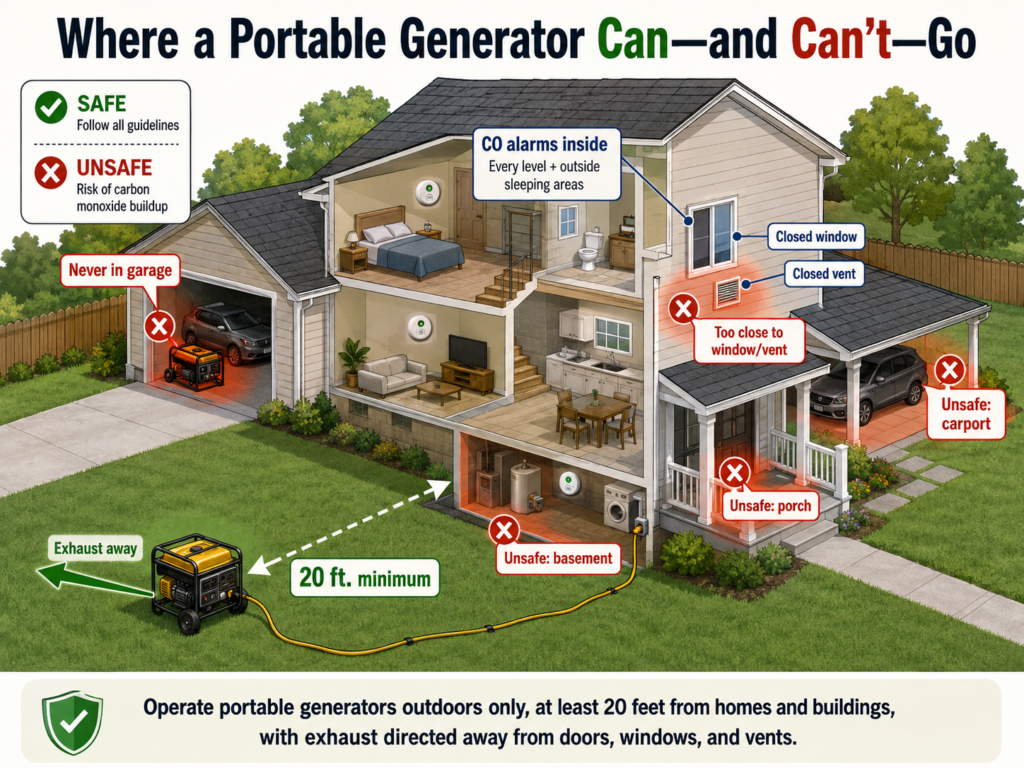
Portable generators create carbon monoxide, a colorless and odorless gas that can kill in minutes.
The Consumer Product Safety Commission says portable generators should operate outdoors only, at least 20 feet from homes and buildings, with the exhaust pointed away from windows, doors, and vents. They should never run in a home, garage, basement, crawlspace, shed, porch, or carport—even if doors and windows are open. (U.S. CPSC)
Install carbon-monoxide alarms with battery backup on every level of the home and outside sleeping areas. Interconnected alarms are best because all of them sound when one detects danger. (U.S. CPSC)
Watch Out: An open garage door doesn’t make generator use safe. Neither does placing the unit just outside a door, window, or vent.
Never Backfeed Your Home
Never try to power household wiring by plugging a generator into a wall, range, or dryer outlet.
This can send electricity back toward utility lines, placing utility crews, neighbors, and your own household at risk. A generator supplying household circuits needs properly installed transfer equipment that prevents generator power and utility power from being connected at the same time. FEMA guidance identifies transfer switches as a way to prevent backfeeding. (FEMA)
Have the connection completed by a qualified electrician and inspected as local rules require.
Refueling, Cords, and Wet Weather
Turn the generator off and let it cool before adding fuel. CPSC specifically warns against refueling a generator while it is running. (U.S. Consumer Product Safety Commission)
Use outdoor-rated cords sized for the connected load. Keep plugs and connections away from standing water.
Follow the manufacturer’s wet-weather instructions. Never improvise an enclosure that could trap exhaust, fuel vapors, or heat.
Think Beyond the Machine
The right generator may still be the wrong backup plan if your household can’t deploy or support it.
Ask:
- Can someone safely move and start it?
- Where will fuel be stored?
- What happens when local gas stations also lose power?
- Can the unit be accessed during snow, wind, or flooding?
- Will the noise disturb nearby bedrooms or neighbors?
- Is the operating location safely away from your home and adjacent buildings?
- Who will test and maintain it?
A fuel-powered generator is reassuring right up until the fuel runs out. The better question isn’t simply which fuel is cheapest. It’s which fuel you could safely access on the second or third day of an outage.
Backup Power for Condos and Multifamily Homes
Detached-home advice doesn’t always travel well to a condo building.
You may own your unit, but you probably don’t control the exterior space, roof, electrical service, fuel connections, or distance to your neighbor’s windows.
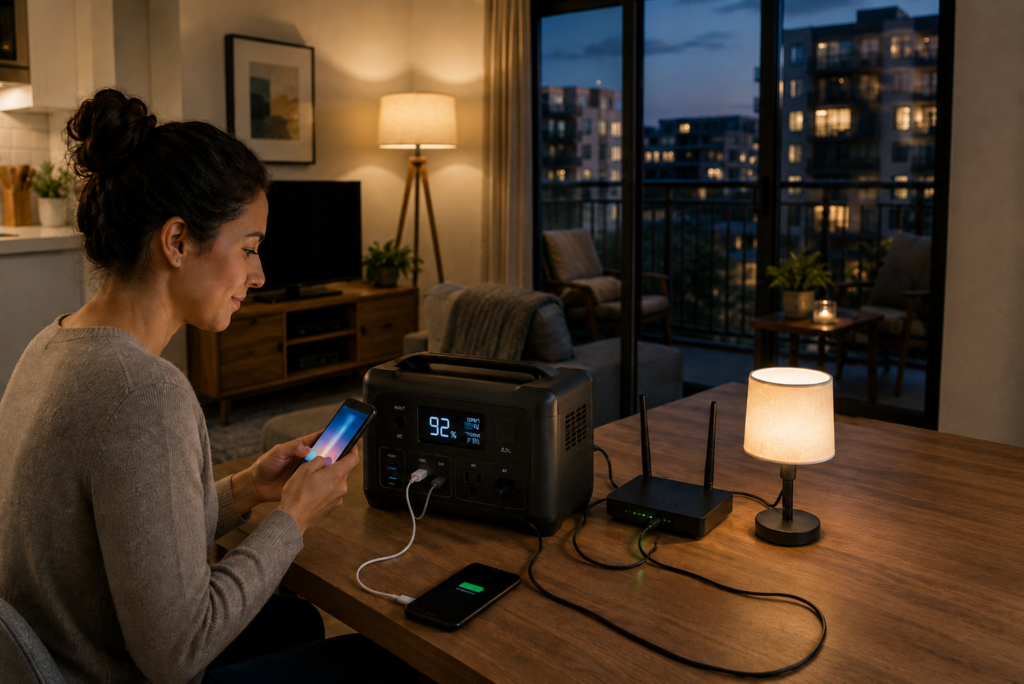
Because a portable generator needs substantial separation from buildings and openings, balconies, porches, garages, carports, corridors, and most shared courtyards are not safe substitutes. (U.S. CPSC)
More practical resident-controlled options may include:
- A portable battery power station
- An uninterruptible power supply for a modem, computer, or security device
- Device-specific medical or accessibility batteries
- Rechargeable lights and communications equipment
- Compatible vehicle power export where allowed and technically supported
Review association rules, lease terms, and local fire requirements before buying a large battery or attempting any electrical connection.
Ask the condo association or building manager:
- Does the building have emergency backup power?
- Which systems does it support?
- Will elevators, water pumps, garage access, or electronic doors operate?
- Is there a common area with emergency outlets, heating, or cooling?
- Are portable batteries or individual backup installations allowed?
Don’t assume the building generator supplies individual units. It may support only emergency lighting, life-safety systems, pumps, elevators, or limited common loads.
Building-level batteries, generators, solar-plus-storage, and microgrids can support prioritized loads, but they require a building-wide electrical and resilience assessment rather than a simple per-unit purchase. DOE recognizes batteries, distributed generation, and microgrids as tools for maintaining selected services during disruptions. (The Department of Energy’s Energy.gov)
A Simple Backup-Power Decision Test
A generator or substantial battery system may deserve serious consideration when:
- Outages are frequent or extended.
- Losing power threatens health, safety, water service, heating, cooling, or flood protection.
- Relocating during an outage would be difficult.
- You have a safe operating or installation location.
- The household can maintain and use the system correctly.
- The cost is manageable without weakening other essential finances.
A smaller system may be enough when:
- Outages are rare and short.
- Your main needs are lights, communications, and small electronics.
- You can relocate safely during an extended outage.
- Fuel storage and generator placement are impractical.
- You live in a condo or multifamily property without a safe operating area.
Questions to Ask Before Accepting a Quote
Ask the contractor to specify:
- Exactly which circuits and appliances will be powered
- Which loads will not operate
- How motor and compressor startup will be handled
- Whether the project includes transfer equipment
- Whether permits and inspections are included
- Whether fuel piping, trenching, and the equipment pad are included
- Whether electrical upgrades or load-management controls are needed
- Expected fuel use at several load levels
- Routine maintenance requirements
- Warranty coverage and exclusions
- Equipment noise and required setbacks
Get the scope in writing. A clear proposal can prevent a reasonably priced machine from becoming a surprisingly expensive project.
Frequently Asked Questions
Is a whole-house generator worth the cost?
It can be when recurring outages threaten medical needs, water supply, heating, cooling, flood protection, or the ability to stay safely at home. For occasional short outages, selected-circuit backup or a battery may offer better value than a system sized to operate nearly everything.
What size generator do I need?
It depends on the equipment that must run simultaneously, its continuous demand, and the startup needs of pumps, refrigerators, air conditioners, and other motor-driven appliances. Create an essential-load list first, then have a professional size a system that will connect to household wiring.
Can a portable generator run a refrigerator and sump pump?
Possibly. Compare both appliances’ running and starting requirements with the generator’s continuous and surge output. Account for anything else that may be operating when the pump or refrigerator starts.
How far should a portable generator be from the house?
CPSC recommends operating it outdoors at least 20 feet from homes and buildings, with the exhaust directed away from windows, doors, and vents. (U.S. CPSC)
Can I use a generator in a garage with the door open?
No. A garage is not a safe generator location, even with the door open. The same applies to basements, crawlspaces, sheds, porches, and carports. (U.S. CPSC)
Is a battery better than a generator?
Neither is universally better. Batteries are quiet and avoid engine exhaust, but runtime is limited by stored energy. Generators can run longer when fuel remains available but require safe placement, fuel, maintenance, and carbon-monoxide precautions.
Will solar panels keep the house running during an outage?
Not necessarily. The system must include compatible equipment and be designed for outage operation—often with battery storage and an appropriate inverter. (The Department of Energy’s Energy.gov)
Can I use a fuel-powered generator at a condo?
Usually not unless the property has a location that meets safe separation, code, and association requirements. Balconies, garages, porches, and shared corridors are not safe operating locations. A portable battery is generally more practical.
The Bottom Line
The right backup-power plan isn’t necessarily the one that keeps every appliance running. It’s the one that protects what your household truly can’t do without—and that you can safely afford, operate, and maintain.
Start with one page. Write down what must keep working, how long you may need it, and what would happen if it stopped. Then compare the smallest practical system that covers those needs.
You may end up with a standby generator. You may choose a battery, an essentials-only portable setup, or simply a better emergency plan.
Any of those can be the right answer when it’s based on your home—not the biggest system someone is willing to sell you.
Explore more practical home-protection and emergency-preparedness guidance in the AHA Resource Center.