

A catastrophe savings account, or CSA, is a state-created way for eligible homeowners to set money aside for certain disaster-related expenses while receiving favorable state tax treatment.
If you’re familiar with a Health Savings Account (HSA), the basic idea may sound familiar. With an HSA, you receive tax advantages when you follow the rules, and withdrawals used for qualified medical expenses can be tax-free. The key word is qualified: having money in an HSA doesn’t automatically make every medical bill eligible.
A catastrophe savings account works on a similar principle, but for your home.
There’s an important difference, though. HSAs operate under federal tax rules. CSAs are created by individual states, so the contribution limits, qualifying catastrophes, eligible expenses, and withdrawal rules depend on where you live.
That means you shouldn’t assume that every storm repair—or even every homeowners insurance deductible—automatically qualifies.
Before putting money in or taking money out, start with two questions:
Does my state offer a CSA?
And:
Would this catastrophe and expense qualify under my state’s current rules?
Does Your State Offer a Catastrophe Savings Account?
As of September 2026, catastrophe savings account programs have been enacted in Alabama, Georgia, Mississippi, and South Carolina. Georgia is the newest, with its program applying beginning with the 2026 tax year.
Rather than asking you to compare four state tax codes—and eventually more as other states consider similar programs—AHA’s State Checker keeps the changing rules in one place.
Use it to see:
- Whether your state currently offers a CSA
- Major catastrophe types that may potentially qualify
- Any major state-specific condition to know about
- The current official state resource
- When AHA last reviewed the information
Catastrophe Savings Account State Checker
Select your state to see whether an active Catastrophe Savings Account program is available, which major catastrophe types may potentially qualify, and any important state-specific condition you should know about.
“Potentially eligible” does not guarantee that a withdrawal qualifies. Your residence, expense, insurance coverage, disaster declarations, documentation, and other state requirements may also matter. Review the current official state guidance before opening an account or making a withdrawal.
AHA Note: “Potentially eligible” doesn’t guarantee a withdrawal qualifies. The property, cause of loss, type of expense, insurance coverage, required declarations, and other state rules may still matter.
What Expenses Qualify for a Catastrophe Savings Account?
Just as an HSA has qualified medical expenses, a CSA has qualified catastrophe expenses.
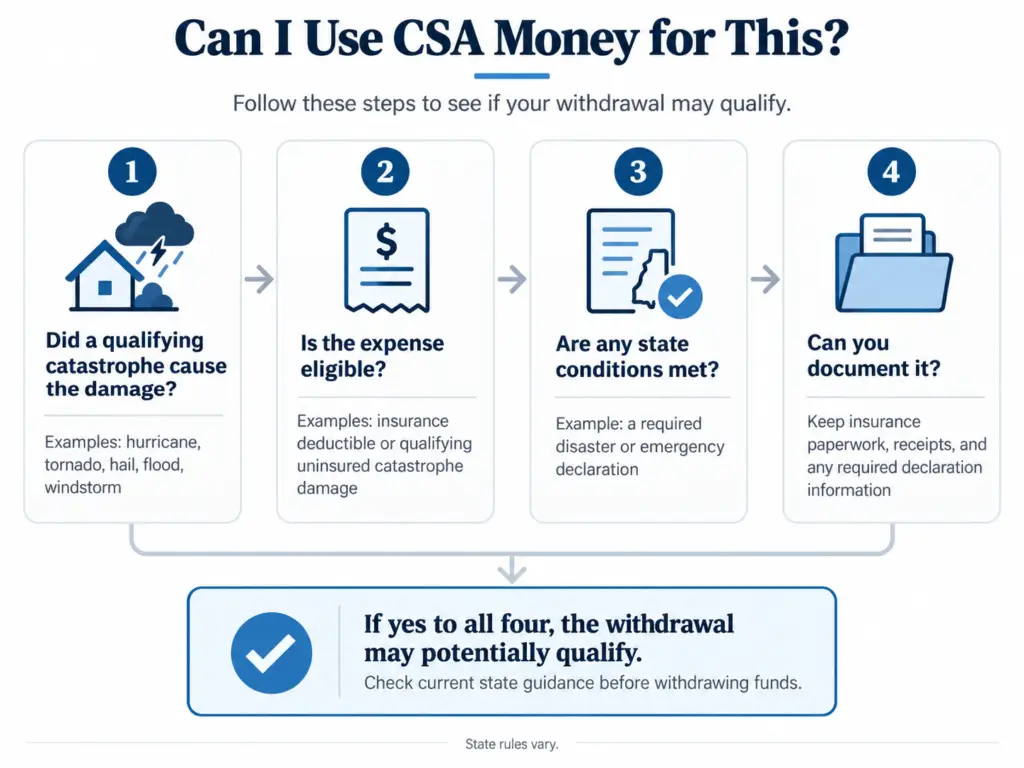
The easiest way to understand whether CSA money may be usable is to look at three things:
The event has to qualify.
The damage must result from a catastrophe recognized under your state’s rules.
The expense has to qualify.
You need to be paying for something your state permits, such as an eligible insurance deductible or certain uninsured catastrophe damage.
Any additional state conditions have to be met.
Depending on where you live, that could include an official disaster or emergency declaration.
A few homeowner scenarios make the distinction clearer.
Example: A Tornado Damages Your Roof
A tornado tears shingles from your roof, breaks several windows, and leaves you responsible for a $5,000 homeowners insurance deductible.
This is the kind of loss a CSA may help with. If tornado damage is recognized under your state’s rules and any additional conditions are satisfied, the deductible—and potentially certain uninsured repair costs—could qualify.
Check the State Checker before withdrawing money.
Example: A Hailstorm Damages the House
A severe hailstorm damages your roof and gutters. Your insurer approves the claim but leaves you responsible for a $4,000 deductible.
The insurance company accepting the claim does not automatically determine whether the CSA withdrawal qualifies.
Your state’s catastrophe-savings rules still apply.
Example: A Hurricane Leaves You With a Large Deductible
A hurricane damages your home, and your policy leaves you with a $7,500 hurricane deductible.
This is one of the clearest examples of why catastrophe savings accounts exist. If the event and expense meet your state’s requirements, CSA funds may potentially help cover the deductible and certain uninsured catastrophe costs.
Some states impose additional conditions, so verify the current rules before withdrawing.
Example: A Tree Falls During a Windstorm
A large tree comes down during severe winds and damages your roof.
The important question may not be the tree itself. It’s what caused the tree to fall.
If the underlying windstorm qualifies under your state’s CSA rules, the related deductible or qualifying uninsured damage may potentially be eligible.
Pro Tip: Start with the cause of loss, not just the repair. “Tree damage” tells you less than “a tree fell during a qualifying windstorm.”
Example: A Pipe Bursts
A plumbing line fails and sends water across your basement.
That can be an expensive home emergency and may even be a legitimate insurance claim. But an ordinary plumbing failure generally isn’t the type of event these catastrophe-savings laws are designed around unless the damage resulted from some other qualifying catastrophe.
Example: Your Air Conditioner Dies in July
Your 14-year-old air conditioner stops working and costs $8,000 to replace.
Household emergency? Absolutely possible.
Qualified catastrophe? Generally not.
Your regular home emergency savings and a CSA have different jobs.
Watch Out: “This is an emergency at my house” and “this is a qualified catastrophe expense under state tax law” are two different standards.
Insurance Deductibles and Uninsured Catastrophe Costs
Although exact definitions vary by state, current CSA programs generally focus on expenses such as a qualifying homeowners insurance deductible, certain catastrophe damage not covered by insurance, and certain qualifying self-insured losses. Mississippi, for example, expressly permits qualifying deductibles, certain uninsured damage after the deductible has been paid, and qualifying self-insured losses.
But “insurance didn’t pay for it” isn’t enough by itself.
The expense still has to arise from an event that qualifies under your state’s rules.
If deductibles on your policy are unfamiliar, AHA’s Homeowners Insurance Coverage Essentials can help you understand how those out-of-pocket amounts fit into your coverage.
How Much Can You Contribute to a Catastrophe Savings Account?
Your state determines the exact contribution limit.
Current programs generally connect contribution capacity to your homeowners insurance deductible, with separate limits for certain self-insured homeowners.
There’s one point that’s particularly easy to misunderstand:
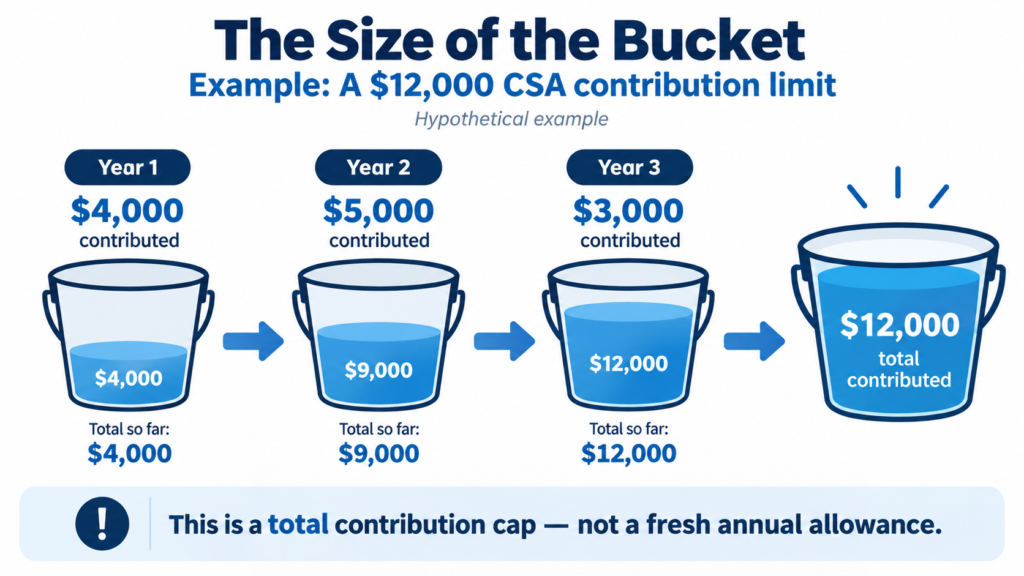
Don’t assume the full contribution limit resets every year.
Think of the limit as the size of the bucket, not a brand-new bucket you receive every January.
For example, suppose the maximum allowed for your situation were $12,000:
Year 1: $4,000
Year 2: $5,000
Year 3: $3,000
Total contributed: $12,000
Alabama expressly allows contributions over multiple years until the applicable maximum has been reached.
Use the official source in the State Checker to determine the current limit for your deductible and state.
Can You Replenish the Account After Using It?
That depends on the state.
This is a good example of the kind of rule we intentionally keep in state guidance rather than hard-coding into the national article.
Mississippi currently says homeowners can replenish an account after a qualified catastrophe withdrawal, subject to its statutory contribution limit. Alabama’s published guidance says its account cannot be replenished after qualified funds are used for catastrophe repairs under the rules covered by that guidance.
Because state laws can change, check the current official source before assuming a withdrawal creates new contribution room.
How to Open a Catastrophe Savings Account
If your state offers one and the rules fit the risks you’re trying to prepare for, setup is generally straightforward.
Start With Your Homeowners Insurance Policy
Find your declarations page and identify the deductibles that apply to your home.
Pay particular attention to separate hurricane, wind, hail, or other catastrophe deductibles. Some may be a fixed dollar amount; others may be a percentage of your insured home value.
AHA’s Homeowners Insurance Renewal Checklist can help you review the deductible and other policy changes that are easy to miss.
Check Your State’s Current CSA Rules
Before opening the account, use the State Checker to confirm:
- Your state currently offers a CSA
- Your home is eligible
- The major catastrophes recognized by the state
- Any major additional condition
- Where to find the official state instructions
Determine Your Contribution Limit
Use the current state guidance to calculate the amount you’re permitted to contribute.
Don’t assume a neighboring state’s formula applies to you.
Open a Separate Qualifying Account
Current programs generally require catastrophe savings to be kept in a dedicated savings or money-market account.
Alabama, for example, requires a new, separate savings or money-market account for catastrophe savings and explains how to document the designation if a financial institution cannot label the account itself. Mississippi likewise requires a new, separate savings or money-market account labeled as a Catastrophe Savings Account. South Carolina requires a separate interest-bearing account established specifically for qualified catastrophe expenses.
The exact labeling and account requirements are worth checking before you transfer money.
Keep the Paperwork
Save records showing:
- When and how the account was established
- Contributions
- Your applicable insurance deductible
- Insurance claims
- Repair invoices and receipts
- Withdrawals from the CSA
- Any disaster or emergency declaration relevant under your state’s rules
If you actually experience a loss, AHA’s Homeowners Insurance Claim Toolkit can help you organize the documentation that matters during the insurance-claim process.
What Should You Check Before Making a Withdrawal?
This is where the HSA analogy is especially useful.
Before using HSA money, you want to know whether the expense is qualified.
Before withdrawing CSA money, ask:
What caused the damage?
Was it a catastrophe recognized by your state?
Does another state requirement apply?
For example, does the event need an official disaster or emergency declaration?
What are you paying for?
Is it a qualifying deductible, eligible uninsured catastrophe loss, or another expense your state permits?
Can you document it?
Keep the insurance paperwork, invoices, receipts, and any required declaration information.
If any part is unclear, check the official state source before treating the withdrawal as qualified.
A CSA can help with the financial side of a qualifying disaster, but it’s only one part of being prepared. AHA’s Homeowner’s Emergency Guide covers practical steps to take before and during common home emergencies, from severe weather and flooding to power outages and water damage.
If you’re also building out your physical preparedness supplies, see AHA’s Home Emergency Kit Guide for the essentials worth keeping on hand.
CSA vs. a Regular Home Emergency Fund
A catastrophe savings account isn’t a replacement for ordinary emergency savings.
A regular home reserve might help when:
- The water heater fails
- Your HVAC system reaches the end of its life
- A plumbing repair can’t wait
- An appliance suddenly needs replacement
- Another expensive home problem appears without warning
A CSA has a narrower purpose because its favorable state tax treatment comes with restrictions.
For homeowners who qualify, the two accounts can complement each other.
Your regular home reserve handles everyday homeownership surprises.
Your CSA is reserved for qualifying catastrophe expenses.
If you’re not sure how much to keep available for ordinary repairs, How Much Should You Save for Home Repairs? walks through practical ways to set a savings target. You can also use AHA’s Home Repair Reserve Calculator to estimate a reserve for your home.
What Happens If You Use CSA Money for Something That Doesn’t Qualify?
You can lose the favorable state tax treatment.
Depending on the state, a nonqualified withdrawal may be included in taxable income and may also trigger an additional state tax. South Carolina, for example, treats nonqualified withdrawals as ordinary state income and generally applies an additional 2.5% tax unless an exception applies.
That’s why the safer habit is simple:
Check first. Withdraw second.
Catastrophe Savings Account FAQ
Is a Catastrophe Savings Account Basically an HSA for Your House?
It’s a useful way to understand the concept, but they aren’t legally the same type of account.
Both tie favorable tax treatment to qualified expenses. HSAs are governed primarily by federal tax law and have their own eligibility requirements. CSA rules are created by individual states.
Is the Catastrophe Savings Account Contribution Limit Annual?
Generally, don’t assume the maximum resets each year. Current CSA programs use overall statutory limits, and at least some expressly allow contributions over multiple years until the maximum is reached.
Can CSA Money Pay for Repairs Insurance Doesn’t Cover?
Potentially. But lack of insurance coverage by itself doesn’t make an expense eligible. The damage still needs to arise from a qualifying catastrophe and satisfy your state’s other rules.
Can I Open a Catastrophe Savings Account at Any Bank?
Requirements differ. Current programs generally use savings or money-market accounts, but state law may specify where the account may be held, how it must be labeled, or how the designation must be documented.
Check the official state guidance before opening one.
Are Catastrophe Savings Account Contributions Federally Tax Deductible?
The current state programs provide state tax advantages. They are not the same as a federally tax-advantaged HSA.
What If My State Doesn’t Offer a CSA?
You can still create a dedicated disaster reserve in a regular savings account. You simply won’t receive the special state CSA tax treatment.
Your catastrophe-related insurance deductible can still give you a useful savings target.
Start With the Qualification Rules, Not the Tax Break
A catastrophe savings account can help make a large disaster deductible less likely to become a financial surprise.
But the tax advantage only matters if the account works for the risks you’re preparing for.
The HSA comparison is useful here:
First determine what qualifies. Then decide how to fund the account.
Start with the AHA State Checker to see whether a CSA is available where you live, which major catastrophe types may potentially qualify, and any important condition you should know about.
Then review the official state guidance before opening the account or making a withdrawal.