
Your homeowners insurance renewal lands in your inbox, and your eyes go straight to the premium. That’s understandable. Insurance paperwork rarely arrives on a quiet day.
But the price isn’t the only thing that can change. A deductible may rise. A particular type of loss may get a smaller limit. An endorsement may introduce a rule you’ve never seen before, even when the insurer, address, and policy number all look familiar.
A Florida television report showed why this matters. A Plant City couple said they learned after catastrophic interior water damage that a renewal endorsement limited the applicable coverage to $10,000. The report doesn’t establish how common that limit is. The bigger lesson is simpler: a policy can renew with terms that aren’t identical to the ones you remember.
The story also highlights another layer of protection: how quickly a leak is detected and stopped when no one is home.
Pro Tip: Smart water sensors can alert you when a leak starts, and some whole-home monitoring systems can detect unusual water flow and automatically shut off the supply. They can’t prevent every plumbing failure or guarantee insurance coverage, but faster detection may help keep a small leak from spreading through multiple rooms—especially when you’re away from home.
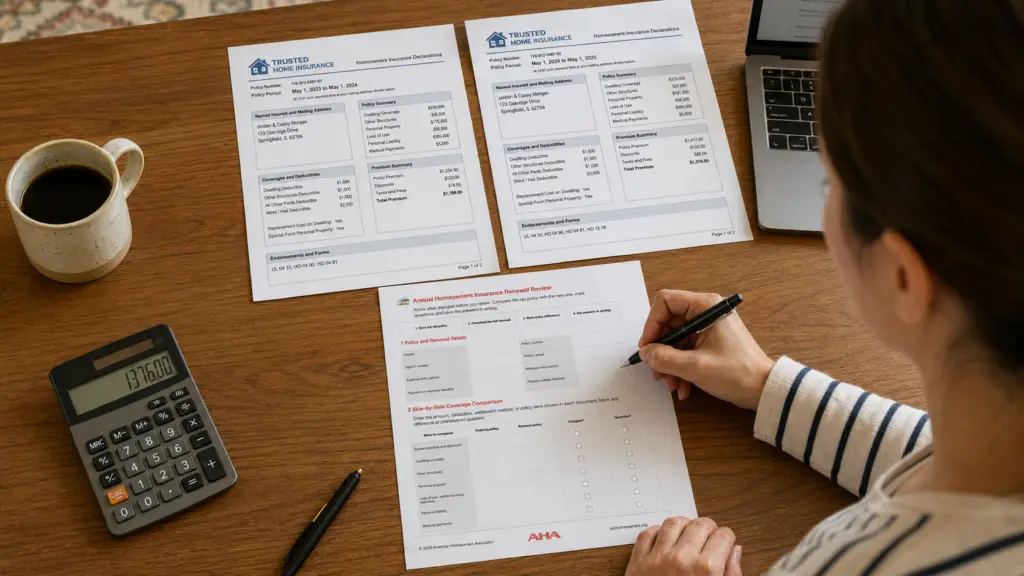
This homeowners insurance renewal checklist will help you compare the old policy with the new one, spot changes worth asking about, and save the answers in writing—without trying to become an insurance expert.
Quick Answer: What Should You Check at Renewal?
Compare the old and new declarations pages, read every change notice, and review the forms and endorsements listed for each policy period. Check your coverage limits, sublimits, deductibles, claim-settlement terms, discounts, property information, and any new conditions. Ask the insurer to explain every difference in writing before the renewal deadline.
Can Homeowners Insurance Change at Renewal?
Yes. A renewal can feel like a continuation of the policy you already have, but it begins a new policy period—and some of the rules may have shifted.
One place those changes can appear is in an endorsement, sometimes called a rider. An endorsement is an amendment to the insurance contract. It can add coverage, remove it, exclude certain losses, change a limit, or revise another part of the policy. Endorsements may be issued when a policy is purchased, during the policy term, or at renewal. (NAIC: Insurance Endorsements and Riders)
Think of the main policy as the original set of house rules. An endorsement is an attached page that can rewrite one of those rules. The older wording may still appear in the policy booklet, but the endorsement can change how that part of the contract works.
That doesn’t make every endorsement bad. Some expand coverage. Others tailor a policy to a particular home or add protection you requested. The important question is whether an endorsement is new, removed, or revised—and what that means for you.
For a broader explanation of coverage terms, start with AHA’s Homeowners Insurance Coverage Essentials.
Watch Out: A familiar insurer, similar premium, or automatic mortgage-escrow payment doesn’t confirm that your coverage stayed the same.
Your Homeowners Insurance Renewal Checklist: Four Documents to Compare
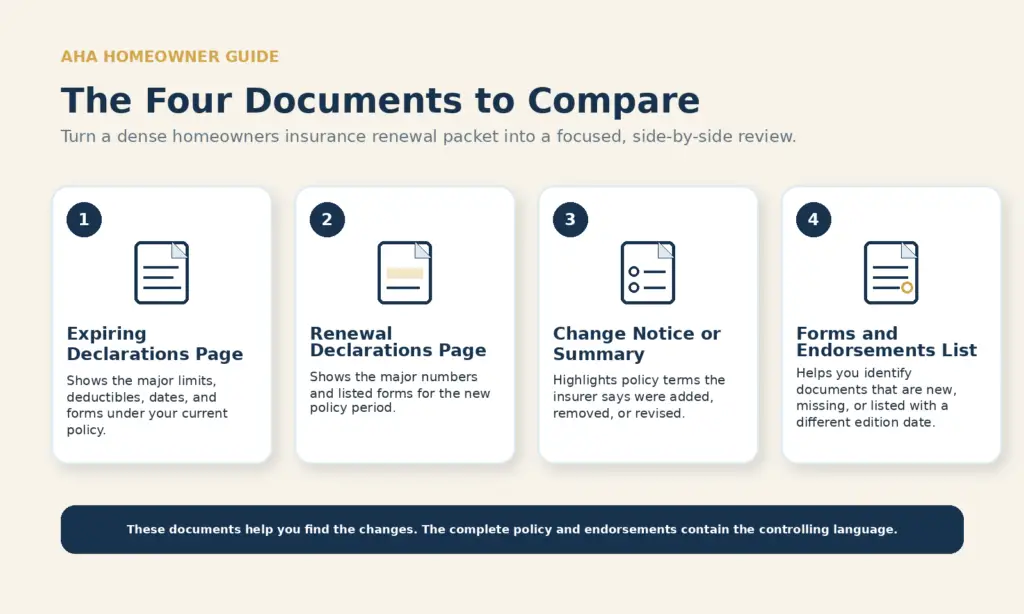
Don’t begin with a cover-to-cover policy read. Start by gathering four documents:
- Your expiring policy’s declarations page
- Your renewal declarations page
- Any notice or summary describing changed terms
- The forms and endorsements lists for both policy periods
Think of the declarations page as your policy dashboard. It generally shows the insured property, policy dates, major coverages, limits, premium, discounts, deductibles, lienholder, and listed endorsements. It’s a useful starting point, but it doesn’t contain every rule behind those numbers. (NAIC: Understanding Your Homeowners or Renter’s Policy)
Keep the old policy until you’ve completed the comparison. Without it, you can see what the renewal contains—but not necessarily what changed.
If your renewal email or online account includes only an invoice or short summary, request the complete renewal policy and all listed forms from your agent or insurer.
Pro Tip: Download the documents instead of assuming they’ll remain available in your online account. Save them in a folder labeled with the insurer and policy period.
What Should You Compare Before You Renew?
Once you have the documents, put the old and new declarations pages side by side.
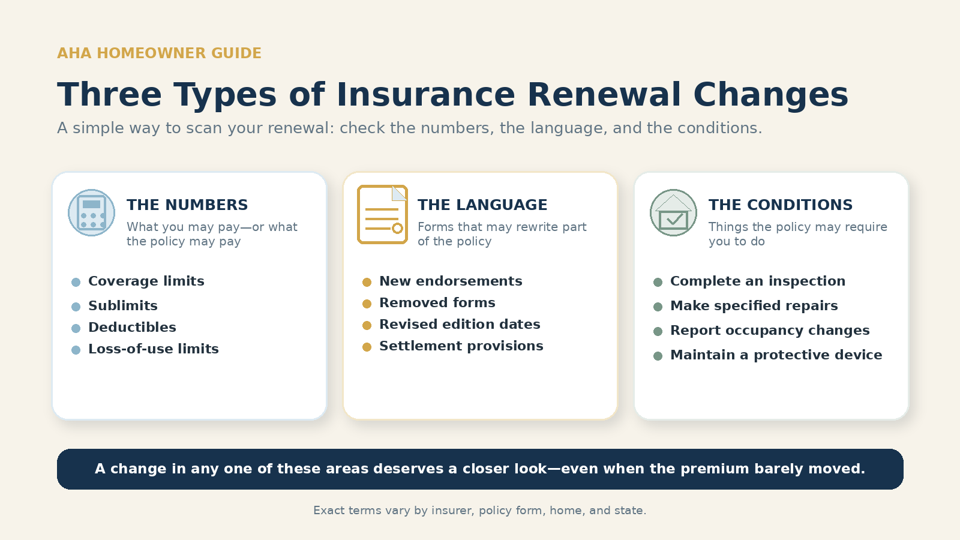
Start with the numbers. Then compare the forms. Finally, look for new conditions involving the home or something you’re required to do.
That order keeps you from getting lost in policy wording before you know which parts actually changed.
Compare the Policy Details and Numbers
First, confirm that the basic information is correct. Check the names of the insureds, property address, lender information, policy dates, and agent or insurer contact information.
If the renewal includes a property-information summary, look for details such as the home’s square footage, construction type, roof information, occupancy, or major systems. An incorrect property detail could affect pricing or the insurer’s understanding of the home.
Then compare the financial protection underneath the premium:
| What to Compare | What to Look For | What to Ask |
| Policy dates and property details | Effective dates, address, named insureds, lender, and home information | Are the listed facts accurate, and when must I respond? |
| Premium and discounts | Total premium and discounts added or removed | Did the price change because of rates, coverage, deductibles, property information, or a lost discount? |
| Major coverage limits | Dwelling, other structures, personal property, loss of use, and liability | Did any major limit increase or decrease? |
| Deductibles | Flat-dollar, percentage, wind, hail, hurricane, roof, water, or other deductibles | Which deductible applies to which loss, and what would it equal in dollars? |
| Sublimits and settlement terms | Smaller caps for specific losses and replacement-cost or actual-cash-value wording | Is any category now subject to a lower cap or different payment method? |
| Forms, endorsements, and conditions | Added, removed, or revised forms; inspections; repairs; occupancy rules | What does each change do, and is there anything I must complete? |
A sublimit is a smaller cap inside the larger policy. You might have a substantial dwelling limit while one category of damage is subject to a much lower amount.
That distinction is especially important with water losses. Water inside a home isn’t treated as one universal insurance category. The source, path, timing, and relevant endorsement can all matter. AHA’s guide to water damage coverage explains the broader coverage questions homeowners may encounter.
When a deductible is expressed as a percentage, don’t assume it’s based on the home’s market value. Ask which policy amount the percentage applies to and request confirmation of the potential deductible in dollars.
Compare the Forms and Endorsements
The forms schedule may look like a string of numbers, titles, and edition dates. You don’t need to understand every code immediately. Begin by looking for differences.
Slow down when you find a form that:
- Appears on the renewal but not the old policy
- Was listed before but is now missing
- Has a different title or edition date
- Includes words such as limitation, exclusion, deductible, actual cash value, water, roof, mold, backup, vacancy, or protective device
Seeing one of those words doesn’t prove you lost coverage. It tells you where to ask a focused question.
Imagine that the annual premium rises only a little. Nothing about the renewal feels dramatically different. Then you compare the forms lists and notice a new roof-settlement endorsement.
The title alone may not explain how a future claim would be handled. But it tells you exactly which document to request and what to ask about.
Check for New Policy Conditions
Not every important change appears as a dollar amount.
A renewal may include conditions involving an inspection, specified repairs, roof condition, occupancy, vacancy, extended absences, protective equipment, or notice you must give the insurer after a household or property change.
Ask whether the renewal requires you to do anything by a particular date. A new condition matters only if you know it exists and understand what satisfying it involves.
When the renewal has changed enough that you’re considering another insurer, AHA’s guide to choosing the right home insurance policy can help you compare the protection—not just the annual price.
Download: AHA Annual Homeowners Insurance Renewal Review
What Questions Should You Ask Your Insurance Agent?
A broad question such as “Did anything change?” may produce a broad answer.
A more specific written request makes it easier for the insurer or agent to identify the relevant forms and explain them clearly.
You can copy and send this message:
Please identify every endorsement, exclusion, deductible, limit, sublimit, claim-settlement term, policy condition, or listed form that differs from my expiring policy.
- Has coverage involving water damage, sewer or drain backup, mold, roof damage, personal property, or additional living expenses changed?
- Has any coverage changed from replacement cost to actual cash value, or has the process for receiving replacement-cost benefits changed?
- Are there new inspection, repair, occupancy, vacancy, protective-device, maintenance, or notification requirements?
- Are broader coverage options available, and what would they cost?
Please send me the relevant form numbers, complete policy language, and your explanation in writing.
A phone conversation can still be helpful. A written response gives you something to save with the policy and review later.
Remember that a general description of what an insurer “normally” covers isn’t the same as an answer based on your current policy and endorsements.
What if You Already Paid the Renewal?
Already paid? Start with clarity, not panic.
State rules differ, and paying the premium may affect your options. But you can still request the complete current policy, identify what changed, and ask whether other coverage choices are available now or at the next renewal.
Request:
- The complete policy currently in effect
- Every endorsement listed on the declarations page
- The notice or summary describing changed terms
- The effective date of each change
- A written explanation of the options currently available
When the insurer’s explanation remains unclear, use the NAIC directory of state insurance departments to find your regulator’s consumer-assistance and complaint resources.
When damage has already happened, you’re no longer dealing with only a renewal review. The policy wording, facts of the loss, documentation, and deadlines may all matter.
AHA’s guide to a denied or disputed home insurance claim explains how to organize the insurer’s decision, policy language, photographs, estimates, and written communications.
Already managing a loss? Use the AHA Homeowners Insurance Claim Toolkit to organize photographs, receipts, estimates, expenses, and insurer communications.
Florida Example: Look for a Notice With a Specific Name
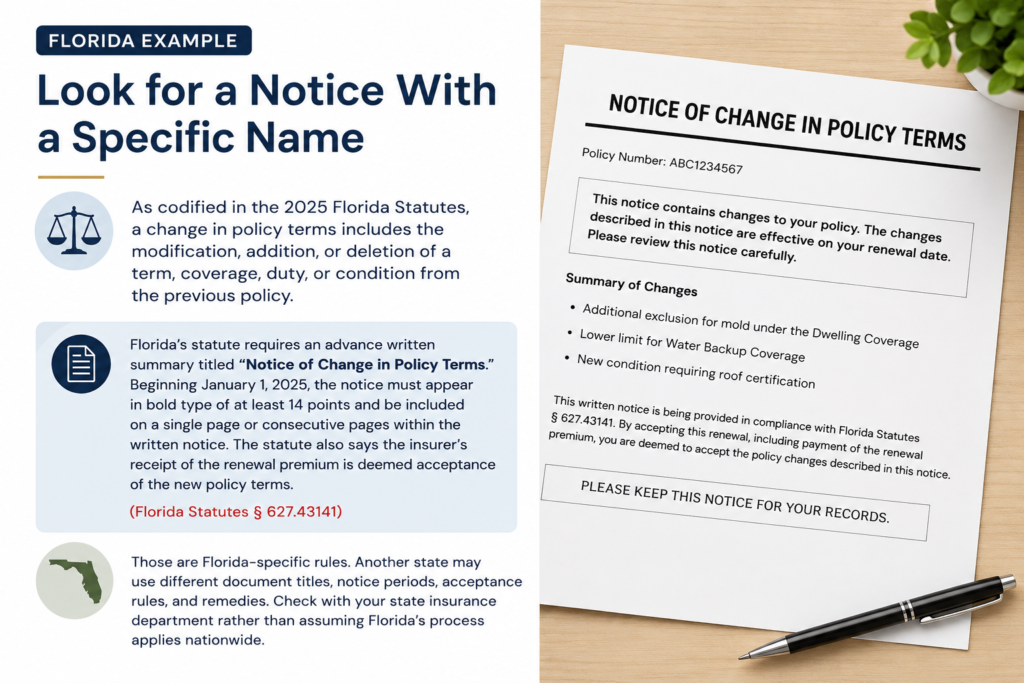
As codified in the 2025 Florida Statutes, a change in policy terms includes the modification, addition, or deletion of a term, coverage, duty, or condition from the previous policy.
Florida’s statute requires an advance written summary titled “Notice of Change in Policy Terms.” Beginning January 1, 2025, the notice must appear in bold type of at least 14 points and be included on a single page or consecutive pages within the written notice. The statute also says the insurer’s receipt of the renewal premium is deemed acceptance of the new policy terms. (Florida Statutes § 627.43141)
Those are Florida-specific rules. Another state may use different document titles, notice periods, acceptance rules, and remedies. Check with your state insurance department rather than assuming Florida’s process applies nationwide.
Keep One Simple Annual Insurance Record
You don’t need an elaborate filing system. Create one digital or paper folder for each policy year and keep four groups of information together:
- The complete policy, declarations page, and endorsements
- Change notices and written answers from the insurer or agent
- Your home inventory and photographs
- Records of major improvements to the roof, plumbing, electrical, heating, cooling, security, or other insured features
The National Association of Insurance Commissioners recommends reviewing homeowners coverage annually and revisiting it when renovations, purchases, security equipment, or other household changes may affect coverage.
That folder gives you something useful at renewal, after a major improvement, and if you ever need to document a loss.
You don’t have to create a perfect record in one weekend. Save the renewal documents now. Add your written questions. Update the home inventory one room at a time.
Know What You’re Buying This Year
Renewal documents are easy to skim because so much of them looks familiar. Missing a change doesn’t mean you’re careless. It means insurance paperwork asks for attention at exactly the time most of us are trying to finish another task and move on with the day.
A side-by-side review gives you a better question than, “Did my premium go up?”
It lets you ask:
What protection am I buying this year?
Save the old policy. Compare the new one. Ask about anything that changed, and keep the answer in writing.
You may never need to rely on that particular provision. But if you do, it shouldn’t be the first time you learn it exists.
Download the Annual Homeowners Insurance Renewal Review to compare your policy limits, deductibles, endorsements, and conditions in one place.