

When part of your home is damaged and you’re waiting for repairs to get things back to normal, time can feel like it’s moving differently.
A week with bare subfloor in the hallway feels longer than an ordinary week. Furniture piled into the dining room makes every meal a reminder that things aren’t back to normal. Three months later, you may be wondering: Is this a complicated repair—or an insurance claim taking too long?
You don’t need to become an insurance expert to get a clearer answer. Start by separating the unfinished repair from the unfinished insurance decisions. They may be connected, but they aren’t necessarily waiting on the same person.
Here’s how to find the bottleneck, ask a useful question, and recognize when the wait deserves closer attention.
Is Your Insurance Claim Taking Too Long?
Three months alone doesn’t tell you whether a claim has been improperly delayed. You need to know what remains unresolved, who needs to act, and which requirements apply.
“How long does a homeowners insurance claim take?” can mean time to inspect damage, decide coverage, issue payment, or finish repairs. Those are different stages, not one shared deadline.
Claim-handling requirements vary by state, policy, and circumstances. There isn’t one nationwide deadline for completing the entire process. That doesn’t mean you have to accept an indefinite “we’re working on it.” You can ask for a specific explanation—and seek guidance about the rules that apply.
Watch Out: A clear explanation and visible progress don’t prove that the insurer has met applicable deadlines. Unfinished repairs also don’t establish, by themselves, that the insurer caused the delay.
A Slow Repair Isn’t Necessarily a Stalled Claim
Imagine a leak damages your kitchen and hallway flooring. After drying and removal of the damaged flooring, the contractor discovers that part of the subfloor also needs repair.
The original estimate no longer describes all the work. The contractor submits photographs and a revised estimate, sometimes called a supplement—a request to account for additional work or cost. The adjuster confirms receipt and begins reviewing it.
Your floor is still unfinished, but you now know which decision is pending. Later, if the repair scope—the work needed—is agreed on but replacement flooring hasn’t arrived, the next question belongs with the contractor or supplier.
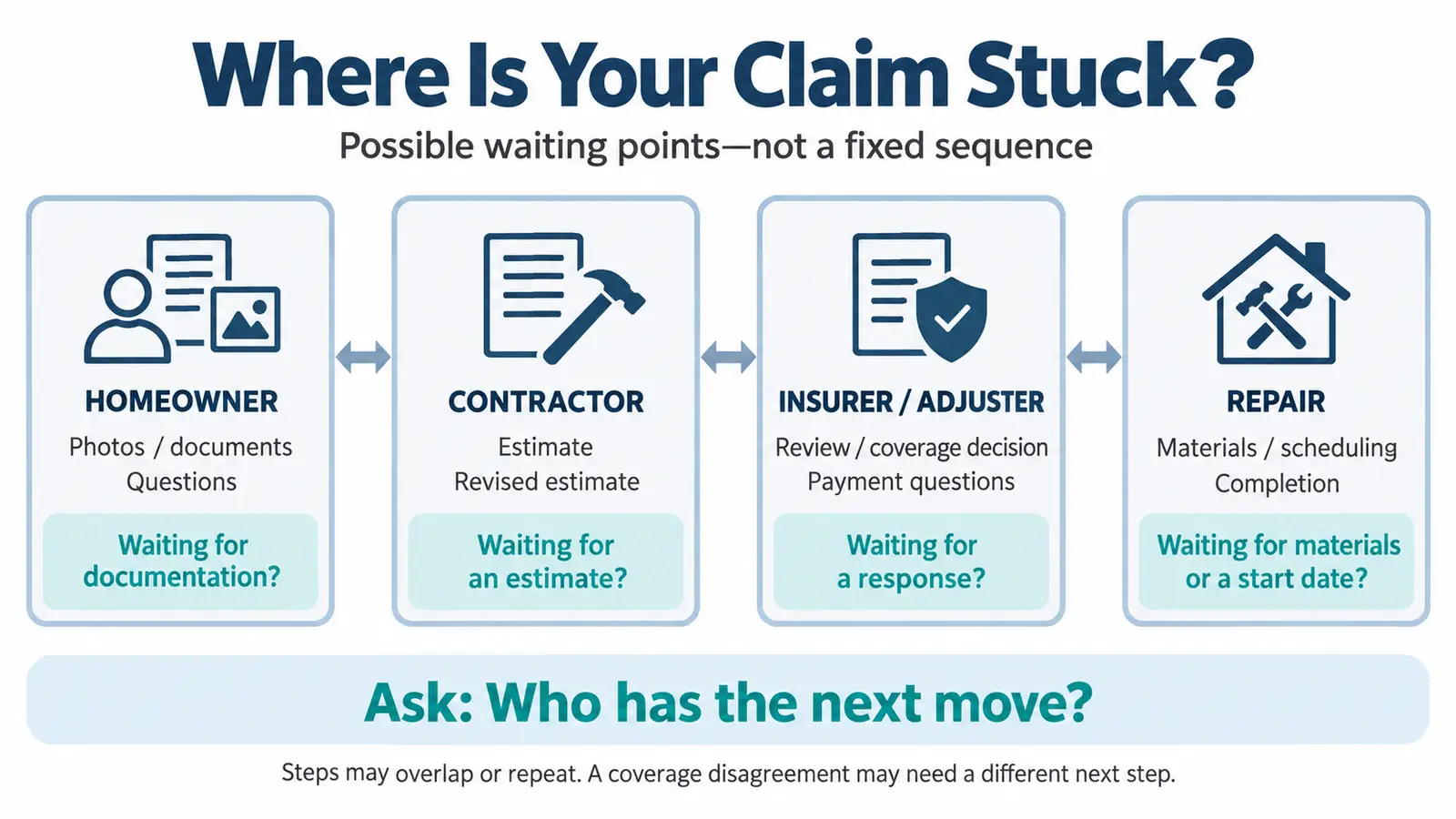
The same unfinished room can reflect different waiting points. Finding the current one helps you contact the right person without retelling the whole story.
Payment can involve another handoff. One check may cover only part of the settlement, and some repair checks include a mortgage lender. Ask what a payment covers, what remains outstanding, and whether lender handling is needed.
For the broader process, AHA’s How to Handle Home Insurance Claims the Right Way explains how claims move through repairs and payments.
Find Out Who Has the Next Move
Think of the process as a relay: someone has the next move, even if nobody has explained it clearly.
“Under review” tells you a status. It doesn’t identify the remaining question, whether the right documents arrived, or when you’ll hear more. Those details are what make a follow-up useful.
Try this short message:
For claim [number], what specifically remains unresolved, who is responsible for the next step, and when should I expect it? Please confirm receipt of [document], sent on [date], and identify anything else needed from me or my contractor. If you can’t estimate completion, what is the next milestone and when should I check back?
An expected update date isn’t necessarily a decision or payment date. Ask which one the adjuster means.
If the adjuster is waiting for an estimate your contractor says was sent, confirm the submission date, recipient, and receipt. If something is missing, ask exactly what it is and where it should go. That turns “we’re waiting on each other” into a specific handoff you can follow up on.
Protect Your Home and Keep Track of the Claim
The paperwork can remain unresolved while your home still needs attention. Temporary protection and permanent repair decisions are separate concerns.
The National Association of Insurance Commissioners (NAIC) recommends documenting damage when safe, taking reasonable temporary protective steps, and saving receipts. Don’t delay urgent protective action to take photos or await a routine claim response. Seek qualified help for active water damage or unsafe conditions; don’t enter unsafe areas or attempt hazardous cleanup yourself.
Before nonurgent removal of damaged materials or major permanent repairs, ask whether the insurer still needs an inspection or other documentation. Keep records of protective work, but don’t assume every expense will be reimbursed.
Once a claim stretches into months, dates start blending together. Was the revised estimate sent last Tuesday or three Tuesdays ago? Was someone supposed to call Friday?
One running note is enough to capture the important events: the loss, inspections, requests and submissions, payments, and promised follow-ups. Record the date, person involved, and next action. Save the related estimates, photos, receipts, and messages together.
Pro Tip: After a phone call, send a brief recap: “My understanding is that you received the revised estimate Tuesday and expect to update me Friday. Please let me know if I misunderstood.” You’ll have a shared reference for the next conversation.
When the Wait Deserves Closer Attention
A missed update is worth following up on. Repeated missed commitments, unanswered messages, or requests for documents already confirmed as received deserve closer attention.
Start with the specific commitment. Reply in the same email thread with your claim number, the expected update date, and a request for the current status and a new contact date. If a document is involved, include when you submitted it and any receipt confirmation.
If you still can’t get a useful answer, ask for a claims supervisor or the insurer’s complaint contact. Keep the request factual: what remains unresolved, what information you supplied, and which commitments were missed. Say what you need next, such as a written explanation or clarification of a pending decision or payment.
The NAIC’s guidance on insurance complaints explains that state regulators can investigate concerns such as unfair delays or lack of timely communication. For a complaint, gather your policy and claim details, relevant correspondence, a short timeline, and the outcome you’re seeking.
Use the NAIC insurance department directory to find your state’s department and complaint process. You can also contact the department sooner to ask about applicable rules; you don’t have to wait for an arbitrary number of days or unanswered messages.
Regulatory contact doesn’t guarantee coverage, payment, or a repair completion date.
If the Answer Is a Disagreement, Treat It as One
Sometimes an update reveals that the insurer has answered, but the answer doesn’t match what your contractor says is needed.
For a repair-scope or cost disagreement, ask which items differ between the contractor’s estimate and the insurer’s estimate. Are they using different measurements? Is newly discovered damage missing? What supporting information would help the insurer review those items?
Submitting a revised estimate doesn’t mean the insurer has agreed to pay it. Identifying the disputed item is more useful than continuing to ask whether the whole claim is “moving.”
If the insurer denies coverage for some or all of the loss, request the decision and policy explanation in writing. AHA’s Home Insurance Claim Denied? What Homeowners Can Do Next addresses that separate path.
One Useful Step You Can Take Today
You don’t have to solve every remaining repair question today. Start with one unresolved item: what is pending, who has the next move, and when you should follow up.
If keeping the records together would help, AHA’s Homeowners Insurance Claim Toolkit includes printable logs, receipt and communication organizers, and scripts.
Living around an unfinished floor is exhausting. A clear next step won’t end the disruption immediately, but it tells you whom to contact and what to ask for.