

You open a utility bill and wonder whether your house really needed that much energy last month. Or maybe the bill seems reasonable, but the bedroom over the garage is cold every winter and uncomfortable every summer. It is tempting to jump straight to a solution: new windows, more insulation, perhaps a new heating-and-cooling system.
But those can be expensive guesses.
A home energy audit can be valuable when it helps you understand the problem before you spend money trying to fix it. You can begin with a DIY review of what you can safely observe. When the cause is still unclear—or you are considering a significant improvement—a professional assessment can help you ask better questions before you commit.
The goal is not to make your house perfectly efficient. It is to decide what is worth investigating, fixing, planning, or monitoring.
The short answer: diagnose before you buy
A home energy audit can be worth it when you have persistent comfort concerns, unexplained drafts, energy use that you want to understand better, or a major efficiency project in front of you. If an aging system is part of that decision, Home Systems Lifespan can help you put its age in context before treating replacement as the answer. Its value is not a guaranteed bill reduction. Its value is better information.
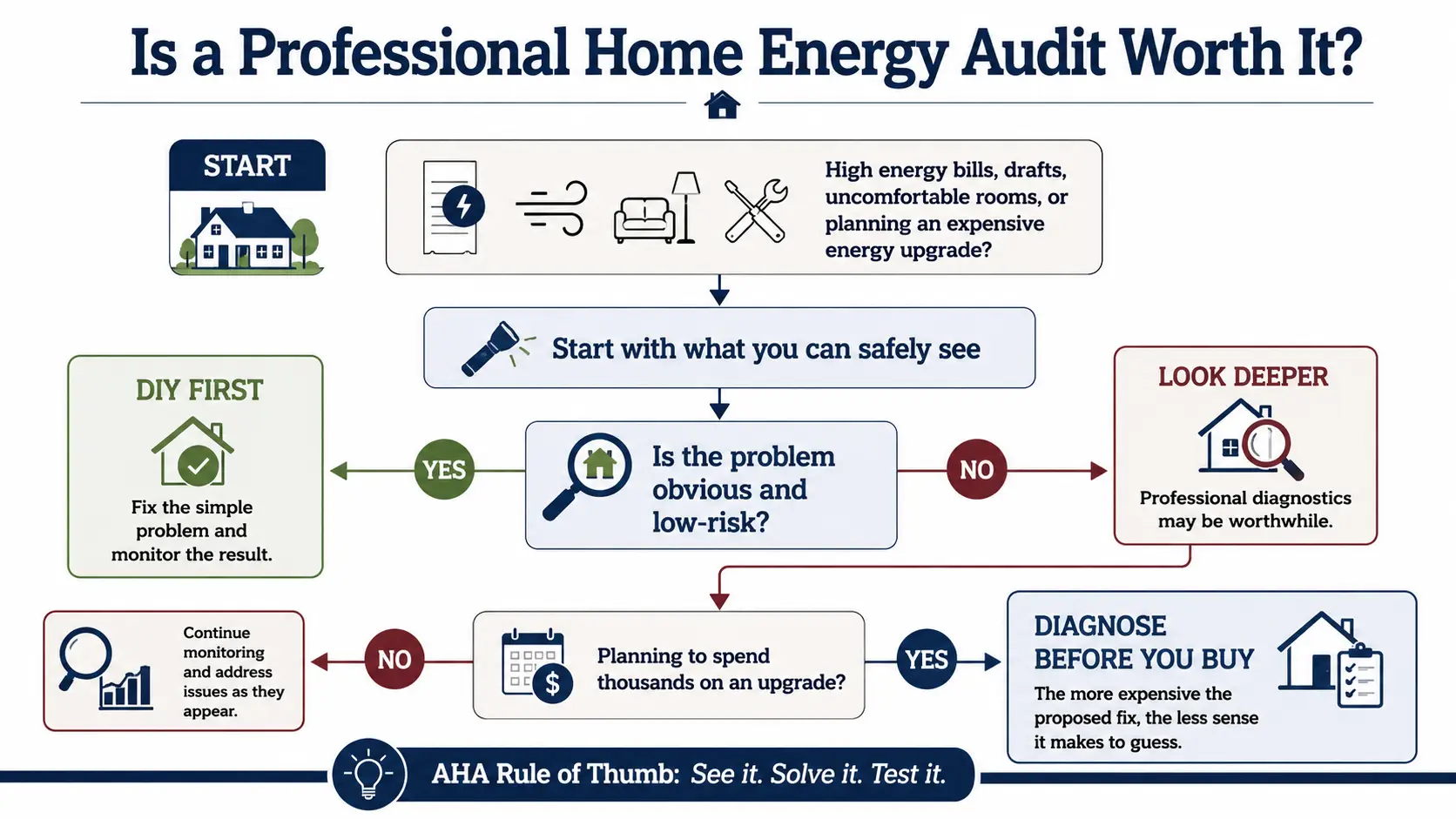
Start with what you can safely see. Notice which rooms feel uncomfortable, when the problem occurs, whether a register is blocked, or whether a door seal is visibly worn. Address simple, low-risk issues you can identify with confidence. If the problem remains unclear, becomes technical, or sits behind a large purchasing decision, that is when professional diagnostics may be worth paying for.
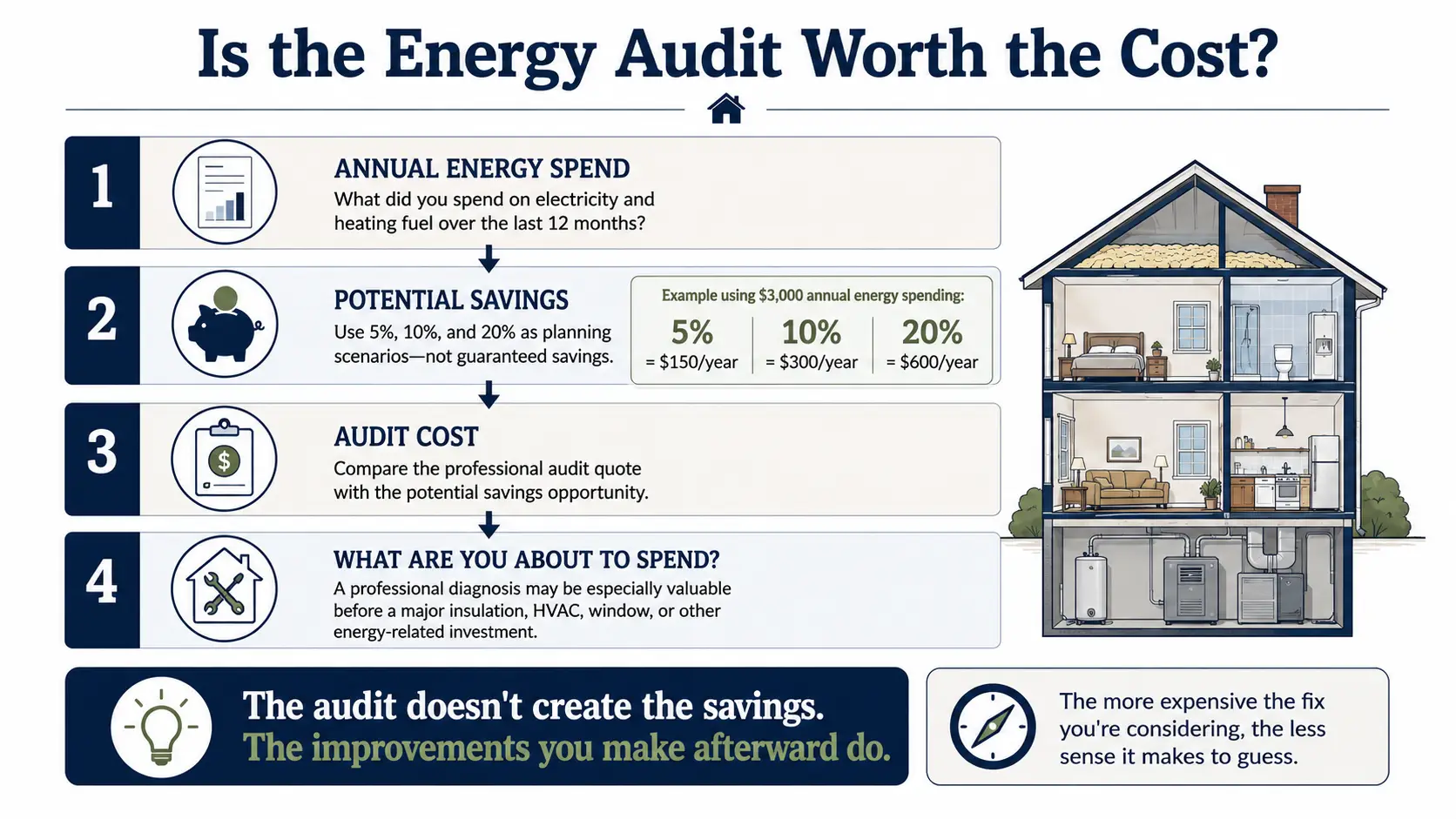
> AHA rule of thumb: The more expensive the fix you are considering, the less sense it makes to guess.
What a professional energy assessment is meant to do
Think of a professional assessment as a whole-home decision tool, not a shopping list. ENERGY STAR describes a home performance assessment as including a conversation about comfort concerns and household patterns, a review of energy bills when available, an evaluation of the home and its systems, safety checks and testing, and prioritized recommendations. Providers and homes vary, so ask what is included before you book. ENERGY STAR’s overview of a home performance assessment is a useful benchmark for that conversation.
The important part is not the equipment list. It is the diagnosis. You want to come away with a clearer view of which problems matter, which questions remain open, and what your next home-improvement dollar is actually trying to solve.
For example, a cold bedroom might make replacing a window look like the obvious answer. But the decision should not rest on one visible clue. The homeowner’s useful next step is to understand whether the concern calls for a straightforward correction, another quote, or a more complete assessment.
DIY first or professional testing?
You do not have to choose between doing everything yourself and hiring an expert before you have looked around. For many homeowners, the practical path is sequential: see it, solve what is straightforward, then test what remains unclear.
Use the AHA DIY Home Energy Audit Checklist to collect clues. Write down comfort concerns, gather recent energy bills if you have them, and note visible issues that are clearly low-risk. For more practical steps after you identify the issue, see How to Lower Utility Bills. A bill-based comparison can also give context, but it is not a diagnosis. ENERGY STAR says its Home Energy Yardstick is not meant to replace a professional energy audit.
Professional evaluation is a better fit when the clue is not the cause, when technical testing is proposed, when a safety concern is involved, or when the next project would be large enough that guessing could be expensive. Do not attempt combustion, electrical, HVAC, ventilation, or moisture diagnostics yourself. If you have a safety concern or an unclear finding, seek qualified evaluation.
What should you ask before booking?
The price alone does not tell you whether two assessments are comparable. Ask each provider for a written scope, then compare the answers to the same questions:
- What comfort or energy-use concerns will you investigate?
- What will the visit and written report include?
- Which observations, tests, or assumptions will support the recommendations?
- Will recommendations be prioritized? Will the report explain tradeoffs or cost-benefit reasoning?
- Are you also bidding on the recommended work? If so, how can I compare the diagnosis and installation proposal separately?
- Are there local programs I should verify directly before deciding?
The Building Performance Institute’s current home-energy-auditing standard summary describes a whole-building assessment and an audit report with prioritized recommendations and cost-benefit analysis. That is not a promise that every provider follows the same standard, but it is a helpful reference point for the kind of report you want. Read BPI’s standard summary.
Compare the audit cost with the decision in front of you
You should not need a quote in hand before you can decide whether it is worth asking for one. The U.S. Department of Energy’s consumer guide says a professional home energy assessment can cost about $250 to $600 or more. Treat that as a national planning range—not a local price promise. Scope, diagnostics, home conditions, location, and utility or state programs can change the amount you actually pay. Read DOE’s consumer guide.
Start with your last 12 months of energy spending. The calculator below translates 5%, 10%, and 20% post-improvement planning scenarios into dollars for your household. It does not predict what an audit will find or what your home will save. Its purpose is to put the audit and the possible opportunity in the same frame before you make a larger decision.
Do not let the calculator guess at a repair or renovation budget. The appropriate work may be simple air sealing, insulation, duct work, ventilation or moisture corrections, equipment work, or no major project at all. A good assessment should prioritize the measures, explain the tradeoffs, and provide the project-specific inputs you need to evaluate them.
Home Energy Audit Value Calculator
Start with your annual energy spending. This tool shows an audit-cost planning range and illustrative post-improvement scenarios for your home; it does not predict savings or tell you which repair to make.
Actual results depend on the home, climate, utility rates, equipment, and the improvements selected. Check local utility and state programs before assuming you will pay full price.
Use simple payback as a comparison—not a promise
Simple payback is a way to organize a conversation. Divide the installed cost of an improvement by the annual savings estimate used for planning. The result is an estimated number of years, based on that estimate, before the savings would equal the installed cost.
For example, a hypothetical $600 improvement paired with a hypothetical $150 annual savings estimate would have a four-year simple-payback calculation. The arithmetic is simple; the assumptions are not. Results can differ with household use, weather, energy prices, the condition of the home, installation quality, and the assumptions in a model.
Use payback to compare possibilities on the same page. Do not treat it as proof that a project will deliver a particular result. A project with a long estimated payback may still be a reasonable choice for comfort, maintenance, replacement timing, or another homeowner priority. The point is to make the tradeoff visible.
Lower bills are not the only reason to investigate
Sometimes the useful outcome is not a number on a utility bill. A room that is consistently uncomfortable, recurring condensation, or a system that does not appear to keep parts of the home comfortable can be a reason to ask for clearer information.
Keep the boundaries clear. A DIY observation can identify a clue; it does not establish the cause. A professional recommendation can help you decide what to investigate; it does not mean every suggested project should be approved immediately. Separate findings into three groups: straightforward items you understand, items that need a clearer quote or explanation, and larger projects that deserve more time or another opinion.
> Watch out: If a finding involves moisture, ventilation, electrical, gas, combustion, structural conditions, or major HVAC work, ask which qualified professional should evaluate it. Do not use an energy-audit article as a substitute for that evaluation.
What should you do with the results?
Do not finish an assessment with a list of findings and assume you have a list of expenses. Prioritize them.
- Address now: clear, time-sensitive concerns that are within the appropriate professional’s scope.
- Plan next: larger work that needs a better quote, more context, or coordination with another project.
- Monitor: observations that need documentation or attention if they change.
This approach keeps a small problem from becoming an expensive investigation—and helps keep a complicated problem from being treated with a cheap guess.
A note on incentives and tax claims
Local utility, state, and other programs can change, and eligibility may depend on location, timing, contractor requirements, or prior approval. Verify any program directly with the responsible organization before making a decision.
For federal tax context, the IRS says the Energy Efficient Home Improvement Credit is not allowed for property placed in service after December 31, 2025. That is general information, not tax advice; individual circumstances may differ. Check the IRS’s current guidance before relying on any tax claim.
Frequently asked questions
Is a home energy audit worth it?
It can be, particularly when the problem is unclear or a significant expense is on the table. Its value is in helping you make a better decision, not in guaranteeing a specific savings result.
How much does a professional home energy audit cost?
The useful answer is local. Ask for written scopes and quotes, then compare what each assessment includes and the size of the decision you are trying to make. Do not assume a national price range tells you whether a specific assessment fits your home.
Can I do a home energy audit myself?
You can start with safe observation and simple, visible issues. A DIY review is a good way to gather clues and decide whether deeper testing is worthwhile. It is not a replacement for qualified evaluation of technical or safety concerns.
Will an audit tell me exactly what I will save?
No. A thoughtful report may include estimates, but estimates depend on assumptions. Ask what assumptions were used, compare scenarios carefully, and treat the result as decision support rather than a promise.
Understand the house before you buy the fix
A home energy audit is not about chasing a perfect score or turning your home into a science project. It is about replacing guesses with better information.
Start with the clues you can see. Solve what is simple. Test the problems that stay unclear. Before you spend heavily on an upgrade, make sure you understand the problem you are actually solving.