
You open your homeowners insurance renewal notice expecting a premium update. Instead, it says your roof needs to be replaced. The roof isn’t leaking, and replacement wasn’t in this year’s budget. Your first instinct may be to call a roofer or push back on the insurer’s decision. Either could be appropriate, but first slow down and understand what the insurer saw and what it is asking you to do.
If your insurer says you need a new roof, start by finding out what the decision is based on. You don’t need to diagnose the roof yourself. You need to know what the insurer saw, what it requires, and when your coverage could change.
You may ultimately need a replacement. But a vague notice isn’t enough to understand why. Asking for the evidence gives you a clearer starting point without losing sight of the deadline.
The short answer: Request the written reason, inspection findings or images and their dates, the roof age and material on file, the policy or underwriting requirement, and the exact deadline. Then ask what updated documentation the insurer will consider and whether repair, reinspection, or an extension is an option.
First, Find Out What the Insurer Is Actually Saying
“Your roof needs replacing” describes work. It doesn’t tell you what is happening to your insurance.
The company may be setting a condition for issuing or renewing coverage. It may be changing how future roof damage would be covered. Or it may be notifying you that the policy will end. A nonrenewal ends coverage when the policy term expires; cancellation ends it before that scheduled date. Those actions have different rules, so have your insurer or agent identify which one the notice describes.
Confirm the date you must respond or finish work, the date any coverage change takes effect, and what happens if you don’t meet the requirement. If a date is close or unclear, contact the insurer promptly while you gather records.
Watch Out: A roof requirement is not automatically a claim. Being told to replace a roof to keep insurance does not mean the policy will pay for it. A claim concerns damage that may be covered under your policy, not replacement simply because a roof is old or worn. Payment depends on the policy and facts of the loss. If you are dealing with damage and a claim, the AHA Homeowners Insurance Claim Toolkit offers claim-specific guidance rather than a way to overturn an underwriting requirement.
What Evidence Should You Ask Your Insurer For?
“Poor roof condition” gives you a conclusion, but not much to work with. Ask the insurer to identify the specific concern and the information behind it: the inspection report, photographs, aerial or drone images, and any vendor data it relied on.
The next question is easy to miss: When and how was the roof evaluated? Find out whether someone physically inspected it, reviewed images, or used a combination. Ask for the collection date, not just the date the notice was sent.
Remote imagery isn’t automatically wrong, but its date and the finding it supports matter. The Connecticut Insurance Department notes that many insurers review updated information when roof images or inspection data are outdated or incomplete. That makes the image date worth checking before you pay for another assessment.
Imagine the image predates your roof replacement. A dated invoice lets you raise a specific discrepancy: “Does this decision reflect the roof currently on the house?” That is more useful than debating how the roof looks from the driveway.
Ask what condition was observed, where it appears, and why it leads to the requested work. If the insurer requires replacement, have it explain why repair or updated documentation would not address the concern.
You can request this information without assuming a universal right to every underwriting record. Disclosure requirements and review procedures vary by state, insurer, policy, and notice type.
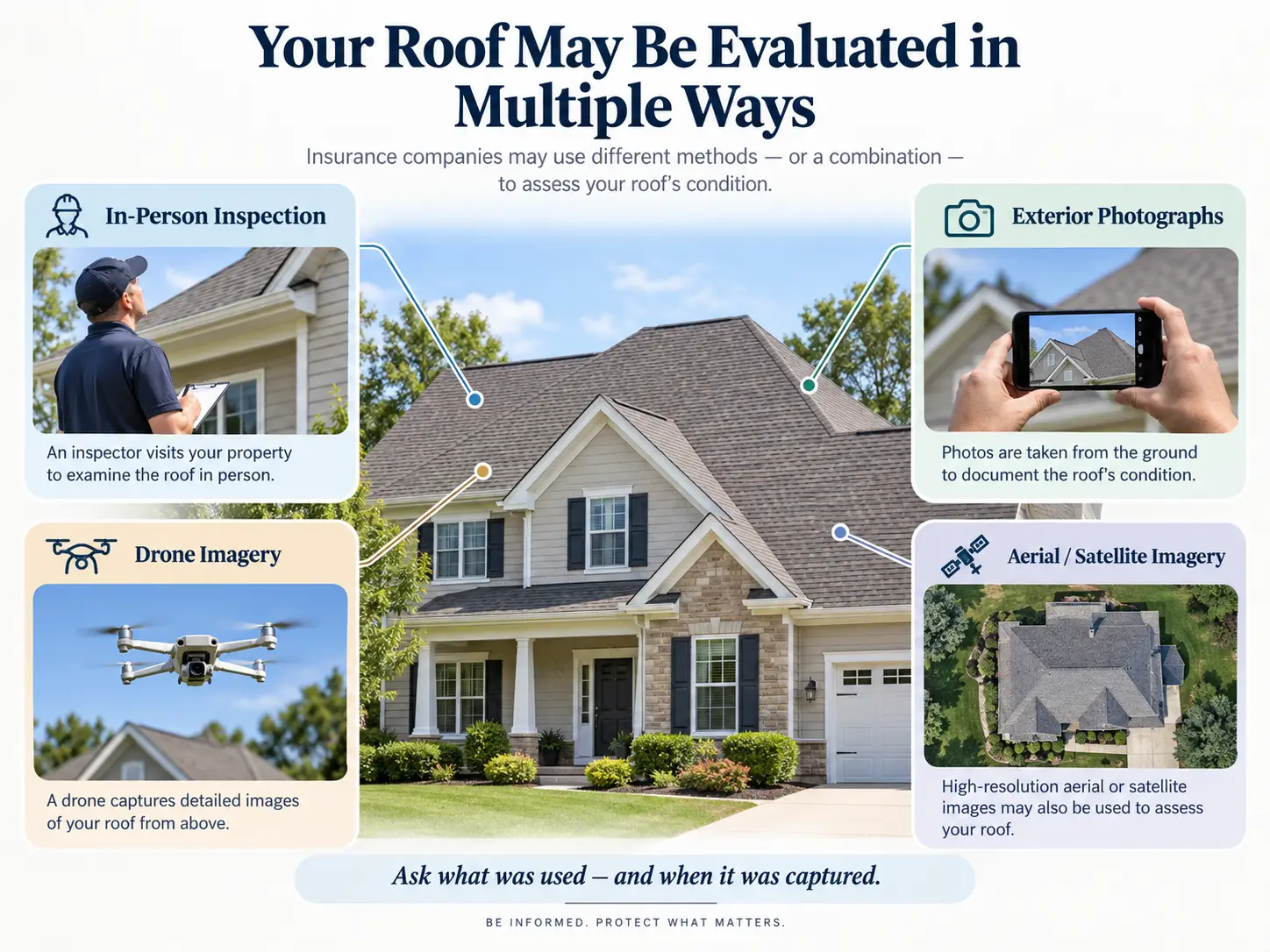
Illustrative evaluation methods. Ask which information your insurer used, when it was collected, and what finding it supports.
Separate Roof Age, Roof Condition, and the Insurance Rule
Before debating whether the roof is too old, check the age and material in the insurer’s file. If they are wrong, submit records that address the discrepancy. If remaining useful life is part of the decision, ask what estimate the insurer used and how it reached it.
A roofing professional and an underwriter may be answering different questions. One assesses the roof’s physical condition and appropriate work. The other decides whether the property meets the company’s insurance requirements, subject to applicable law. A report that says “no active leak” may not answer the concern in an underwriting notice.
Ask for the policy term, endorsement, or underwriting rule being applied. An endorsement changes policy terms. Keep that explanation beside your notice and policy so you can see whether this is about keeping coverage, changing coverage, or payment after a loss. For unfamiliar policy terms, AHA’s Homeowners Insurance Coverage Essentials provides background.
State rules can affect whether roof age alone justifies an insurer’s action and what review options are available. Before relying on advice from someone in another state, ask your own insurance department which rules apply to the notice you received. Have the notice and the insurer’s written explanation available so the question is about your situation, not roof age in the abstract.
Gather Records That Answer the Actual Concern
Start with what you already have: replacement or repair invoices, earlier inspection reports, and dated photographs. Permit or warranty paperwork may also help identify work or materials, but check what each document actually establishes. You don’t need a perfect roof history, and an unknown installation date should stay unknown until you can document it.
Think of this as comparing two files about the same roof. The insurer has information supporting its concern. You have records that may confirm it, correct an error, or show what has changed. More paperwork isn’t automatically better; the useful record answers the disputed point.
If the disagreement concerns current condition, ask what professional qualifications and report format the insurer accepts before paying for another assessment. Have the professional document findings and photographs, not simply write “roof looks good.” A replacement estimate describes proposed work and cost; it may not explain the condition that prompted the notice.
Watch Out: Don’t climb onto the roof to gather evidence. Use existing records and photos taken safely from the ground, and leave roof-level inspection to qualified help. An active leak or apparent damage deserves prompt professional attention while you address the insurance notice separately.
Find Out What the Insurer Will Reconsider
An independent assessment may support repair, replacement, or a request to correct the insurer’s records. None of those outcomes guarantees a changed insurance decision.
Ask whether full replacement is the only acceptable response or whether specific repairs, newer photographs, or another report could satisfy the requirement. Confirm where to send documents and how to verify receipt. If work is scheduled, ask whether a contract or other documentation can be reviewed and whether an extension is available.
A review request is not an extension. Don’t assume that submitting documents or filing a complaint changes the deadline or preserves coverage. Get written confirmation of any changed requirement or date.
If nonrenewal is approaching, work on coverage options while pursuing reconsideration. Your agent or broker can help you explore alternatives; you do not have to wait for the review to finish before discussing them. For questions about notice requirements or complaint procedures, find your state insurance department through the NAIC directory. Have the notice and your correspondence ready when you contact it.
Keep These Eight Questions in Front of You
Use these as a compact reference, not eight separate assignments. One call or written request may cover several answers.
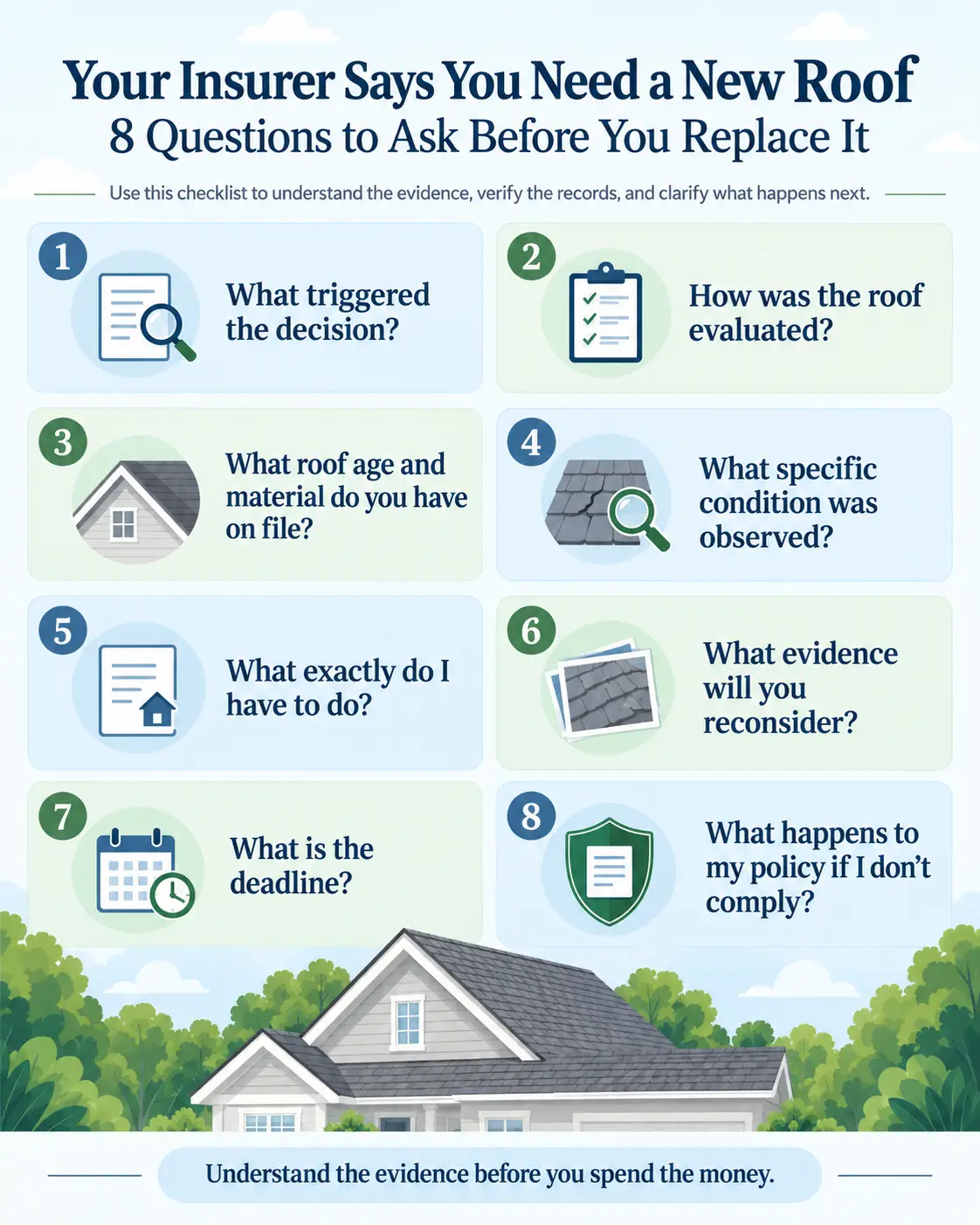
Use these questions with the insurer’s notice in front of you. Ask for the policy or underwriting basis and written confirmation of any changed deadline.
1. What triggered the decision? Ask whether the concern is age, condition, a coverage change, or an underwriting requirement, and which rule applies. 2. How was the roof evaluated? Request the findings or images and the date the evidence was collected. 3. What roof age and material do you have on file? Compare those details with records you already have. 4. What specific condition was observed? Ask where the concern appears and how it supports the decision. 5. What exactly do I have to do? Clarify whether replacement is required or whether repair or documentation could address it. 6. What evidence will you reconsider? Confirm accepted qualifications, report format, and submission instructions. 7. What is the deadline? Separate the response or work deadline from the date coverage changes. 8. What happens to my policy if I don’t meet the requirement? Have the insurer explain the consequence in writing.
You can open the conversation with:
> “I received your roof notice and want to understand the requirement before deciding on work. Please send the written reason, the inspection findings or images and their dates, and the policy term or underwriting rule you’re applying. What documentation would you consider, and what are my response deadline and the effective date? Please confirm whether reinspection or an extension is available.”
Pro Tip: Keep the notice, roof records, and call notes in one folder. Record whom you spoke with, the date, and any promised follow-up so you don’t have to reconstruct the conversation later.
Understand the Evidence Before Deciding on the Work
Sometimes the evidence will support replacement. Sometimes it will identify a records error or a question that needs a closer assessment. Either way, you will understand more than you did when you opened the notice.
If replacement becomes the likely next step, AHA’s Roof Lifespan guide offers planning context. It is not a substitute for evaluating your roof or confirming the insurer’s requirements.
For now, put the deadline on your calendar and request the evidence in writing. You aren’t trying to prove the insurance company wrong. You’re making sure you understand the problem before deciding how to address it.