
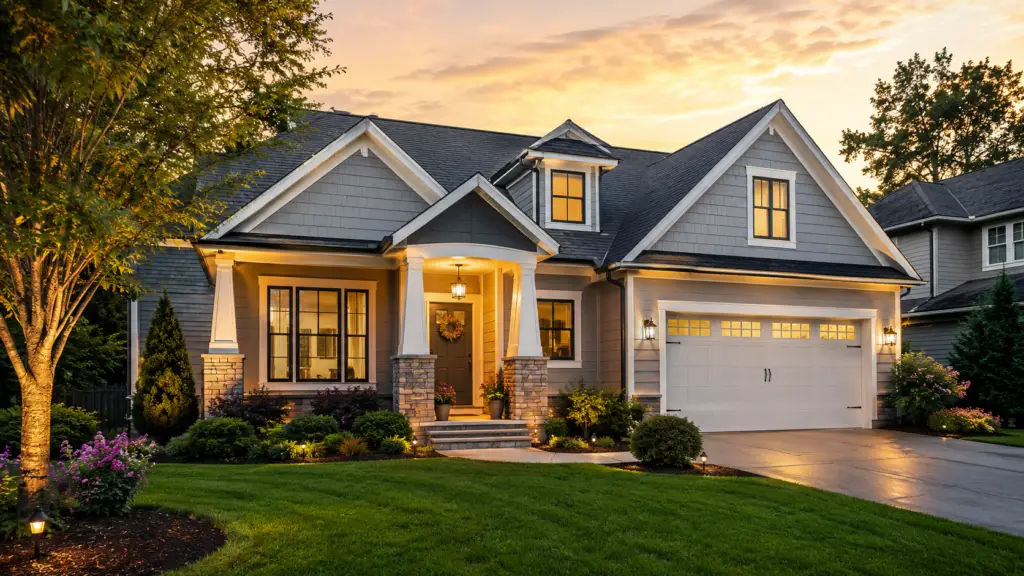
Most homeowners want to increase their home value at some point. Maybe you’re thinking about selling in a few years. Maybe a neighbor’s house just sold for more than you expected. Or maybe you’re staring at your kitchen, your roof, your siding, or that one bathroom tile that has been “temporary” for six years and wondering where your money would actually make a difference.
Here’s the honest answer: not every improvement adds value in the same way.
Some projects help your home sell faster. Some protect you from expensive problems. Some make daily life better, even if they don’t return every dollar when you sell. And some upgrades mostly just make you happy — which is allowed, by the way.
The trick is knowing which kind of project you’re looking at before you start writing checks.
Home Value Is About More Than Pretty Finishes
When people think about increasing home value, they often jump straight to the fun stuff: new counters, fresh tile, upgraded lighting, kitchen cabinets, bathroom vanities, maybe a dramatic before-and-after reveal.
Those things can matter. Buyers notice them.
But your home’s value is also built on quieter things: a dry basement, a roof that isn’t near failure, safe electrical systems, good drainage, efficient heating and cooling, working plumbing, and the general feeling that the house has been cared for.
A buyer may love your backsplash. But if the inspection turns up moisture damage, roof issues, unsafe wiring, or a furnace limping toward retirement, that excitement can fade quickly.
Think of your home like a car. A fresh detail makes it look great. But if the engine light is on and the brakes are grinding, the shine only gets you so far.
That’s why the smartest home value strategy usually starts with protection before upgrades.
What You Spend Isn’t Always What Buyers Will Pay For
This is the part that can feel a little unfair: the cost of a project and the value it adds are not always the same number.
Buyers don’t reimburse you for your contractor invoice. They respond to how your home compares with similar homes nearby — its condition, layout, features, location, and overall appeal.
That’s why a $75,000 kitchen remodel may make perfect sense in one neighborhood and be too much in another. Appraisers also look at improvements, needed repairs, added features, and modernization in the context of the property and market, not simply what the homeowner spent. (Fannie Mae Selling Guide)
So before you start a major project, ask: “Will this make my home more competitive for my market, or am I just making it more expensive?”
Sometimes the answer is both. Sometimes… not so much.
The Best Home Improvements Usually Do One of Three Things
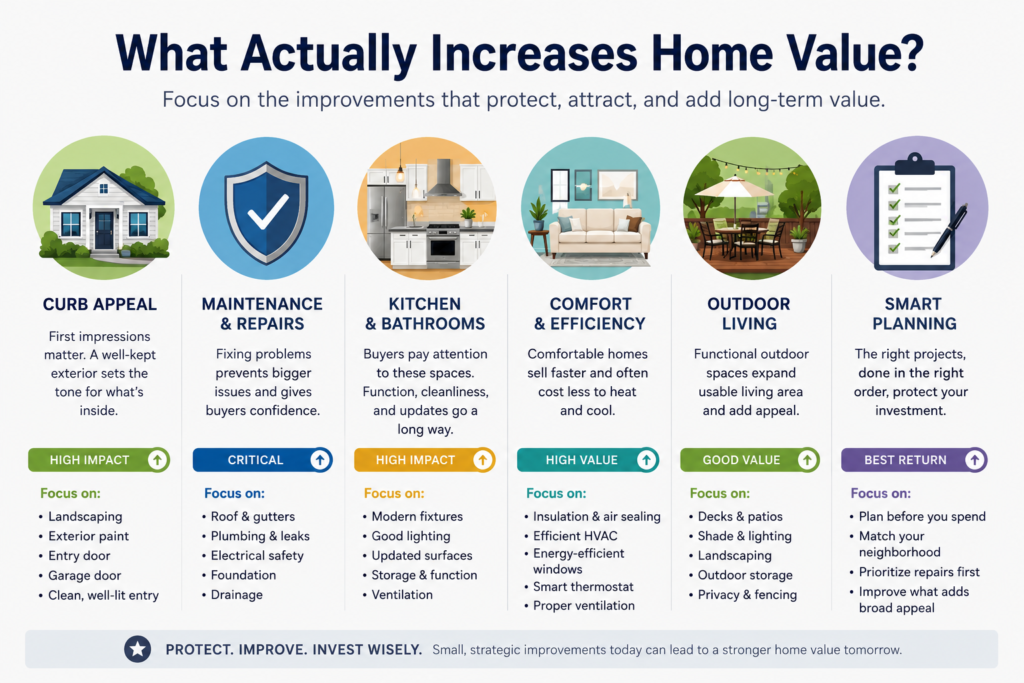
A project that supports home value usually does at least one of these things:
It improves first impressions.
It fixes or prevents a costly problem.
It makes the home easier, safer, or more comfortable to live in.
That’s one reason exterior projects often rank well in remodeling value reports. The 2025 Journal of Light Construction Cost vs. Value Report compares average project costs with estimated resale value across 119 U.S. markets, and visible exterior updates such as garage door replacement, steel entry door replacement, manufactured stone veneer, and siding replacement continue to rank strongly in national cost-recoupment estimates. (Wikipedia)
That doesn’t mean everyone should run out and replace a garage door tomorrow. Local market, home condition, neighborhood expectations, and project cost all matter. But the pattern is useful: buyers respond to improvements they can see, understand, and trust quickly.
A clean exterior says, “This home has been looked after.”
That message has value.
Curb Appeal Still Pulls More Weight Than People Think
Curb appeal sounds a little fluffy until you remember this: people start judging a home before they walk through the front door.
Peeling paint, damaged siding, overgrown shrubs, cracked walkways, rusty railings, loose gutters, and a tired entry can quietly tell buyers, “There may be more problems inside.” Fair or not, that first impression sticks.
Good curb appeal doesn’t have to mean a full exterior renovation. Often, the highest-impact work is basic and wonderfully unglamorous.
Fresh mulch. Trimmed shrubs. Clean gutters. A repaired fence gate. Washed siding. Working exterior lights. A front door that closes properly. House numbers you can actually read from the street.
Small things say, “Someone pays attention here.”
Pro Tip: Stand across the street and take a photo of your home. You’ll notice things your brain has been politely ignoring for years — faded shutters, crooked lights, patchy lawn spots, or that one sad planter that gave up sometime around 2022.
Maintenance May Not Feel Like an Upgrade, But It Protects Value
This is the part homeowners don’t always want to hear, mostly because maintenance isn’t exciting. Nobody invites friends over to admire newly sealed exterior caulk.
But maintenance is one of the strongest ways to protect home value.
Water is the big one. Small leaks, poor drainage, failing caulk, clogged gutters, loose flashing, and grading problems can quietly damage framing, drywall, foundations, roofing, and indoor air quality. Homeowners can learn to spot common defects themselves, while recognizing that a do-it-yourself check is not a substitute for a professional home inspection.
A home with fewer hidden issues is easier to sell, easier to insure, and easier to live in. You may not get a dramatic “return on investment” line item for fixing drainage or replacing failed flashing. But you may avoid a painful inspection surprise later.
That counts.
Actually, it counts a lot.
Safety, Soundness, and Structure Come Before Style
Cosmetic updates help people feel good about a home. Safety, soundness, and structural condition help determine whether a sale keeps moving.
That’s a big difference.
Fannie Mae’s appraisal guidance requires appraisers to identify physical deficiencies that could affect a property’s safety, soundness, or structural integrity, and serious deficiencies may require repairs or alterations before the property can move forward under certain lending standards. (Fannie Mae Selling Guide)
For homeowners, the takeaway is simple: don’t put pretty finishes on top of problems.
If your home has active leaks, electrical hazards, serious drainage issues, roof problems, pest damage, or structural concerns, those deserve attention before cosmetic upgrades. A fresh bathroom vanity is nice. A dry, safe, solid home is better.
Watch Out: If you’re preparing to sell, consider a pre-listing inspection or a focused contractor evaluation for obvious red flags. You don’t need to fix everything, but you do want to know what could surprise you later.
Low-Cost Fixes Can Carry More Weight Than You Think
Not every value-supporting project requires a major renovation budget.
In fact, some of the most useful pre-sale improvements are simple: paint, lighting, deep cleaning, minor drywall repair, fresh caulk, updated hardware, clean landscaping, and decluttering before photos and showings.
The 2025 Remodeling Impact Report from the National Association of Realtors and the National Association of the Remodeling Industry found that the projects with the highest homeowner “Joy Scores” are not always the same as the projects with the highest cost recovery; for example, added primary bedroom suites, kitchen upgrades, and new roofing received top Joy Scores, while a new steel front door had the highest reported cost recovery. (NARI)
That’s useful because it reminds us that home improvement has two kinds of payoff: financial return and everyday satisfaction.
A $150 lighting update will not transform your appraised value overnight. But a brighter entry, cleaner walls, and a home that smells fresh instead of “old basement mystery” can absolutely change how people feel when they walk in.
And feelings matter in real estate.
Kitchens and Bathrooms Help — But Don’t Overbuild
Kitchens and bathrooms are emotional rooms. People picture their mornings there. They picture guests. They picture whether life will feel easy or mildly annoying every single day.
So yes, updating them can help home value. But this is also where homeowners can overspend fast.
A minor kitchen refresh often makes more sense than a full tear-out, especially if the layout already works. Cabinet painting, updated hardware, better lighting, a new faucet, fresh counters, or modern appliances can change the room without turning the project into a second mortgage with drawer pulls.
The same goes for bathrooms. Clean, bright, functional, and dry usually beats trendy and over-customized.
If you’re staying for years, personal choices are fine. It’s your home. Paint the vanity green. Put in the tile you love. Make the space feel like yours.
But if resale is the goal, aim for broad appeal. Buyers don’t need to gasp. They just need to think, “Good, I don’t have to fix this right away.”
Watch Out: Expensive doesn’t always mean valuable. A luxury remodel in a modest neighborhood may not return what you expect, especially if it pushes your home far beyond nearby comparable homes.
Don’t Upgrade Past Your Neighborhood
One of the easiest ways to overspend is to renovate your home far beyond what nearby buyers expect.
That doesn’t mean you can’t choose quality materials or make your home beautiful. It just means a luxury-level remodel in a midrange neighborhood may not return what you hope.
Before a major project, look at recently sold homes nearby. Not fantasy homes. Actual comparable homes. What finishes do they have? What condition are they in? What features seem common at your price point?
That’s your reality check.
A home can be improved and still fit the neighborhood. That’s usually the sweet spot.
Be Careful Chasing Trendy Features
Trend reports can be interesting, but they can also tempt homeowners into spending money for the wrong reason.
For example, Zillow’s 2025 analysis found that certain listing features, including soapstone countertops, white oak floors, Venetian plaster, outdoor showers, outdoor kitchens, and bluestone patios, were associated with sale premiums. (Zillow)
That does not mean every homeowner should install those features.
Sometimes the feature adds appeal. Sometimes it appears in homes that were already higher-end, better maintained, better photographed, or located in stronger markets. Correlation is not the same as a guaranteed return.
Watch Out: A design feature that appears in higher-selling listings is not automatically a smart project for your home. Trends can help with inspiration, but your budget, neighborhood, climate, and timeline should make the final call.
Outdoor Spaces Can Help When They’re Practical
Outdoor living can support home value, especially when the space feels usable, maintained, and appropriate for the climate.
That might mean a simple patio, safe deck, shade, lighting, clean landscaping, and a place to sit without feeling like you’re balancing a chair on a slope. It does not always mean a full outdoor kitchen with stone counters and a built-in grill station worthy of a cooking show.
In some markets, outdoor living is a major selling point. In others, a clean, low-maintenance yard may matter more.
Practical beats overdone.
A buyer should be able to look at the space and instantly understand how they’d use it: coffee in the morning, kids playing outside, friends over for dinner, a quiet place to sit at the end of the day.
That kind of clarity helps.
Energy Efficiency Can Add Comfort and Lower Costs
Energy efficiency can support home value in a quieter way. It may not create the same visual excitement as a kitchen remodel, but it can make your home feel better and cost less to operate.
The U.S. Department of Energy says a home energy assessment can help homeowners understand how their home uses energy and identify improvements that may improve efficiency and comfort. AHA’s research reference pack also identifies Energy.gov as a trusted source for energy efficiency, appliances, and weatherization guidance.
Buyers may not always ask about air sealing or duct leakage. But they do notice drafty rooms, uneven temperatures, loud heating and cooling equipment, and windows that make a room uncomfortable.
Good energy-related projects may include:
- Air sealing
- Insulation
- Duct sealing
- Smart or programmable thermostats
- Efficient heating and cooling equipment
- Window and door improvements where appropriate
The smartest starting point is usually an energy audit, not a shopping trip. A trained professional can help you avoid spending thousands on the wrong fix.
In Some Areas, Resilience Protects Value
In higher-risk areas, home value is not just about finishes. It’s also about durability, insurability, and confidence.
If your area faces hurricanes, high winds, wildfire, flooding, hail, or repeated severe storms, buyers and insurers may care about roof condition, drainage, impact protection, defensible space, flood mitigation, and wind-resistant upgrades.
FEMA’s wind retrofit guidance explains that strengthening a home’s building envelope and load path can improve performance in high-wind events, especially in hurricane-prone regions.
That does not mean every home needs major resilience work. It does mean local risk should be part of your value conversation.
If insurance costs are rising in your area, or coverage is harder to get, talk with your insurance agent, local building department, and qualified contractors before choosing major upgrades. In some communities, the most valuable improvement may be the one that helps your home stand up better to the weather it actually faces.
Major Systems Matter Because They Affect Buyer Confidence
Roof. Heating and cooling. Plumbing. Electrical. Water heater. Drainage. Foundation.
Not glamorous. Very important.
A buyer may not fall in love with a newer electrical panel. But they may absolutely hesitate over an outdated one. Same with an old water heater, a visibly worn roof, slow drains, leaking supply lines, or heating and cooling equipment near the end of its expected life.
These projects don’t always “add” value in the fun sense. Sometimes they preserve value. They keep your home from being discounted, negotiated down, or flagged during inspection.
That distinction matters.
If your roof is failing, replacing it may not feel like a dream upgrade. But trying to sell with an obviously worn roof can make buyers nervous. They may ask for a credit, lower their offer, or walk away entirely.
Pro Tip: Keep receipts, permits, warranties, inspection reports, and before-and-after photos for major work. Documentation helps tell the story that your home has been maintained, not just decorated.
A Simple Way to Sort Home Improvements
Here’s a helpful way to think about projects before you commit.
| Project Type | What It Does | Examples |
| Protects Value | Prevents damage or avoids inspection problems | Roof repair, drainage fixes, plumbing leaks, electrical safety, pest issues |
| Adds Perceived Value | Improves buyer confidence or first impressions | Entry door, garage door, siding repair, landscaping, lighting, fresh paint |
| Improves Daily Life | Makes the home more comfortable or functional | Insulation, storage, better lighting, HVAC improvements, bathroom updates |
| Personal Enjoyment | Makes the home feel more like yours | Bold finishes, luxury features, custom layouts, specialty rooms |
The best projects often overlap. For example, replacing a failing front door may improve curb appeal, comfort, security, and energy performance. That’s a strong combination.
A highly custom wine room? Maybe wonderful. Maybe not a resale play.
Both can be valid. Just know which one you’re choosing.
The Best Upgrade Depends on How Long You’ll Stay
Before choosing a project, ask one question:
“Am I improving this for resale, or for my life?”
Both are valid. They’re just different.
If you’re selling soon, focus on visible, practical improvements with broad appeal: curb appeal, paint, lighting, small kitchen or bath refreshes, obvious repairs, and anything likely to come up during inspection.
If you’re staying five or more years, comfort and function deserve more weight. You’ll actually live with the results. That may make insulation, heating and cooling upgrades, safer stairs, better storage, improved lighting, or aging-in-place features worthwhile even if they don’t return every dollar on paper.
If you’re not sure, choose projects that do both: improve your daily life and make the home feel well cared for.
Avoid These Common Home Value Mistakes
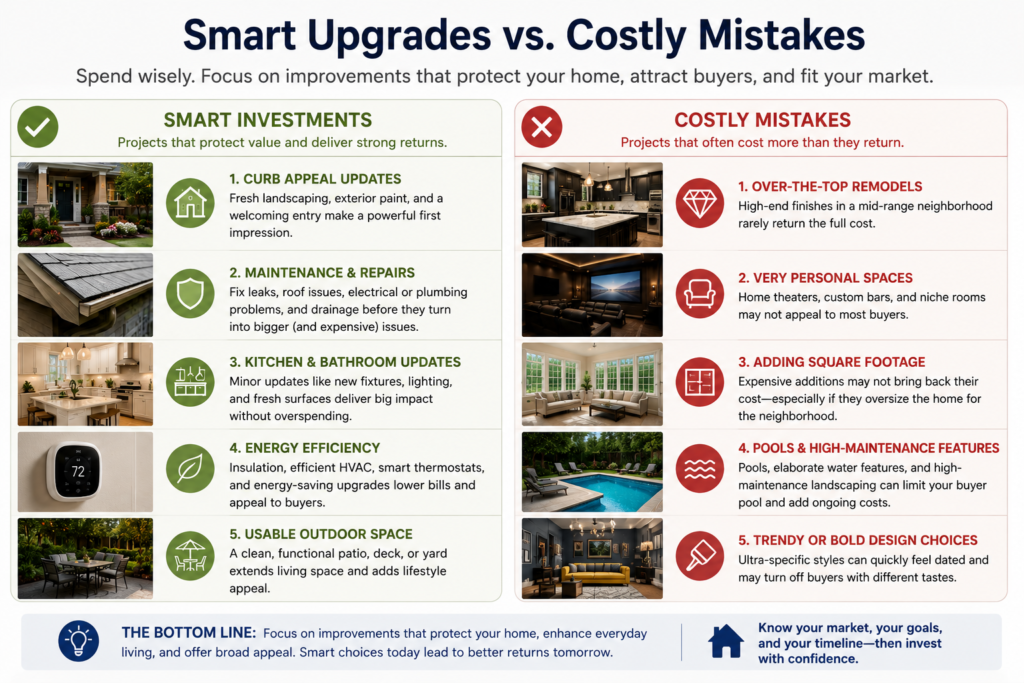
The biggest mistake is assuming expensive means valuable.
A high-end remodel may be beautiful and still not make financial sense. The same goes for adding square footage without improving layout, upgrading finishes while ignoring repairs, or choosing materials that don’t match the neighborhood.
Another mistake is renovating for imaginary buyers.
You can drive yourself a little nuts trying to predict what strangers might want three years from now. Better approach: keep the home clean, functional, safe, efficient, and consistent with your local market.
That’s not flashy advice. It’s just the kind that tends to age well.
Watch Out: Local market matters. A project that helps in one area may matter less in another. Climate, insurance concerns, buyer expectations, neighborhood price ranges, and labor costs can all change the math.
Home Value Priority Checklist
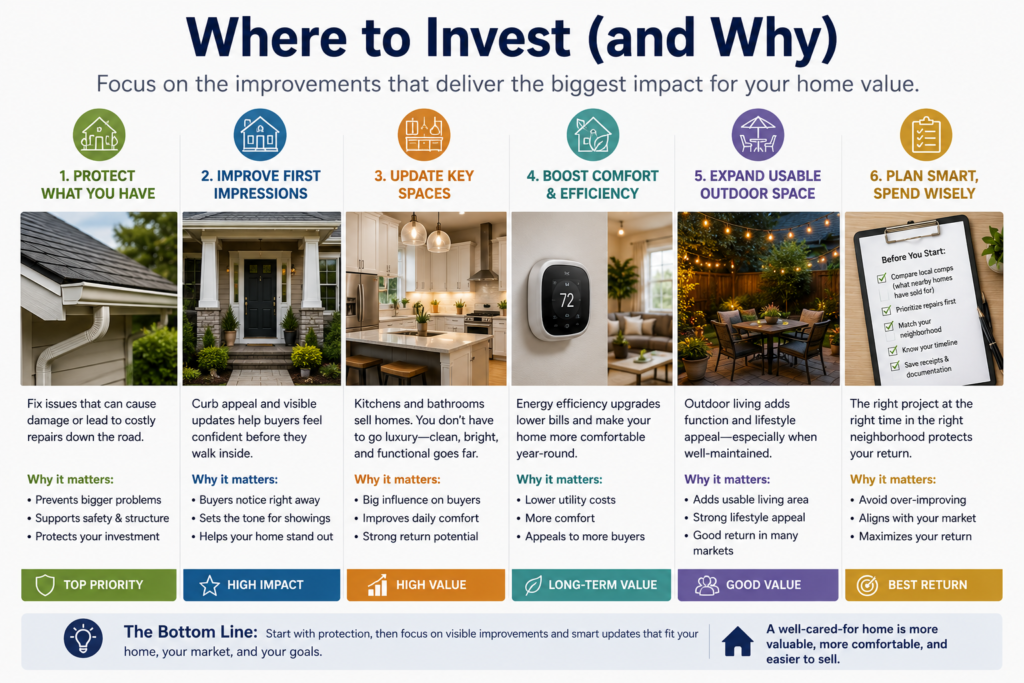
If you’re deciding where to start, use this order:
- Fix anything that can cause damage, including leaks, drainage issues, roof problems, electrical hazards, plumbing concerns, pests, or structural red flags.
- Improve what people notice quickly, such as the front entry, siding, paint, landscaping, lighting, flooring, and general cleanliness.
- Address comfort and efficiency, including insulation, air sealing, heating and cooling performance, windows, doors, and smart controls.
- Then consider style upgrades, including kitchens, bathrooms, fixtures, finishes, and design improvements.
That order keeps you from putting pretty things on top of problems.
Because yes, a new bathroom looks great — unless the subfloor is quietly waving a white flag.
FAQ: Increasing and Protecting Home Value
What increases home value the most?
The projects that usually help most are the ones that improve first impressions, fix obvious problems, or make the home feel well cared for. Curb appeal, exterior repairs, fresh paint, updated lighting, functional kitchens and bathrooms, roof condition, and major system maintenance can all influence home value. The best choice depends on your local market and your home’s current condition.
What home improvements add the most resale value?
Exterior improvements often perform well because buyers notice them quickly. Garage doors, entry doors, siding, landscaping, and manufactured stone veneer frequently rank well in resale value reports. Minor kitchen updates can also help when they make the space feel cleaner, brighter, and more functional without overbuilding for the neighborhood.
Is it better to renovate or repair before selling?
Repair first. Buyers may appreciate a pretty kitchen, but inspection issues can create bigger problems during a sale. Fix leaks, roof concerns, electrical hazards, plumbing problems, drainage issues, and safety concerns before spending heavily on cosmetic upgrades. Once the home feels sound, then focus on visible updates that make it feel fresh.
Do kitchen remodels increase home value?
Kitchen remodels can increase home value, but the scale matters. A modest refresh often makes more sense than a full luxury remodel, especially if the existing layout works. Updated hardware, lighting, counters, faucets, paint, and appliances can improve the feel of the kitchen without overspending.
Do bathroom remodels increase home value?
Bathroom remodels can help when they improve function, cleanliness, lighting, ventilation, and water protection. A bathroom does not need to be luxury-level to support home value. Most buyers want a bathroom that feels clean, dry, bright, and easy to maintain.
What upgrades do buyers notice first?
Buyers usually notice curb appeal, the front entry, flooring, paint, lighting, odors, kitchen condition, bathroom condition, and signs of deferred maintenance. They also notice whether the home feels clean, dry, and cared for. Small details can shape the first impression quickly.
What hurts home value?
Water damage, roof problems, foundation concerns, outdated or unsafe electrical systems, plumbing leaks, poor drainage, pest damage, strong odors, neglected landscaping, and visible deferred maintenance can hurt home value. Highly personalized renovations can also limit appeal if you plan to sell soon.
Are energy-efficient upgrades worth it?
Energy-efficient upgrades can be worth it when they lower utility costs, improve comfort, or solve problems like drafts, uneven temperatures, and outdated equipment. Air sealing, insulation, duct sealing, smart thermostats, and efficient heating and cooling systems may help your home feel more comfortable and easier to operate.
Should I upgrade my home if I’m not selling soon?
Yes, but your priorities can be different. If you’re staying for several years, choose upgrades that improve comfort, safety, function, and maintenance — not just resale appeal. The best projects often do both: they make life better now and help the home feel well cared for later.
How do I avoid overspending on home improvements?
Start with repairs, then compare your home with similar homes nearby. Avoid renovating far beyond your neighborhood unless the improvement is mainly for your own enjoyment. Before a major project, ask whether it protects the home, improves daily life, or adds broad appeal. If it only follows a trend, pause before spending heavily.
Protect First, Upgrade Second
Increasing home value doesn’t have to mean chasing every trend or spending money because someone online said a project has “great return on investment.”
The best approach is steadier than that.
Protect the home from damage. Keep major systems in good shape. Improve curb appeal. Make smart updates that fit your neighborhood and your timeline. And when you do spend, spend in a way that makes the home easier to live in, easier to trust, and easier to maintain.
That’s how you build value without losing your mind — or your weekend every weekend.