
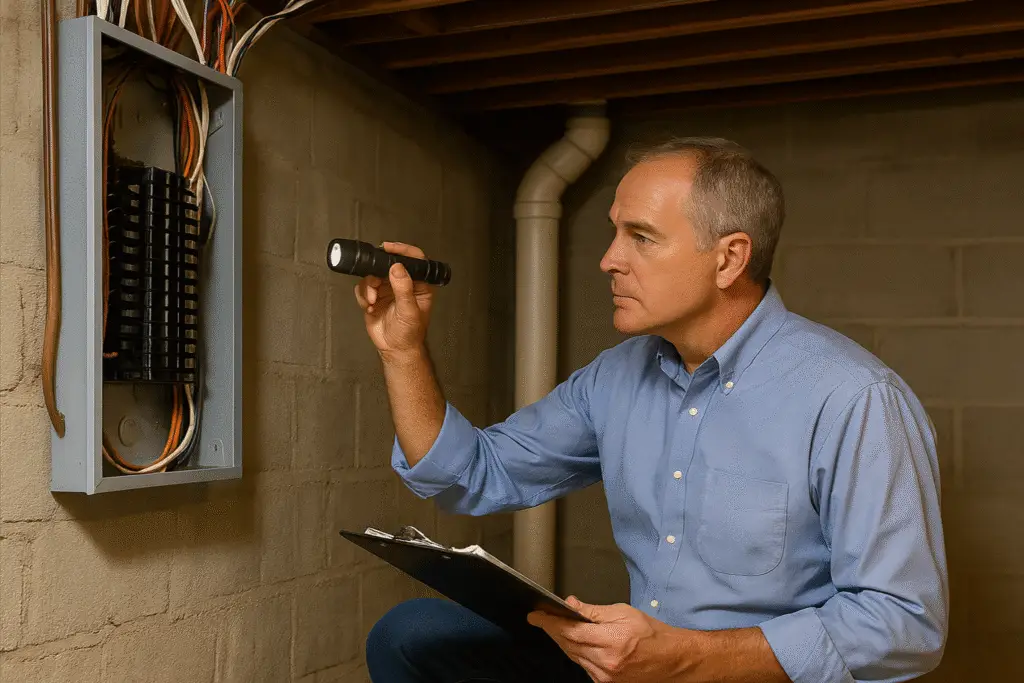
Buying a home can make the inspection feel like the moment everything finally becomes real. Someone trained is walking the house, looking at the systems, and handing you a report before you decide what to do next.
That can be reassuring. It can also be easy to ask too much of the inspection.
A home inspection is a decision tool, not a guarantee that every hidden problem has been found. Used well, it can help you understand the condition of the home, ask better questions, and decide when to bring in a specialist before you commit.
Quick answer: how do you avoid home inspection mistakes?
Avoiding home inspection mistakes starts with understanding the scope. A standard home inspection generally looks at visible, readily accessible systems and components at the time of the inspection. It is not a pass-fail test, a warranty, a code inspection, an appraisal, or a substitute for specialist evaluation.
Before you hire an inspector, ask what is included, what is excluded, how the report is written, whether optional testing is available, and what happens if an area cannot be inspected. During and after the inspection, focus less on whether the house “passed” and more on what the report says, what it could not evaluate, and which concerns need follow-up before closing.
What went wrong in the inspection story
Contractor Mike Holmes shared a home inspection story involving first-time buyers Keith and Caitlin. The buyers hired an inspector and expected the inspection to help them understand the house before purchase. Later, the home was reported to have serious roof and structural concerns that the inspection did not clearly surface. The original story describes a rushed inspection, roof issues, missing roof venting, an unfinished addition roof, and cut floor joists.
That example is useful, but it should not be treated as proof that all inspectors work this way. The better lesson is narrower: an inspection is only as useful as its scope, access, time, report quality, and follow-up. If the inspector cannot evaluate something, if the report is vague, or if a concern points beyond a general inspection, the buyer needs to know that before the decision window closes.
Where inspection mistakes and misunderstandings happen
Some inspection problems are actual misses. Others are misunderstandings about what a standard inspection is designed to do.
The American Society of Home Inspectors explains that a home inspection examines a home’s physical structure and systems and results in a report describing findings and recommendations. ASHI also notes that a home inspector does not pass or fail a house, and that a home inspection is not an appraisal or municipal code inspection.
Inspection standards also include limits. ASHI’s Standard of Practice and InterNACHI’s Standards of Practice both describe home inspection as focused on visible or readily accessible components and systems, with exclusions for things the inspector is not required to determine. That matters because some expensive concerns may be hidden, inaccessible, outside the inspection agreement, or better evaluated by a specialist.
Common friction points include:
- The buyer assumes every hidden defect will be found.
- The inspector cannot access the attic, crawl space, roof, panel, or mechanical equipment and the buyer misses that limitation in the report.
- Optional testing, such as radon testing or specialized mold assessment, is assumed but not actually included.
- The report lists a concern but the buyer does not ask whether specialist follow-up is needed before closing.
- The buyer treats a checklist as a diagnosis instead of a prompt for better questions.
What to ask before hiring a home inspector
Before hiring an inspector, ask questions that make the scope clear.
- Which standard of practice do you follow?
- Are you licensed or certified where my state or locality requires it?
- What systems and areas are included in the inspection?
- What is not included unless I request it separately?
- Will you inspect the roof, attic, crawl space, electrical panel, HVAC equipment, plumbing fixtures, and drainage conditions if they are accessible?
- What happens if an area is unsafe, blocked, locked, or not readily accessible?
- Can I see a sample report?
- Will the report include photos, limitations, and recommendations for follow-up?
- Do you carry errors and omissions insurance, and what does your inspection agreement say about limits and claims? Licensing rules, complaint processes, and claim limits can vary by state, locality, inspector, and agreement, so read the agreement before relying on it.
- Are radon testing, sewer scope, chimney inspection, mold assessment, pest inspection, or other specialty services included or separate?
That last question is important. EPA guidance for home buyers says homes should be tested for radon when buying or selling. But radon testing may be a separate service depending on the inspector, state rules, and the inspection agreement. Do not assume it is included unless the inspector says so in writing.
What to pay attention to during the inspection
If you can attend the inspection, use the time to understand the house, not to hover over every note.
Ask the inspector to explain:
- which areas were fully inspected;
- which areas were only partly visible;
- which areas could not be inspected;
- which findings are routine maintenance;
- which findings may need repair negotiation;
- which findings may need specialist evaluation before closing.
Pay close attention to access limitations. If the roof is too steep, the attic hatch is blocked, the crawl space is unsafe, the electrical panel is covered, or the furnace cannot be operated, the limitation should appear in the report. A limitation is not automatically a crisis, but it is a decision point. You may need more information before you are comfortable moving forward.
How to read the inspection report
A good inspection report should help you sort concerns, not just scare you.
Read the report in four passes:
- Look for safety concerns or items the inspector recommends evaluating soon.
- Look for systems or components described as not functioning, significantly deficient, unsafe, or near the end of service life.
- Look for areas that were not inspected and the reason they were excluded.
- Look for follow-up recommendations, especially when the inspector suggests a qualified contractor, engineer, electrician, plumber, HVAC technician, roofer, or other specialist.
Do not focus only on the longest section. Sometimes the most important sentence is a limitation note: the inspector could not access the attic, could not walk the roof, could not remove a panel cover, or could not test equipment that was shut down.
Red flags you can notice without diagnosing the house yourself
You do not need to become an inspector to be a better buyer. You can still notice conditions worth asking about.
Before or during the inspection, write down visible concerns such as:
- stains on ceilings or walls;
- musty smells in basements, bathrooms, attics, or crawl spaces;
- loose stairs, guardrails, or handrails;
- cracks that are wide, growing, offset, or paired with sticking doors and windows;
- outlets or switches that do not work as expected;
- flickering lights, damaged cords, scorch marks, or warm outlets;
- standing water near the foundation;
- missing gutters, poor drainage, or visible roof damage;
- HVAC equipment that is noisy, leaking, short-cycling, or not operating normally.
Treat these as prompts, not conclusions. A stain does not tell you the source of a leak. A crack does not automatically prove structural movement. An electrical symptom does not tell you the wiring defect. The useful move is to ask the inspector what they observed, what they could not determine, and whether a specialist should evaluate the issue.
For mold and moisture concerns, the EPA emphasizes the same practical point: controlling indoor mold starts with controlling moisture. If you see or smell mold, or if a report points to moisture intrusion, make sure the next step addresses the source of moisture rather than only the visible surface.
When to bring in a specialist
A general home inspection can point you toward concerns. It may not answer every technical question.
Specialist follow-up may be appropriate when:
- the report recommends further evaluation;
- a major system appears near the end of its useful service life;
- the inspector could not access an important area;
- there are signs of structural movement or water intrusion;
- electrical concerns may need a qualified electrician;
- roof conditions need a roofer’s opinion;
- HVAC equipment needs testing beyond the inspection scope;
- radon, sewer, chimney, pest, mold, or environmental concerns require separate testing or expertise.
The goal is not to collect endless opinions. The goal is to close the information gap that affects your decision.
Internal resources that may help
If you are still early in the process, AHA’s first-time homebuyer guide can help you think about the broader buying sequence.
If the issue is moisture-related, AHA’s mold and moisture guide can help you understand common warning signs and why fixing the source matters.
If inspection findings point toward repair work after closing, the AHA SmartHire Contractor Kit can help you compare contractors and organize project questions. Use it as a hiring resource, not as a replacement for a qualified home inspector or specialist.
The bottom line
A home inspection should make you better informed, not falsely certain.
The biggest inspection mistake is not finding a house with a concern. Many homes have something worth understanding before you decide. The bigger mistake is treating the inspection as a promise that there are no hidden issues, skipping the limitations, or failing to follow up when the report points to something serious.
Use the inspection to ask better questions:
- What was inspected?
- What was not inspected?
- What needs repair?
- What needs monitoring?
- What needs a specialist before I decide?
That is how a home inspection protects you: not by removing every risk, but by helping you understand which risks deserve attention before they become your problem alone.