

Your Closing Disclosure arrives, and the estimated monthly payment is lower than the figure you’ve been budgeting around. Say it’s $180 a month. With moving expenses adding up, that sounds like welcome breathing room. Before you count on that extra room, one question deserves an answer: what changed?
A new construction mortgage payment can look lower because the estimate for property taxes or insurance changed, even when the loan terms stayed the same. The lower number doesn’t tell you what’s behind it.
You don’t need to become a property-tax expert to sort this out. Compare the two written estimates, find the changed line, and ask the lender what the updated figure is based on. That gives you a clearer basis for your budget before closing.
Check What Changed in Your New Construction Mortgage Payment
Start with Projected Payments on page 1 of your Closing Disclosure. Compare the estimated total monthly payment with your most recent Loan Estimate, then look for the line that moved. The CFPB’s Closing Disclosure explainer shows the payment components and costs paid outside escrow.
For most mortgages, you must receive the Closing Disclosure at least three business days before closing. Use that time to compare the documents and ask about an unexplained difference.
Principal and interest are the loan portion of the payment. Mortgage insurance, if required, is another charge. Estimated escrow is the amount collected through your payment for property costs such as taxes and homeowners insurance. Also check which taxes, insurance or assessments you’ll pay separately; those costs still belong in your housing budget.
Here’s a simplified illustration of the $180 difference. These are made-up monthly figures, not a loan quote or tax forecast. The example leaves out mortgage insurance and other charges and assumes the insurance estimate is unchanged.
| Payment Component | Loan Estimate | Closing Disclosure |
|---|---|---|
| Principal and interest | $2,000 | $2,000 |
| Estimated escrow for taxes and insurance | $500 | $320 |
| Estimated total monthly payment | $2,500 | $2,320 |
In this example, the entire decrease comes from a lower tax estimate within escrow. The loan portion hasn’t changed. The question to resolve is what supports that lower estimate.
Lenders don’t control property taxes or insurance premiums, so lower estimates for those costs don’t establish that a loan offer is better. AHA’s explanation of how property taxes can raise a mortgage payment provides more background on that connection.
Check Whether the Tax Estimate Reflects the Finished Home
Picture the house ready for move-in while an earlier property record still describes the lot or construction in progress. Depending on local rules and timing, the tax information used in a mortgage estimate may reflect the land, a partially built house or the completed property.
That doesn’t automatically mean there’s a mistake. It means you need to know which information the lender used before relying on the lower payment.
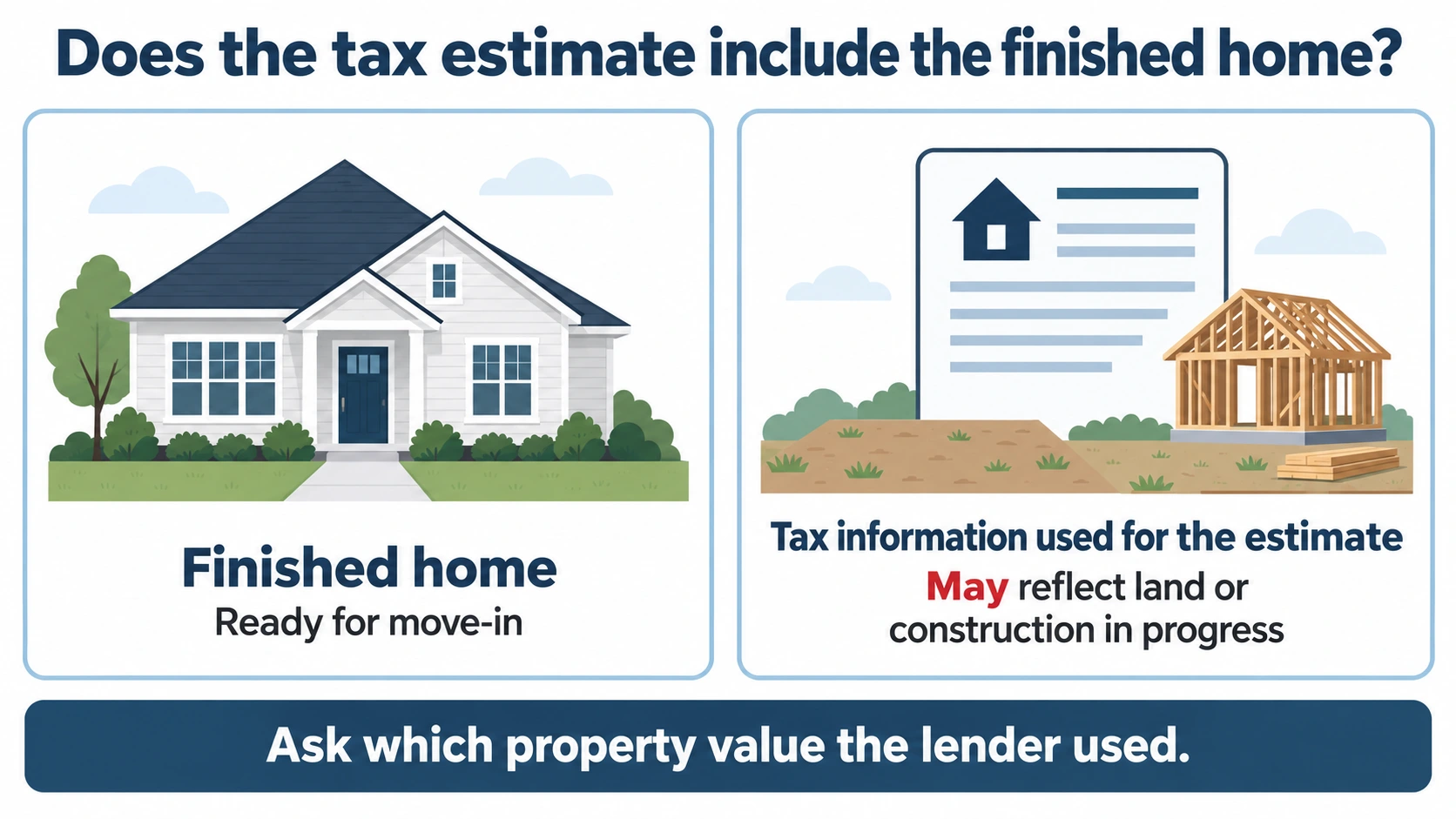
Ask what assessed or taxable value the calculation uses, whether it includes the completed home and which exemptions are assumed. If an exemption is included, clarify whether your eligibility has been confirmed. AHA’s guide to understanding your property-tax bill can help you make sense of the value labels you’re discussing.
The lender can explain its calculation. Your local assessment or tax-billing office can clarify the property record and local process, including whether new construction can produce an additional bill.
For example, Loudoun County, Virginia’s tax FAQ explains that a newly constructed home may receive a separate land-only bill and a prorated construction-supplement bill. Its supplemental assessment covers new construction completed after the original January 1 assessment. Ask about the rules where your home is located; Loudoun’s billing arrangement isn’t a national schedule.
Watch Out: If the actual tax cost is higher than the estimate used for escrow, your payment may rise. Check what the current estimate covers before treating the lower payment as permanent savings.
If Taxes Don’t Explain the Difference, Check the Loan Terms
If the tax estimate doesn’t explain the difference, review the loan terms and ask your lender what else changed. An adjustable-rate mortgage (ARM) may have payment changes under its terms. Some loans also include temporary buydowns that reduce what you pay for a limited period.
A seller-funded buydown’s reduction may not appear in the Closing Disclosure’s Projected Payments table. If your loan includes either feature, request its specific payment schedule and ask how the payments will change.
Ask for One Written Explanation
Once you’ve found the changed line, you can ask the lender to connect the earlier figure to the current one:
“My estimated monthly payment is lower than on my most recent Loan Estimate. Please explain which line changed and what information supports it. If the difference is in property taxes, show the estimate for the completed home, identify any assumed exemptions, and explain what still needs confirmation from the local tax office.”
A useful estimate shows you which numbers the lender used and which are still uncertain. If the information doesn’t yet support a completed-home figure, ask the lender to identify what’s missing. This is a request to understand the assumptions, not a guarantee of the future tax bill.
Pro Tip: Keep the lender’s written answer with your latest Loan Estimate and Closing Disclosure. If the explanation comes by phone, ask for a short follow-up note so you won’t need to reconstruct the conversation later.
Know What the Lower Number Means for Your Budget
A lower monthly payment is welcome news. Understanding whether it reflects changed loan terms or an estimate that may change helps you decide how much room it creates in your budget.
Before closing, send the lender the message above and ask for a clear explanation of the difference. Knowing which costs are confirmed and which are still estimates will help you plan with more confidence.
If you’ve already closed and your payment has increased, AHA’s guide to why your mortgage payment went up can help you identify the cause and your next step.