

You found a home you want to see, but before the private tour, an agent asks you to sign a buyer representation agreement. The timing can make the document feel routine—even though it may define whom you work with, what services you receive, and what compensation you could owe.
Fast answer: Before signing a buyer representation agreement, check five things: its scope, duration, promised services, compensation, and exit terms. Make sure you can explain who the agent represents, what services you will receive, how compensation is calculated, and how the relationship can end. A requirement to sign before a private tour does not mean you must accept a long, exclusive, or unclear financial commitment.
Why you may be asked to sign before a tour
Under current National Association of REALTORS® Multiple Listing Service policy, an MLS Participant working with a buyer generally must enter into a written agreement before an in-person or live virtual home tour, unless that requirement would conflict with state or federal law or regulation. This is an NAR MLS policy for covered professionals—not a universal new federal law governing every homebuying interaction.
An independent open-house visit is treated differently under NAR consumer guidance. You generally do not need a written buyer agreement merely to attend an open house on your own or ask an agent about their services. The timing changes when an agent begins working with you, such as arranging a private showing or conducting a live virtual tour on your behalf.
Before signing, ask what kind of agreement is being offered and whether it can be limited to one property, a short period, or a defined search while you decide whether the relationship is a good fit.
Confirm who the agent represents
Start with the most basic question: Who is this agent working for?
An agent may represent the buyer, the seller, or—in arrangements permitted by applicable state law—both sides or another defined role. Ask before sharing information that could affect your negotiating position.
The Consumer Financial Protection Bureau encourages buyers to ask whom an agent represents, how the agent is compensated, and how conflicts would be handled. It also recommends considering relevant experience, references, and any disciplinary history available through the state licensing agency.
Questions to ask the agent
- Are you representing me as the buyer?
- What information will you keep confidential?
- What happens if I want to buy one of your brokerage’s listings?
- What happens if your brokerage represents a competing buyer?
- Will I receive a separate agency disclosure?
Agency and conflict rules vary by state. If the explanation is vague, pause before signing.
Match promised services to written services
A verbal promise to “help you buy a home” is not very specific. The agreement should describe the services you expect the agent or brokerage to provide.
Those services might include identifying properties, arranging tours, preparing offers, explaining deadlines, coordinating inspections, discussing repair requests, and communicating with the lender or closing team. The exact service package can vary.
Check whether the agreement covers:
- Help before and after an offer is accepted
- New construction, for-sale-by-owner homes, land, condos, or other property types relevant to you
- Availability for showings and time-sensitive offers
- Who will perform the work if your primary agent is unavailable
- Any services carrying a separate fee
If the document is detailed about your obligations but vague about the agent’s services, ask for clarification or a written revision.
Check exclusivity, geography, property type, and duration
A buyer representation agreement may be exclusive or nonexclusive. It may cover one home or a broad region, one property type or several, and a short trial period or a longer relationship. NAR policy does not dictate the relationship type, term, services, or compensation structure; available choices still depend on the form, brokerage, and applicable state law.
Define the agreement’s boundaries:
- Exclusivity: Must you work only with this brokerage?
- Geography: Does it cover one neighborhood, a county, or a larger region?
- Property type: Does it include new construction, land, or investment property?
- Duration: What are the exact start and end dates?
- Self-found homes: What happens if you find a listing, visit an open house independently, or contact a builder?
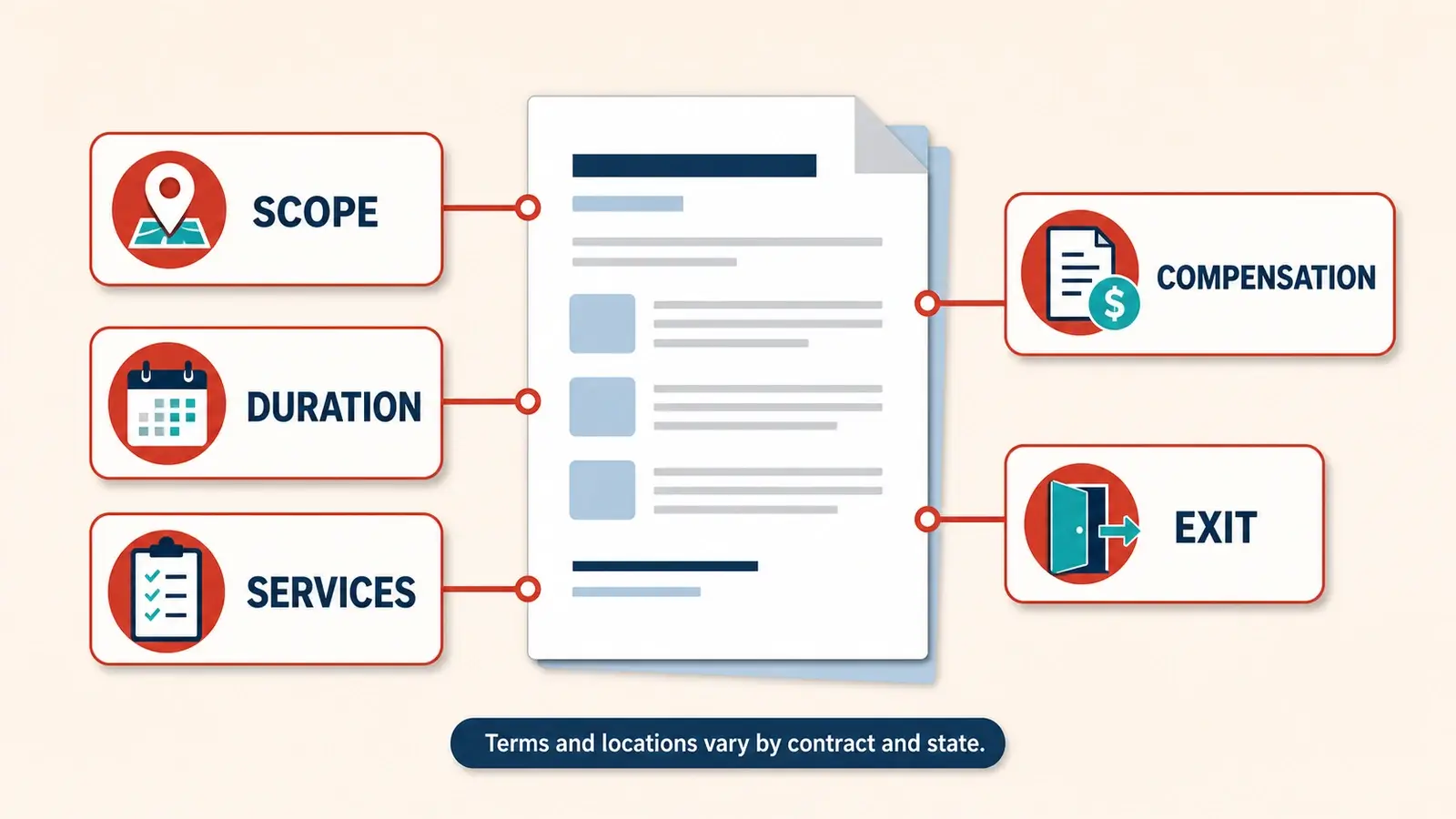
Pro Tip: Summarize the scope aloud: “I am hiring this brokerage for these services, in this area, for these properties, until this date.” If you cannot complete that sentence confidently, keep asking questions.
The right commitment is the smallest one that fits the relationship you are ready to begin. Rather than assuming a particular term is always too long or too short, decide whether the proposed duration and scope match how well you know the agent and how broadly you want help.
Understand compensation and any buyer-paid gap
Read the compensation section slowly. Under current NAR MLS policy, compensation must be stated specifically and conspicuously, be objectively ascertainable rather than open-ended, and be described as negotiable rather than set by law.
You should be able to answer two separate questions:
- What does the agreement say the brokerage may be paid?
- Who, if anyone, has agreed to provide that payment?
Do not assume a seller or listing broker will cover the full amount. Seller-side payment may be requested or negotiated, but it is not guaranteed. Depending on the agreement and transaction documents, the buyer may remain responsible for a difference.
Consider a purely hypothetical example. Suppose the home’s purchase price is $450,000 and the agreement sets compensation at 3% of that price. The agreed compensation would be $13,500 because $450,000 × 3% = $13,500. If another party agrees to pay $9,000 and the agreement separately adds a $700 brokerage or administrative fee, the possible arithmetic difference is $5,200:
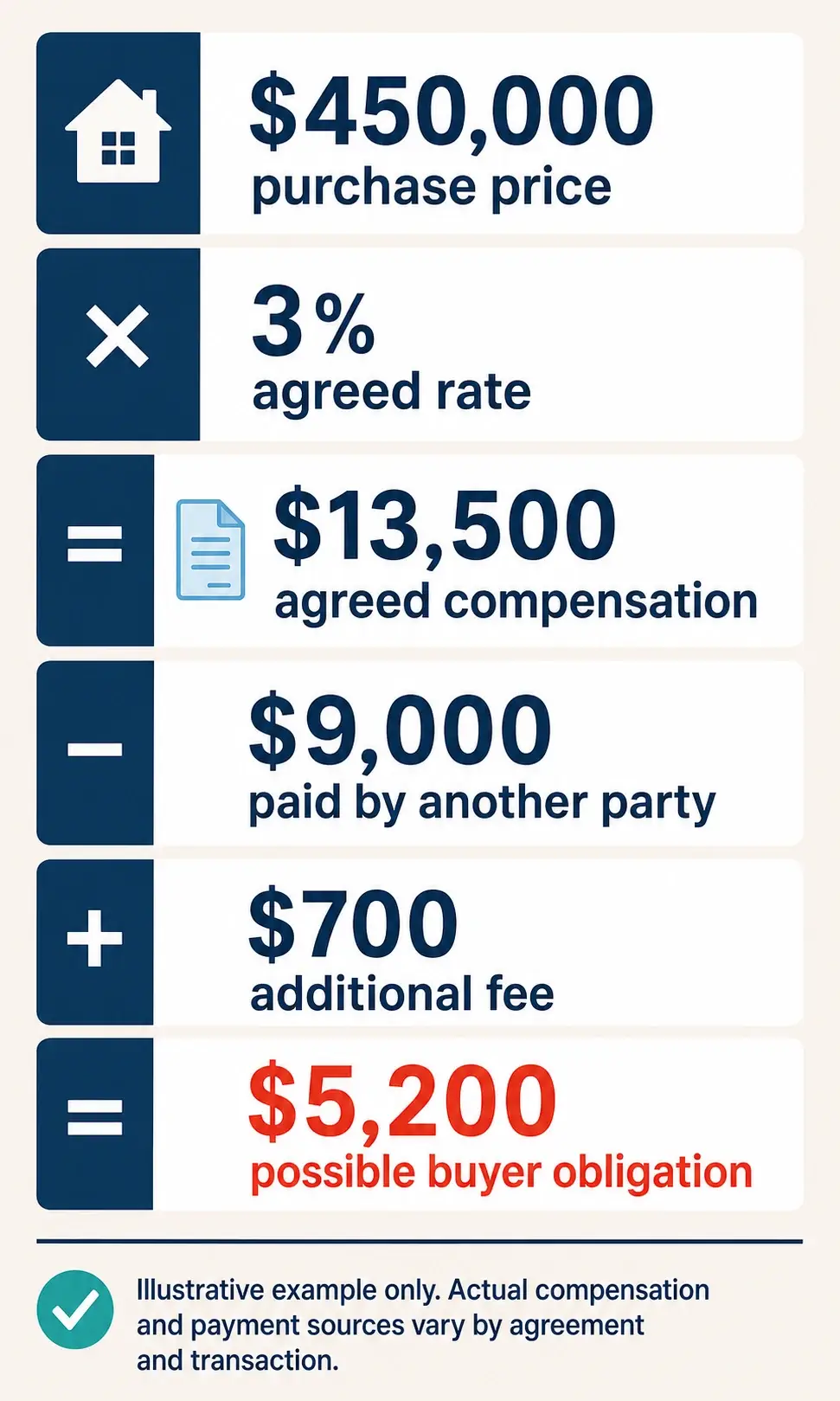
Percentage-based compensation is only one possible negotiable structure; an agreement might instead use a flat fee, hourly amount, or another clearly defined method permitted by applicable law. These figures are not typical amounts or a prediction. The fee must actually appear in the agreement, and the payment terms must be confirmed in the transaction documents. Do not assume an uncovered amount can automatically be rolled into a mortgage. Loan programs, lender requirements, transaction structure, appraisal, concessions, and credits can affect what is permitted. Ask the lender before making an offer if the payment source affects your ability to close.
If a possible buyer-paid amount changes your budget, revisit how much house you can comfortably afford before making an offer.
Read termination, carryover, conflict, and dispute terms
The agreement should explain not only how the relationship begins, but how it can change or end.
Termination language may address whether either party can end the agreement with or without cause, how notice must be delivered, whether a retainer or termination charge applies, and whether the broker must agree in writing. Do not assume you can always cancel immediately without notice, cost, cause, or a later obligation. Exit rights depend on the signed agreement and applicable state law.
A carryover period may state that compensation remains due if you end the agreement and later buy a property introduced or shown during the relationship. Ask:
- How long does the carryover period last?
- Which properties does it cover?
- What conditions trigger payment?
- Can the covered-property list be provided in writing?
Also check for mediation, arbitration, venue, attorney-fee, governing-law, dual-agency, or conflict provisions. A generic article cannot determine whether a particular clause is enforceable. For that question, consult a qualified local attorney.
Use a short before-you-sign checklist
Before signing, confirm:
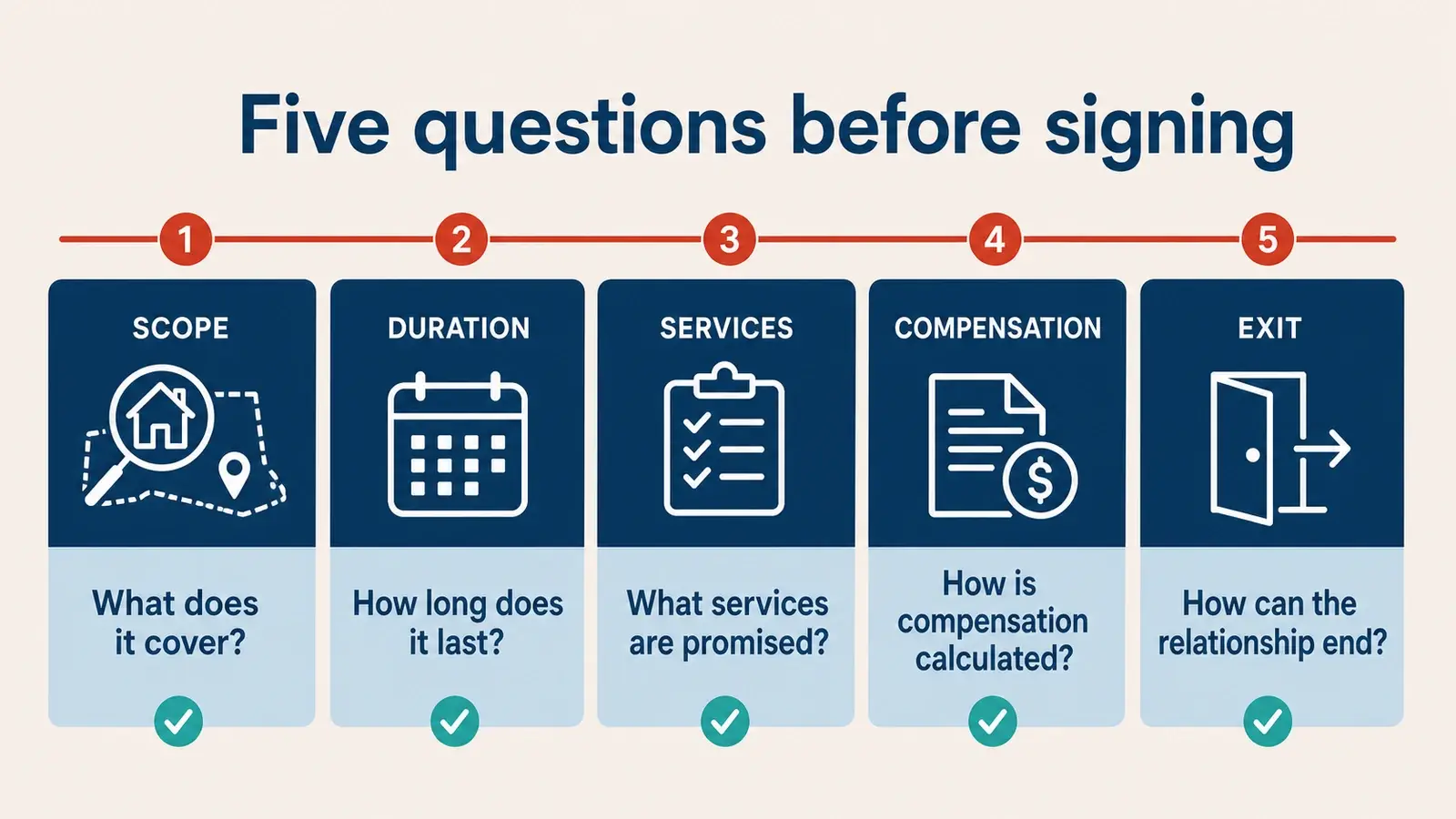
- The buyer, agent, and brokerage are identified correctly
- Representation and confidentiality duties are clear
- Promised services appear in writing
- Exclusivity, geography, and property types are defined
- Start and end dates are filled in
- Compensation and every separate fee are understandable
- You know what happens if seller-side payment is lower than the agreed amount
- Termination, notice, and carryover terms are clear
- Conflict and dispute procedures are disclosed
- All blanks are completed and referenced attachments are included
- You will receive a signed copy
Keep the agreement, amendments, compensation discussions, offer terms, and lender answers together. A clear paper trail is more useful than trying to remember a conversation later.
What to do if you have already signed
First, get a complete signed copy and read the scope, expiration date, compensation, termination, and carryover provisions. Write down what you do not understand.
Then ask the agent or managing broker to explain the language and any options for changing or ending the agreement. If the explanation does not resolve your concern—or if the question involves enforceability, cancellation rights, fees, or agency duties—consider speaking with a qualified local real estate attorney or state real estate regulator before taking action.
Do not assume that stopping communication automatically ends the contract.
Know when to pause and get local help
Pause if you cannot explain the compensation formula, the agreement is broader than your search, you feel pressured to sign immediately, the exit language is unclear, or the agent’s explanation conflicts with the written terms.
For broader homebuying preparation, HUD-participating housing counseling agencies can provide pre-purchase counseling and homebuyer education. Some services may involve a disclosed nominal and reasonable fee; participating agencies must waive a fee when a client cannot afford it. Housing counseling does not replace legal advice about a specific contract.
Your next step is simple: ask for time to read the agreement, mark the scope, money, and exit clauses, and sign only when you can explain what each one means for your home search.