
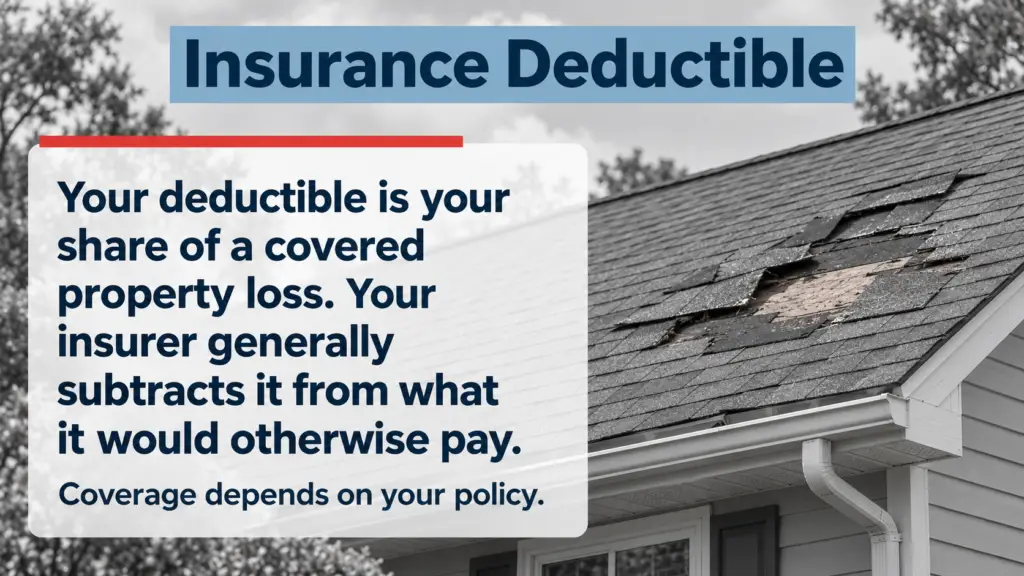
A homeowners insurance deductible is your share of a covered property loss. It is different from your premium, which is what you pay for the policy. Paying the premium does not eliminate the deductible that may apply when you have a covered loss.
Deductibles can be fixed dollar amounts or percentages, and some policies have separate deductibles for certain kinds of losses. Understanding how your policy calculates each deductible helps you see what the insurer may pay and what you would need to cover yourself. The examples below explain the differences without assuming that every policy works the same way.
How a Deductible Works: Flat-Dollar vs. Percentage
The insurer generally subtracts the applicable deductible from the amount it would otherwise pay for a covered property loss.
A Flat-Dollar Deductible
Imagine a covered kitchen fire leaves $12,000 in repair costs. With a $1,000 deductible, sufficient coverage and no other claim adjustments, the simplified insurance payment would be $11,000. The actual result still depends on the policy, its limits, exclusions, endorsements—documents that change the policy’s terms—and the facts of the loss.
A Percentage Deductible
A percentage deductible is not necessarily a percentage of the repair bill. The National Association of Insurance Commissioners (NAIC) explains that percentage deductibles typically use the home’s insured value to determine a dollar amount, although the exact calculation depends on the policy.
For illustration only: if a policy uses $400,000 of dwelling coverage—the amount it insures for your home’s structure—to calculate a 2% deductible, the dollar deductible would be $8,000. A $12,000 otherwise payable covered loss subject to that deductible would leave a simplified $4,000 insurance payment.
| Item | $1,000 fixed deductible | 2% deductible on $400,000 |
|---|---|---|
| Otherwise payable covered damage | $12,000 | $12,000 |
| Applicable deductible | $1,000 | $8,000 |
| Simplified insurance payment | $11,000 | $4,000 |
Both examples assume a covered loss, sufficient coverage, no other adjustments, and the stated deductible applying to that loss.
Watch Out: Your policy may calculate a percentage deductible from an insured amount, rather than the repair bill. Ask what your policy uses and what that means in dollars.
The deductible is not an automatic fee whenever something breaks. If an otherwise covered repair costs less than the applicable deductible, the insurer may not pay toward that repair—but you do not owe the insurer the full deductible amount simply because it appears on the declarations page.
Why You May Have More Than One Deductible
Some policies have a standard deductible plus a separate hurricane, named-storm, windstorm, or wind-and-hail deductible. NAIC says these can be fixed-dollar or percentage deductibles. Whether one applies depends on the event or conditions that activate that deductible, the policy terms, state law, and insurer rules. Do not assume that two deductibles both apply to the same loss—or that a storm deductible will apply the same way in every state.
Start with the declarations page, then read the policy and endorsements. If you see more than one deductible, ask for a written explanation of when each applies and what each means in dollars.
How Your Deductible Affects Your Premium
NAIC explains that a lower deductible generally corresponds with a higher premium.
A higher deductible may reduce the premium while increasing the amount you would need to handle after a covered loss. A lower deductible may do the opposite. Compare the actual quotes, then ask: if a covered loss happened next month, could we manage this deductible without putting essential bills at risk?
Does Mortgage Escrow Cover the Deductible?
Paying your premium through mortgage escrow does not, by itself, pay your deductible. An escrow account holds money your mortgage company collects with your mortgage payment for bills such as property taxes and insurance premiums.
That is different from funding your share of a future claim. For questions about what your mortgage payment covers, ask the company handling those payments. For questions about the deductible, ask your insurer.
Which Deductible Amount Makes Sense for You?
NAIC’s consumer guidance is straightforward: choose a deductible you can afford if a loss occurs.
The amounts available depend on the insurer, policy, location, and home. A 2026 Federal Reserve Bank of New York analysis of millions of mortgage-linked homeowners policies from 2021 found that the policies had deductibles in common round-number increments such as $500, $1,000, $1,500, $2,000, $2,500, and $5,000, with $1,000 the most common choice in that dataset. That is context, not a recommendation for your home or proof that those choices will be offered to you.
| If the quote offers this choice | Ask yourself |
|---|---|
| Lower deductible | Would the higher premium still fit the household budget? |
| Higher deductible | Could the household cover that amount after a covered loss without creating another financial problem? |
| Percentage or separate storm deductible | Could the household cover the calculated dollar amount if that deductible applies? |
Ask whether the insurer can quote different deductibles without changing the coverage limits, endorsements or method it uses to value a covered loss. Then compare the actual premium difference against the additional claim-time amount you would take on. Do not rely on a generic savings percentage: the change in price and terms is specific to the quote.
Compare the Full Policy, Not One Number
Whether you are reviewing your current policy or comparing quotes, look at these details together:
- Premium and standard deductible.
- Any separate deductible and its calculation base.
- Limits for your home’s structure, belongings, liability, and extra living costs if a covered loss makes your home unlivable.
- Exclusions and endorsements that need clarification.
- The declarations page, policy form, and contact who can explain an unclear term.
NAIC notes that the policy contract and its limits govern homeowners coverage. A deductible comparison is incomplete if you have not also read what the policy covers and excludes.
One Question to Ask About Your Policy
Ask the insurer or agent: “Can you show me every deductible that could apply, what each one means in dollars, and when it would apply?”
Save that explanation with the quote, declarations page, policy form, and endorsements. You cannot predict every problem your home may have. You can avoid choosing only on premium when the deductible and policy terms could matter just as much later.
For a broader policy check at renewal, use AHA’s homeowners insurance renewal checklist to compare what changed.