
A slow drain rarely announces itself as a plumbing problem. The bathroom sink takes a little longer to empty. Water starts lingering around your feet in the shower. The kitchen sink seems fine—until one evening it isn’t.
Then comes the familiar question: What should you pour down there?
Learning how to keep drains clear is less about finding the strongest cleaner and more about keeping clog-causing material out, removing buildup while it’s still easy to reach, and recognizing when a slow drain points to something deeper.
Chemical drain cleaners such as Drano have a place in that picture, too. But they’re one option—not a maintenance plan.
Here’s what works, what doesn’t, and how to know when your drain needs more than another treatment.
Most Drain Clogs Build Before You Notice Them
A completely stopped drain can feel sudden, but many clogs develop little by little.
In a bathroom, hair catches around a stopper or inside the drain. Soap residue and other debris collect around it. In the kitchen, grease and food residue can gradually narrow the path water has to travel.
That’s why good drain maintenance starts before the water stops moving.
Catch hair before it disappears into bathroom plumbing. Keep fats, oils, and grease out of the kitchen sink. Use strainers where they make sense. And pay attention when a drain begins emptying noticeably slower than it used to.
A slow drain is often the easiest version of the problem to fix.
How to Keep Kitchen Drains Clear
Kitchen drains have one especially stubborn enemy: grease.
Liquid cooking oil may look harmless while it’s warm, but fats and grease don’t belong down the sink. Let grease cool and dispose of it appropriately instead. Scrape substantial food scraps from plates before washing them rather than expecting the drain to handle everything.
If you have a garbage disposal, think of it as a helper for ordinary food residue—not a substitute for the trash can. Follow the operating instructions for your particular model and avoid sending large amounts of food through it at once.
A basic sink strainer is also surprisingly effective. Empty what it catches into the trash rather than washing the debris through.
Pro Tip: The easiest clog to clear is the one that never enters the pipe. A strainer, hair catcher, and trash can can do more for long-term drain maintenance than a shelf full of cleaners.
Bathroom Drain Maintenance Is Mostly About Hair
Bathroom drains tend to give you a more obvious culprit.
One strand of hair isn’t much of a problem. Enough strands wrapped around a stopper, mixed with soap residue and other debris, can become a dense obstruction.
A simple hair screen can stop much of that material before it enters the plumbing.
Periodically remove an accessible stopper or drain cover and clean away the hair and buildup you can reach. A small plastic hair-removal tool can sometimes solve a slow bathroom drain in minutes.
There’s nothing sophisticated about physically pulling a clog out.
That’s part of why it works so well.
What to Try When a Drain Starts Running Slowly
If just one sink, tub, or shower is affected, start near that fixture.
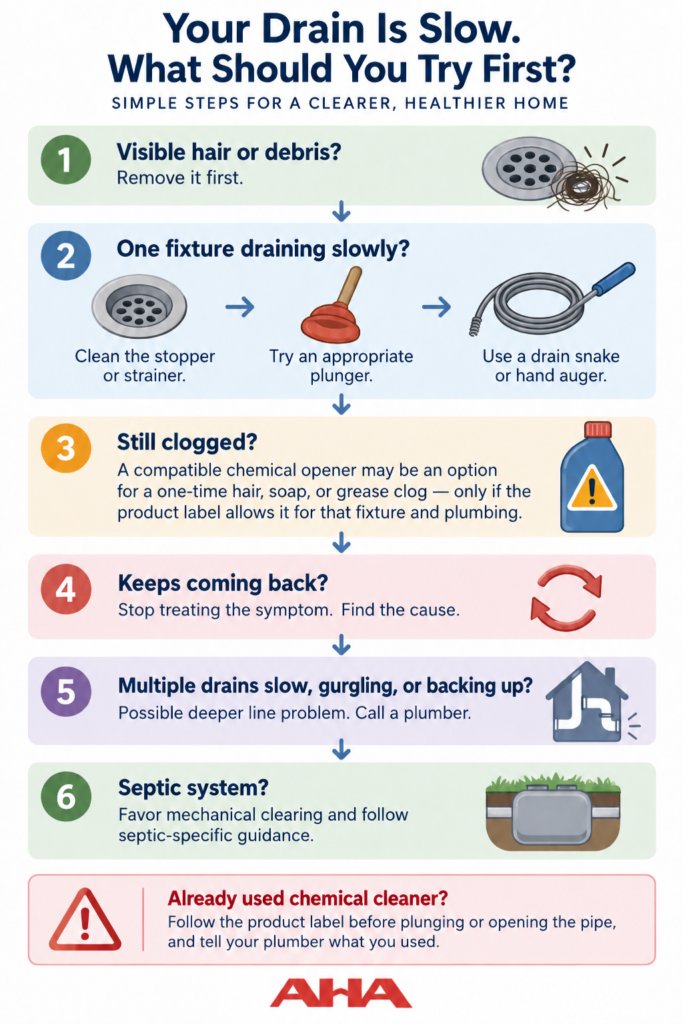
Remove visible debris and clean the stopper or strainer first. If the drain is still slow, an appropriate plunger may help move a localized obstruction. A hand-operated drain snake or auger can reach farther into the line and retrieve or break through buildup.
The U.S. Environmental Protection Agency lists a plunger or plumber’s snake as alternatives to drain cleaner in its household hazardous-waste guidance. EPA household hazardous-waste guidance
The larger principle is useful whether you’re on septic or connected to a municipal sewer:
Start with the least aggressive method likely to solve the problem.
How to Unclog a Slow Drain Safely
If a drain is slow but still moving, start with the simplest fix before reaching for a chemical cleaner.
First, remove the stopper or strainer and pull out any hair or debris you can reach. In bathrooms, that alone may solve the problem. If the drain is still slow, try an appropriate plunger or a small hand-operated drain snake.
These mechanical methods have an advantage: they remove or break through the blockage without adding a corrosive product to the pipe.
If you’re considering a chemical drain opener after that, make sure the product is approved for your fixture and plumbing, and follow the label exactly.
Watch Out: If you’ve already poured a chemical drain cleaner into the pipe, don’t automatically plunge or take the plumbing apart. Some products can splash back if the clog is still holding chemical in the line.
If the same drain keeps slowing down after you clear it, stop treating it as a simple clog. A recurring problem may be farther down the line or caused by something a drain cleaner can’t fix.
Are Chemical Drain Cleaners Like Drano Safe for Your Pipes?
This is where homeowner advice often becomes more dramatic than it needs to be.
You may have heard that products like Drano inevitably eat away at plumbing. That’s too broad.
SC Johnson says its Drano Max Gel is safe for household pipes when used according to the label and says the formulation contains an ingredient intended to protect pipes from corrosion. Its directions also specify where and how the product should be used. Drano Max Gel product instructions
That means we shouldn’t tell homeowners that one properly used dose of a compatible mainstream drain opener automatically damages healthy plumbing.
But there’s an equally important second half to the answer: chemical drain cleaners are powerful products, and formulas differ.
Poison Control notes that many non-enzymatic drain cleaners contain concentrated corrosive chemicals and that some formulations generate heat as they work on grease and other oily material. Poison Control’s drain-cleaner guidance
So the sensible rule isn’t “chemical drain cleaners always ruin pipes” or “chemical drain cleaners are harmless.”
It’s this:
Use only a product that’s intended for your fixture and plumbing, follow the label exactly, and don’t make repeated chemical treatment your answer to a drain that keeps clogging.
The Pros and Cons of Chemical Drain Cleaners
Their biggest advantage is convenience.
Some chemical drain openers can break down hair, soap residue, grease, and other organic buildup without requiring you to open a trap or feed a cable into the pipe. Certain gel products can also move through standing water to reach the obstruction.
For an occasional clog that matches what the product is designed to treat, that can be useful.
But there are limits.
A chemical cleaner can’t repair a damaged drain line. It can’t straighten a poorly sloped pipe, remove tree roots, or fix a collapsed section of sewer line. And if a solid object is lodged in the plumbing, dissolving hair and grease around it doesn’t solve the real problem.
There’s also a more immediate downside: safety.
Poison Control warns that corrosive drain cleaners can cause serious skin and eye burns, and splash-back can occur when product is poured into a completely blocked drain.
That becomes especially important if the cleaner doesn’t work. Now you may have a clogged drain containing a corrosive product, which changes what you should do next.
Watch Out: Never mix a drain opener with another drain cleaner or household cleaning product. Follow the manufacturer’s precautions exactly.
Some Drano products specifically warn against using a plunger during or after treatment because chemical product may still be present if the drain hasn’t cleared.
If you’ve already used a chemical cleaner and later call a plumber, tell them exactly what you put into the drain.
Do Chemical Drain Cleaners Damage Plumbing Over Time?
This question deserves a careful answer.
There isn’t a good basis for saying that every proper use of every mainstream drain opener gradually destroys every household pipe. The manufacturer of Drano Max Gel, for example, specifically labels it as safe for pipes when used as directed.
But that doesn’t make repeated chemical treatment a good strategy.
Different cleaners use different formulations, and homes can contain different generations and types of plumbing. More importantly, a drain that continually needs treatment is giving you useful information.
Think about a tire that needs air every few days.
At first, adding air solves the immediate problem. Eventually, though, the useful question becomes: Why does it keep losing air?
A recurring drain clog deserves the same shift in thinking.
If you’re trying to decide where a recurring plumbing issue fits among everything else your home needs, AHA’s guide to prioritizing home repairs with the Protect–Prevent–Improve Framework can help you sort the decision without assuming every slow drain is an emergency.
Does Baking Soda and Vinegar Actually Unclog a Drain?
Few DIY drain-cleaning tricks look more convincing.
Pour baking soda and vinegar together and you immediately get fizzing and bubbling. It certainly looks like the clog is under attack.
The chemistry is less impressive than the show.
Baking soda is alkaline and vinegar is acidic. Their reaction produces carbon dioxide gas, but household drains aren’t airtight. The gas can escape rather than building enough pressure to force out a substantial obstruction.
Poison Control says the combination generally doesn’t generate enough pressure to dislodge a clog and is unlikely to be strong enough to tackle tough oil- and grease-based blockages.
That doesn’t mean baking soda and vinegar have no cleaning uses.
It simply means fizzing isn’t the same as unclogging.
If there’s a wad of hair sitting beneath a stopper, physically removing it is usually more direct.
What About Enzyme or Bacterial Drain Products?
These products are different from fast-acting caustic drain openers.
Rather than aggressively attacking a blockage, enzyme- or bacteria-based products work more gradually on certain types of organic material.
That can make them better suited to maintenance than to a sink that’s already completely blocked.
But they’re still products being introduced into your drainage system. Use only one intended for your plumbing, follow the directions, and don’t assume a maintenance product can correct a physical obstruction or damaged pipe.
If a drain continually needs treatment—chemical, biological, or otherwise—the recurring problem deserves attention more than the choice of cleaner does.
If You Have Septic, Drain Care Is Different
A home with a septic system deserves more conservative drain-care guidance.
Some manufacturers label individual drain-cleaning products as compatible with septic systems. But EPA’s broader homeowner guidance recommends avoiding chemical drain openers for clogged drains in septic systems and using mechanical clearing, such as a drain snake, instead. EPA also cautions homeowners about what they send down the drain because the septic system depends on living organisms to treat household wastewater. EPA guidance for caring for a septic system
For AHA homeowners, that makes the next step simple:
If your home is on septic, favor mechanical drain clearing and follow septic-specific guidance for your system.
State and local septic requirements can vary, so your local health department or qualified septic professional may also be an important resource.
When a Slow Drain Is Telling You Something Bigger
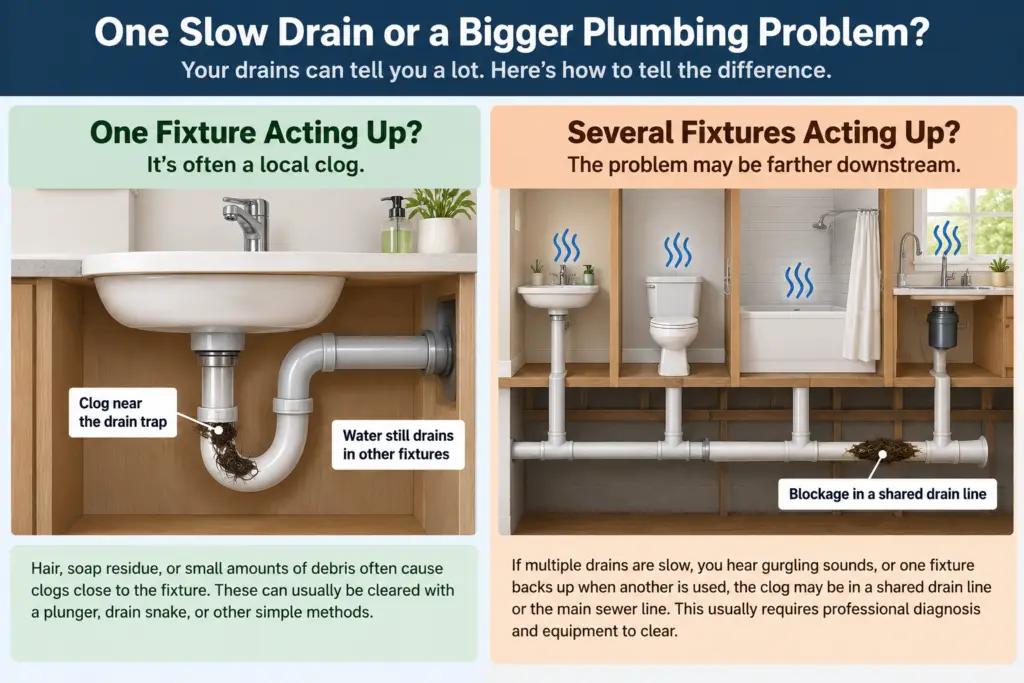
One sluggish bathroom sink often points toward something near that fixture.
Several fixtures behaving strangely at the same time are different.
Pay more attention if multiple drains begin slowing down, the same clog quickly returns after being cleared, one fixture backs up when another is used, or you hear recurring gurgling from drains or toilets.
Those patterns can suggest that the obstruction is farther downstream.
A chemical cleaner designed to dissolve hair or grease won’t repair a deteriorating line or remove every type of deeper obstruction.
That’s the point where diagnosis becomes more useful than another treatment.
When to Call a Plumber
You don’t need professional help every time a sink takes a few extra seconds to empty.
But consider calling a plumber when the same clog keeps returning, several drains become slow at once, wastewater backs up into another fixture, or reasonable mechanical clearing doesn’t restore normal flow.
If you’re unsure whether the job still belongs in DIY territory, AHA’s DIY Home Repairs: Fix It Yourself or Call a Pro?offers a practical way to think about risk, tools, and when professional help makes more sense.
If sewage or contaminated wastewater is actually backing up into the home, treat it differently from an ordinary slow drain. Avoid casual contact with the water and get appropriate help. AHA’s Homeowner’s Emergency Guide also covers flooding and sewer-backup planning as part of broader home-emergency preparation.
And if a chemical drain opener is already sitting in the plumbing, make sure the plumber knows before work begins.
The Best Drain Maintenance Is Simple
Good drain care doesn’t need to become another complicated homeowner routine.
Keep grease and obvious solids out of kitchen drains. Catch hair before it disappears into bathroom plumbing. Clean strainers and stoppers when you notice buildup.
When a drain starts slowing down, deal with the material you can see and reach before escalating to stronger methods.
Use an appropriate plunger or drain snake when it makes sense.
A compatible chemical drain cleaner can be one option for certain clogs. It simply doesn’t need to be your default—or something you repeatedly use without understanding why the problem keeps returning.
The rule worth remembering is:
Prevent what you can. Remove what you can reach. Use the least aggressive method that works. And when a clog keeps coming back, find out why.
You don’t need to become a plumbing expert to take good care of your drains. You just need to recognize when the simple fix is enough and when your home is telling you to look deeper.
Want a broader view of what deserves attention around your home? The free AHA HomeCheckup helps you see what matters now, what can wait, and what to plan for next.