

A property alert can make your stomach drop. One minute you are checking email; the next, you are staring at a notice with a document number, an unfamiliar office name, or your property address attached to it.
It is natural to wonder, “Did someone just mess with my house?”
Take a breath. Most property alerts are early-warning tools. They watch activity in a specific records system and notify you when a new filing matches the name, parcel number, address, or other information you registered. They generally do not investigate the document, stop it from being recorded, or monitor every system connected to your home.
Think of the notice as a prompt, not a verdict. You should not ignore it, but you also do not need to assume the worst before checking what actually happened.
Quick answer: Property alerts commonly monitor newly recorded local land documents that match a registered name, address, parcel number, or similar identifier. Depending on the program, they may flag deeds, mortgages, liens, releases, or other selected documents. An alert does not prove fraud, prove ownership, decide whether a document is legally valid, or fix a title problem.
Why a Property Alert Can Feel So Urgent
Your home is not just another account on a dashboard. It may be your largest asset, your mailing address, your mortgage, your insurance file, and the place where everyday life happens. So when an unexpected notice mentions a deed, lien, mortgage, or recorded document, it can feel personal fast.
Most homeowners do not review their local land records regularly. The documents themselves often use formal language, unfamiliar abbreviations, and filing numbers that provide little immediate context. An alert may tell you that something matched without explaining whether it is expected, unrelated, routine, or worth closer attention.
A helpful way to think about it is like a smoke alarm chirp. You do not ignore it, but you also do not assume the house is on fire until you check what is causing it.
What Is a Property Alert?
Think of a property alert as a saved search inside a records system.
You tell the service which name, address, parcel number, business name, or property identifier to watch. When a newly recorded document matches the program’s search rules, the system may send an email, text message, letter, or automated call.
Depending on where you live, the alert may be offered by a county recorder, register of deeds, county or circuit court clerk, municipal property-record office, local government vendor, or private monitoring company.
These programs are not standardized nationwide. Hillsborough County, Florida, says its program notifies enrolled users when a document is recorded using a registered personal or business name. Palm Beach County’s program uses an exact match involving a registered name, address, or parcel number. New York City’s program is tied to selected deed-related and mortgage-related documents recorded against a registered property. Those examples show why the words “property alert” alone do not tell you exactly what is being watched.
Most programs also begin monitoring after your registration becomes active. Do not assume that enrolling today will automatically identify documents recorded before you signed up. Check the local program’s terms if you are concerned about older activity.
What Property Alerts Commonly Monitor
Most property alerts watch one public recording system. They do not continuously scan every account, government database, or private file connected to your home.
Documents Recorded Under Your Name
Some systems look for newly recorded documents containing the personal or business name you registered. Depending on the local office and the program’s coverage, a match might involve a:
- Deed
- Mortgage or deed of trust
- Lien
- Release or satisfaction
- Assignment
- Easement
- Corrected or re-recorded document
- Other locally indexed land document
Name-based monitoring has an important limitation: the system may search the version of the name you entered.
Suppose your deed lists you as Rebecca L. Morgan, but you register only Becky Morgan. An exact-match system may not connect the two. Middle initials, former last names, suffixes, spelling variations, trust names, and business entities can all matter.
Pro Tip: Review your current deed before enrolling. When the system allows it, register each owner separately and include the name, address, trust, or business-name variations the local office recommends. Palm Beach County, for example, specifically warns that its alerts depend on exact matches.
Documents Connected to an Address or Parcel Number
Some systems let you monitor a street address, assessor parcel number, property identification number, folio number, borough-block-lot number, or similar local identifier.
A parcel-based search can be more property-specific than a name search. But identifiers and matching rules still vary, so use the current information accepted by the local program rather than assuming an old closing document has everything you need.
Address matching can have limits too. A program may treat abbreviations or variations differently, or it may index the property using a legal or local identifier rather than the mailing address you use every day.
Selected Ownership, Deed, or Mortgage Documents
Some alert programs are narrower than others. New York City, for example, says its Notice of Recorded Document program covers selected deed-related and mortgage-related documents rather than every document recorded on the property.
Before relying on a service, check whether it monitors:
- All indexed land records or only selected document types
- Ownership-transfer documents
- Deed-related or mortgage-related filings
- Personal or business names
- Addresses or parcel identifiers
- Some combination of these criteria
The enrollment page should explain the program’s actual coverage.
What an Alert Actually Means
An alert means the system found a match. It does not mean the document is fraudulent or that someone has taken your home.
Ordinary homeowner transactions can produce recorded documents and alerts, including:
- Buying or selling a home
- Refinancing a mortgage
- Paying off a mortgage or home-equity loan
- Recording a release or satisfaction
- Transferring property into a trust
- Settling an inheritance, divorce, or probate matter
- Recording or releasing a contractor lien
- Correcting an earlier document
- Recording an easement or boundary agreement
The timing can be confusing. You may have paid off a loan several weeks ago and mentally crossed it off your list, while the related release is recorded later. The alert can seem suspicious even when it reflects something you authorized.
A recording office generally records documents that meet its filing requirements. New York City’s Department of Finance explicitly notes that it is required to record documents that meet those requirements. An alert from a recording system is therefore not a ruling about a document’s truth, signature, legal effect, or validity.
Watch Out: An unfamiliar alert deserves a closer look, but it is not proof of fraud. Verify the filing through the official records office before clicking payment links, sending money, or assuming ownership has changed.
What Property Alerts Do Not Prove
A property alert can tell you that something matched the system’s rules. It generally cannot answer the larger legal or financial question for you.
| Tool or notice | What it commonly watches | What it does not decide |
|---|---|---|
| Property or recorder alert | New activity matching a registered name, address, parcel, or local search field | Whether the filing is fraudulent, legally valid, or effective |
| Paid title monitoring | Activity covered by the provider’s monitoring system | Whether title is clear or a filing can be prevented |
| Title insurance or title review | Covered title issues under a policy or professional review | Every new property-record change after closing |
| Credit fraud alert or freeze | New-credit activity and access to a credit file | Ownership, deed validity, or county land-record activity |
| Mortgage servicing alert | Account, payment, escrow, or servicing activity | Every document recorded against the property |
A notice is not a title search. It is not a court ruling. It is not proof of a valid debt. It is not a determination that ownership has changed.
It is a reason to look closer.
What Property Alerts Usually Do Not Monitor
Knowing what may trigger an alert is only half the picture. The other half is understanding the systems the alert should not be assumed to check.
Credit and Identity Activity
A deed or recorder alert generally does not tell you that someone applied for unrelated credit in your name, changed information in a credit file, or used your identity somewhere outside the land-record system.
Credit freezes and fraud alerts operate through the credit-reporting system. The Federal Trade Commission explains that a freeze restricts access to a credit report, while a fraud alert tells businesses to verify identity before opening new credit. Those tools may help with identity-theft risks, but they do not monitor a county deed index.
If you believe your identity was misused, IdentityTheft.gov can create an FTC Identity Theft Report and a personal recovery plan.
Mortgage-Servicing Activity
Your mortgage servicer maintains its own account records. A property alert may detect a recorded mortgage, assignment, release, or satisfaction if that document matches the program’s rules. It should not be assumed to report a missed payment, escrow adjustment, automatic-payment change, attempted account login, or other activity that stays inside a servicer’s system.
Continue reviewing mortgage statements and servicer notices separately.
Tax, Assessment, Permit, and Code Activity
Land records, tax records, and building records may be handled by different local offices and systems. Unless an alert program explicitly says otherwise, do not assume a recorder alert covers assessment changes, tax-account activity, building permits, zoning matters, inspections, or code cases.
Check which office maintains the record in your jurisdiction and whether that office offers a separate notification service.
Insurance Activity and Unrecorded Scams
A local land-record alert should not be assumed to monitor homeowners insurance claims, cancellations, renewals, premium changes, phishing emails, fake invoices, account takeovers, or pressure to sign a document that has not reached the recording system.
If a scam never produces a matching public record, the recorder alert has nothing to find.
Property Alerts Do Not “Lock” Your Title
Some paid services use phrases such as “title lock,” which can sound as though a protective barrier has been placed around your deed.
That is not how the monitoring service described by the Federal Trade Commission works. The FTC distinguishes so-called home title lock products from title insurance and says the monitoring product would notify someone after an unauthorized transfer rather than stop the transfer.
Title insurance is different. State insurance regulators describe it as coverage for certain title defects or claims under the policy’s terms. Coverage, exclusions, claims procedures, and state rules vary, so monitoring should not be treated as a replacement for reviewing your actual policy or contacting the title insurer.
When comparing a paid monitoring service, look past words such as “lock” and “protection.” Ask:
- Which jurisdictions are monitored?
- Does the service search by name, address, parcel, or another identifier?
- Which document types are covered?
- How quickly are alerts delivered?
- What help is available after a suspicious alert?
- What exclusions or limits apply?
- What does the service cost, and how do you cancel?
A local-government alert may provide the notification a homeowner wants at no charge, where such a program is available. A paid service may offer different coverage or assistance, but its value depends on what it actually does—not what it is called.
What to Check When an Alert Arrives
You do not need to solve every possible problem at once. Start by figuring out what the alert is and whether it corresponds to a real official record.
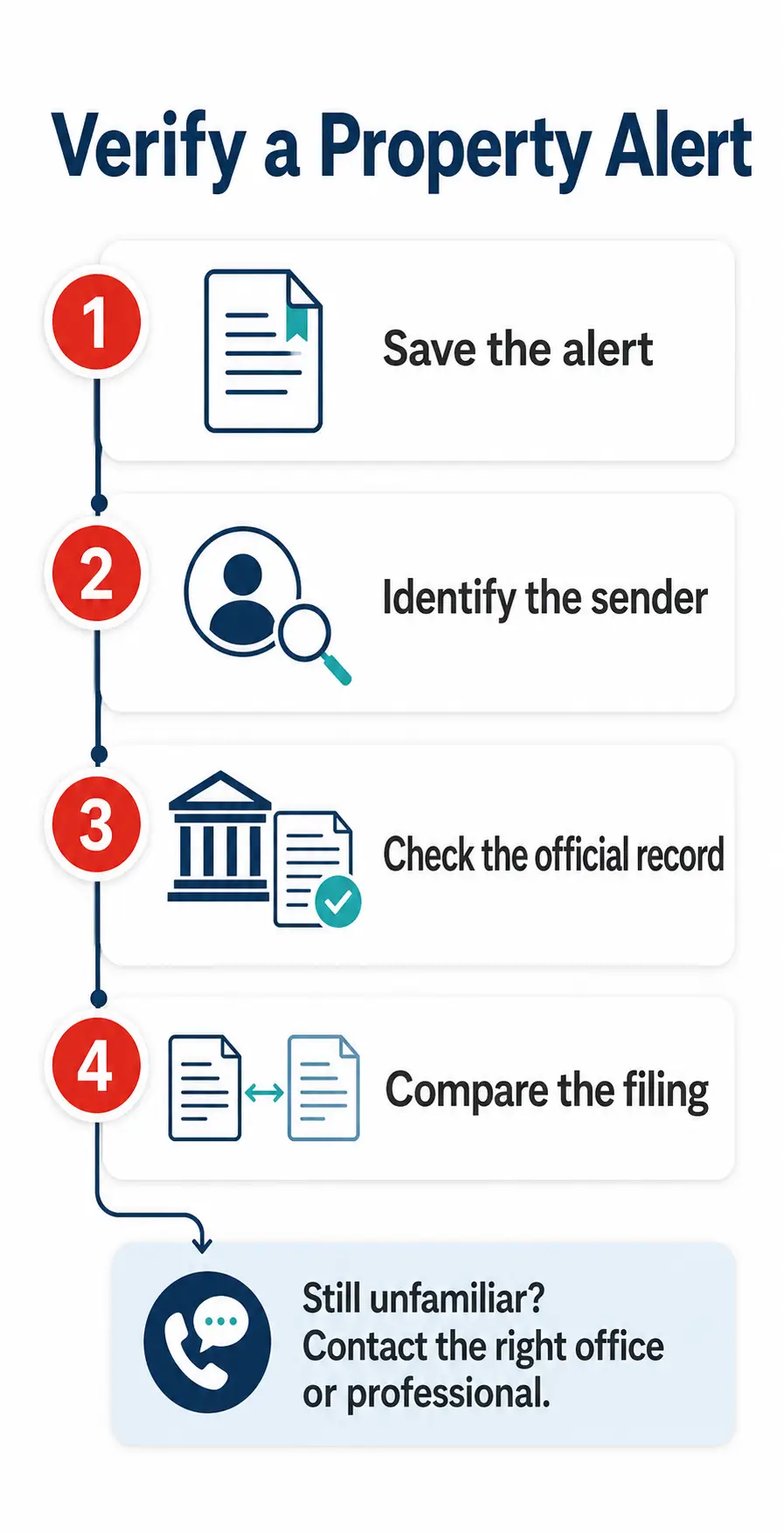
Save the Alert
Keep the email, screenshot, voicemail, text, or letter. Save any document number, recording date, office name, names listed, property identifier, and search terms included in the notice.
Confirm Who Sent It
Identify the source. Was the notice sent by a recorder or clerk, a municipal portal, a lender or servicer, a title company, a credit or identity-monitoring provider, or a paid title-monitoring company?
The sender helps you identify which system may have detected the activity.
Check the Official Record
Do not rely only on a link or phone number in an unexpected message. Navigate independently to the official county, city, court, recorder, or clerk website. When possible, begin with the local government’s main website rather than a search-result advertisement or lookalike domain.
Use the search method accepted by the official system. That might be a document number, owner name, parcel number, address, or another local identifier.
Compare the Details
Look for the:
- Document type
- Recording date
- Names of the parties
- Property address or parcel number
- Legal description
- Instrument, document, clerk file, or book-and-page number
- Office that recorded or indexed it
- Connection to a recent event you recognize
Ask whether the filing could relate to a refinance, payoff, sale, trust update, probate matter, contractor lien, mortgage release, or another transaction.
Property records often use formal language. You do not need to become a title expert overnight. Your immediate goal is simpler: confirm that the alert corresponds to a real record and determine whether that record makes sense.
Who to Contact First
You do not need to turn one alert into six phone calls. Match the question to the right source.
Start With the Recording Office
Contact the recorder, clerk, register of deeds, or other local recording office when you need help confirming whether a document appears in the official record, locating or obtaining a copy, understanding the local index, or learning the office’s reporting process.
The office may explain its records and procedures. It generally cannot act as your attorney or decide the legal validity of a disputed document.
Call Your Lender for Loan-Related Documents
Contact your lender or mortgage servicer if the filing appears to involve a mortgage, deed of trust, assignment, release, satisfaction, payoff, or loan you do not recognize. Compare the recorded document with your account and closing records.
Ask Your Title Company About Title Concerns
Contact your title company or title insurance provider if the issue appears connected to a prior closing, your title policy, ownership history, an old lien, a possible title defect, or a claim that may fall under the policy.
Coverage and claim procedures depend on the policy and applicable state law.
Get Legal Help for Ownership or Signature Disputes
Consider contacting a qualified real estate attorney when a document appears to change ownership, create a lien or claim you do not understand, include a signature you dispute, transfer rights without your knowledge, or raise a legal question the recording office cannot answer.
Property law, recording rules, liens, title remedies, and dispute procedures vary by state and locality.
Treat Identity Theft as a Separate Problem
If you suspect someone used your identity, the property alert alone will not resolve the issue. You may need to address the land record and identity theft through separate channels. IdentityTheft.gov provides a federal reporting and recovery-planning process.
If you believe a crime occurred, law enforcement may also be appropriate. Gather the official document, alert, identification records, closing papers, lender communications, and any professional guidance so you can explain the concern clearly.
A Simple Property-Monitoring Routine
A property alert is most useful when it is one small part of how you keep tabs on your home—not the only part.
Start with the office that records deeds in your jurisdiction. Search the official local-government website for terms such as recorder, register of deeds, county clerk, circuit court land records, or official records.
Enroll in the official alert program if one is available and useful to you. Register the information the system actually uses, which may include owner-name variations, a property address, a parcel number, or a business or trust name.
Keep important records where you can find them, including your deed, title policy, closing disclosure, mortgage documents, loan-payoff records, trust or estate documents, major lien releases, and property-tax notices.
Remember that different records may live in different places:
| Office or service | Records it commonly maintains |
|---|---|
| Recorder or clerk | Deeds, mortgages, liens, releases, assignments, and other recorded land documents |
| Assessor or tax office | Assessment, exemption, mailing, ownership, or tax-account information, depending on local structure |
| Building department | Permits, inspections, zoning, or code records, depending on local structure |
| Mortgage servicer | Payments, escrow, payoff, and servicing activity |
| Credit bureaus | Credit applications, accounts, and credit-file activity |
| Insurance company | Coverage, claims, renewal, and policy changes |
You do not need to check each system every week. You simply need to know which alerts you have activated and where to verify an unfamiliar notice.
The Bottom Line
Property alerts can help you notice unfamiliar land-record activity sooner. Used properly, they are a useful layer of awareness.
They are not a lock on your deed, proof that a document is valid, or a substitute for watching your mortgage, taxes, credit, and insurance. They are a starting point.
When an alert arrives:
- Save it.
- Identify the sender.
- Check the official record.
- Compare the filing with recent activity.
- Route the question to the right office or professional.
You do not have to become an expert in deeds, liens, title searches, and recording systems to be a responsible homeowner. You just need to know the difference between a notice and a conclusion.
That is the real protection: not watching every public record every day, but knowing what to check and what to do when something does not look familiar.
Explore more AHA guidance for protecting your property records, documents, and homeownership decisions.