
You’re reviewing a mortgage estimate for a home you can already picture living in. You’ve worked through the down payment and started thinking about moving costs. Then you notice another charge: private mortgage insurance (PMI).
It’s reasonable to pause. You’re already budgeting for homeowners insurance. Why would you need another policy—and should you put more money down to avoid it?
You don’t have to follow someone else’s rule about the “right” down payment. Start with the full payment, the cash needed to buy, and the savings you’ll have afterward. If you already own your home, the question changes: what kind of mortgage insurance are you paying, and when can it end? Understanding the charge makes both conversations easier.
What Is Private Mortgage Insurance?
PMI protects the lender against losses if you stop repaying your mortgage. It’s typically required on a conventional purchase loan with less than 20% down. A conventional loan is a mortgage outside government insurance or guarantee programs such as the Federal Housing Administration (FHA).
Paying for someone else’s protection can feel backward. But reducing the lender’s risk can make a smaller-down-payment loan available to you. The tradeoff is an additional borrowing cost. PMI doesn’t take over your payments after an income loss or cover damage to your house and belongings. Homeowners insurance serves a different purpose.
Seeing PMI on an estimate doesn’t mean you’ve made a mistake. It means there’s another cost to understand. The CFPB’s explanation of private mortgage insurance is a useful starting point; AHA’s home-loan basics guide puts it in the context of your overall mortgage.
Why PMI Exists—and How It Came About
The home is collateral for the mortgage, but that doesn’t guarantee the lender will recover everything it is owed. If a borrower stops paying and the home goes through foreclosure, the amount recovered may fall short of the unpaid loan and related costs. A smaller down payment leaves less cushion if the home’s value falls or selling costs reduce the proceeds.
PMI shares that risk with a private insurer. The lender or mortgage investor can file a claim, and the insurer pays the covered amount under the policy’s terms and limits. It doesn’t necessarily cover every dollar lost, and the payment goes toward the lender’s loss—not to you to catch up on payments. That protection can help you qualify with a smaller down payment.
The lender can make PMI a condition of approving that loan. It generally arranges the coverage; with borrower-paid PMI, the cost appears in your loan disclosures. You generally can’t decline required coverage and keep the same loan offer, but you can ask about a different down payment or loan option.
Requirements can also come from the companies that buy mortgages from lenders. For the single-family mortgages Fannie Mae and Freddie Mac buy, their charters require additional credit protection when the loan exceeds 80% of the property’s value. Mortgage insurance is the most common way to meet that requirement, though other permitted arrangements exist. That helps explain the familiar 20% threshold; it isn’t a rule that every mortgage with a smaller down payment must carry PMI.
A milestone in the modern industry came in 1957, when Milwaukee real estate attorney Max Karl founded Mortgage Guaranty Insurance Corporation, or MGIC. The company’s history describes his approach of insuring part of a mortgage as an alternative to government-backed insurance.
Decades later, the Homeowners Protection Act of 1998 addressed a different problem: borrowers’ difficulty ending coverage they no longer needed. It established cancellation, automatic-termination, and disclosure requirements for covered loans. That distinction explains why today’s PMI conversation has two parts: why the loan includes it, and what must happen before the charge can end.

How Much Will PMI Add to Your Payment?
Start with your lender’s quote. Pricing can vary with the down payment, credit score, loan amount, and mortgage type. A number from a general online calculator isn’t a promise of what you’ll pay.
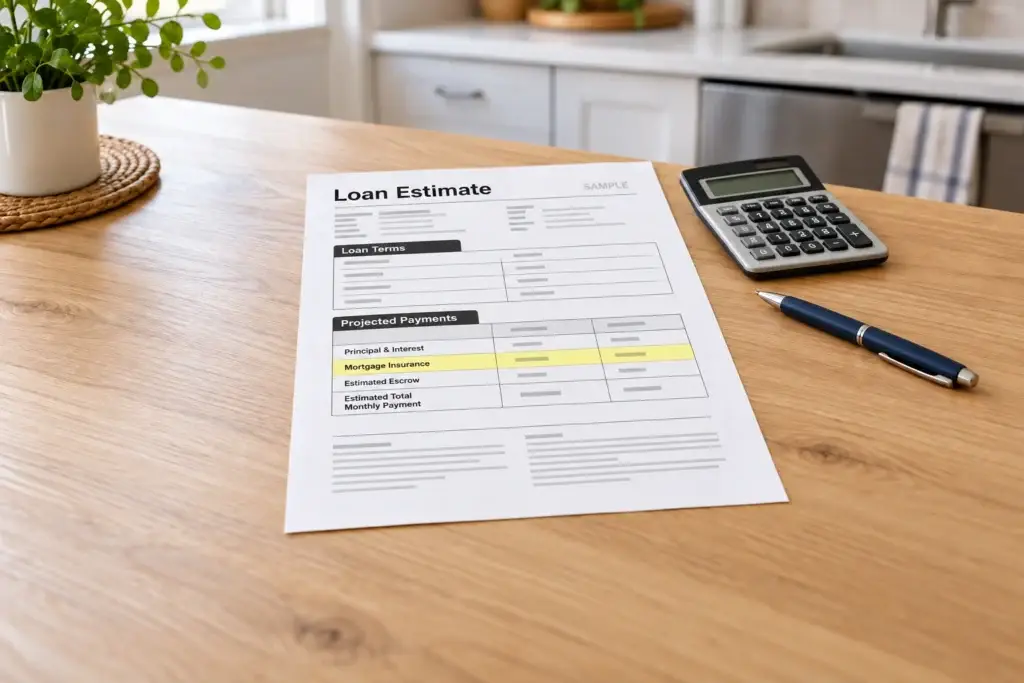
Monthly premiums are common. On the Loan Estimate, look for mortgage insurance in Projected Payments on page 1. An upfront premium appears on page 2 in Section B; some arrangements combine upfront and monthly charges. Ask whether an upfront payment could be refunded if you sell or refinance early.
For illustration, $125 a month adds $1,500 a year while that premium remains in effect. That is hypothetical arithmetic, not a market average or an estimate for your loan.
Then look beyond the charge itself. The Loan Estimate’s estimated total monthly payment includes mortgage insurance and escrow where applicable. Escrow holds money collected for expenses such as property taxes and homeowners insurance. Check which expenses you would pay separately, and leave space in the household budget for utilities, maintenance, and any association dues.
For buyers working through a new build, AHA’s guide to checking a new-construction mortgage payment before closing can help you review the full estimate.
Should You Put More Down to Avoid PMI?
A 20% down payment generally avoids PMI on a conventional purchase mortgage. It may also leave you with less cash after closing. Both effects belong in the decision.
Consider this illustrative purchase:
| $300,000 Home Purchase | 10% Down | 20% Down |
|---|---|---|
| Down payment | $30,000 | $60,000 |
| Starting mortgage principal | $270,000 | $240,000 |
Assumes the purchase price and appraised value are both $300,000. Excludes closing costs and any financed fees; it does not compare interest rates or total borrowing costs.
The additional $30,000 upfront reduces what you borrow. It also reduces the money available for moving, necessary work on the home, and emergencies. AHA’s down-payment guide explores that broader tradeoff.
Imagine one buyer can make the larger down payment, cover closing costs, and retain a comfortable reserve. Another would have almost nothing left, so an appliance replacement would immediately strain the budget. The same purchase presents different decisions for those households. A smaller down payment deserves consideration only if the resulting payment also fits.
If neither option leaves enough breathing room, a lower purchase price or more time saving may be the useful adjustment. Avoid treating the largest loan available as your spending target.
Pro Tip: Ask lenders to price realistic down-payment options using the same loan type and repayment term. Compare rates, fees, mortgage insurance, and rate-lock status together. Beside each offer, write down the savings you expect to have left after closing.
Does a “No PMI” Mortgage Automatically Cost Less?
An offer can remove a separate mortgage-insurance line while putting the cost somewhere else. With lender-paid mortgage insurance, the lender pays the insurer, but the arrangement usually comes with a higher mortgage rate than borrower-paid coverage.
It also lacks the same borrower cancellation rights. Reaching 20% equity doesn’t automatically lower the interest rate. Ask how the cost is built into the offer and compare it over the time you expect to keep the mortgage, including a longer period in case your plans change.
Watch Out: “No PMI” describes one feature of an offer. Compare its interest rate, fees, full payment, and cash needed at closing before deciding whether it costs less overall.
When Can You Remove PMI After Buying?
Start by confirming that you have borrower-paid PMI on a conventional loan. The federal baseline below generally concerns covered single-family primary-residence mortgages closed on or after July 29, 1999. Special rules can apply, including for certain high-risk loans; FHA and lender-paid insurance follow different paths.
For these rules, original value generally means the lower of the purchase price and appraisal at purchase. After refinancing, it generally means the appraisal used for that refinance.
Requesting PMI Cancellation
For a covered loan, you can generally request cancellation when the balance is scheduled to reach 80% of original value, or earlier if extra principal payments bring it there. Make the request in writing. You generally need to be current with a good payment history, certify that there are no junior liens such as a second mortgage, and provide evidence that the property’s value hasn’t fallen below its original value.
For an original value of $300,000, 80% is $240,000. The calculation uses the home’s original value, not 80% of the amount you borrowed. The CFPB’s PMI-removal guidance explains the baseline and conditions.
When PMI Ends Automatically
Automatic termination generally occurs at the scheduled 78% point if payments are current. Paying down early doesn’t necessarily advance that date, which is why a cancellation request can matter. A final-termination rule generally ends coverage the month after the halfway point of the loan’s repayment schedule if you’re current.
Can a Higher Home Value Help?
Some loans offer a separate cancellation route based on current property value. Investor rules can involve loan age, payment history, and a servicer-approved valuation. A higher online home estimate or a renovation does not guarantee removal. Check the procedure before paying for an appraisal.
Refinancing replaces the loan and may change the insurance requirement, but it also brings a new rate, repayment term, and usually closing costs. Compare the complete transaction before using it to eliminate a monthly charge; a lower payment alone can hide a longer repayment period.
FHA Mortgage Insurance Follows Different Rules
FHA loans use mortgage insurance premiums (MIP), generally including upfront and ongoing charges. Conventional PMI cancellation rules do not determine when FHA MIP ends.
For standard FHA loans with case numbers assigned on or after June 3, 2013, HUD’s servicing guidance bases ongoing MIP duration on original loan-to-value—the loan’s starting balance relative to the property value used for it.
The duration is 11 years at 90% or less, and the mortgage term above 90%, unless the loan is paid off sooner. Reaching 20% equity later does not by itself shorten that duration. Older loans and special programs need their own check.
If you are comparing conventional and FHA offers, ask about both the amount of mortgage insurance and its duration. A similar first payment can conceal a different long-term commitment.
The Next Conversation Depends on Where You Are
Before buying, ask your loan officer:
“Please show me the full payment and cash to close for the down payments I’m considering. Identify monthly or upfront mortgage insurance, explain when it can end, and compare costs over the time I might keep the loan.”
If you already own the home, ask your servicer:
“What kind of mortgage insurance is on my loan? Am I eligible to request removal now, and what dates, documents, fees, or conditions apply?”
Keep the written answer with your loan documents.
You don’t need to avoid PMI at any cost. You need to understand its cost, the way it can end, and how the mortgage fits the life you want after moving day.