

A power surge is one of those home problems you usually don’t think about until something expensive stops working.
Maybe the lights flicker during a storm. Maybe the power goes out, pops back on, and your internet router suddenly acts possessed. Or maybe your refrigerator, garage door opener, furnace control board, or smart thermostat quietly takes the hit — and now you’re staring at a repair bill wondering, Could I have prevented this?
A whole house surge protector is designed to help reduce damaging voltage spikes before they move through your home’s wiring and into the devices you rely on every day. It won’t make your home invincible. Nothing does. But for many homeowners, especially homes full of smart devices, newer appliances, work-from-home equipment, and sensitive electronics, it can be a practical layer of protection.
Let’s break down what it does, what it doesn’t do, and when it’s worth asking an electrician about.
What Is a Whole House Surge Protector?
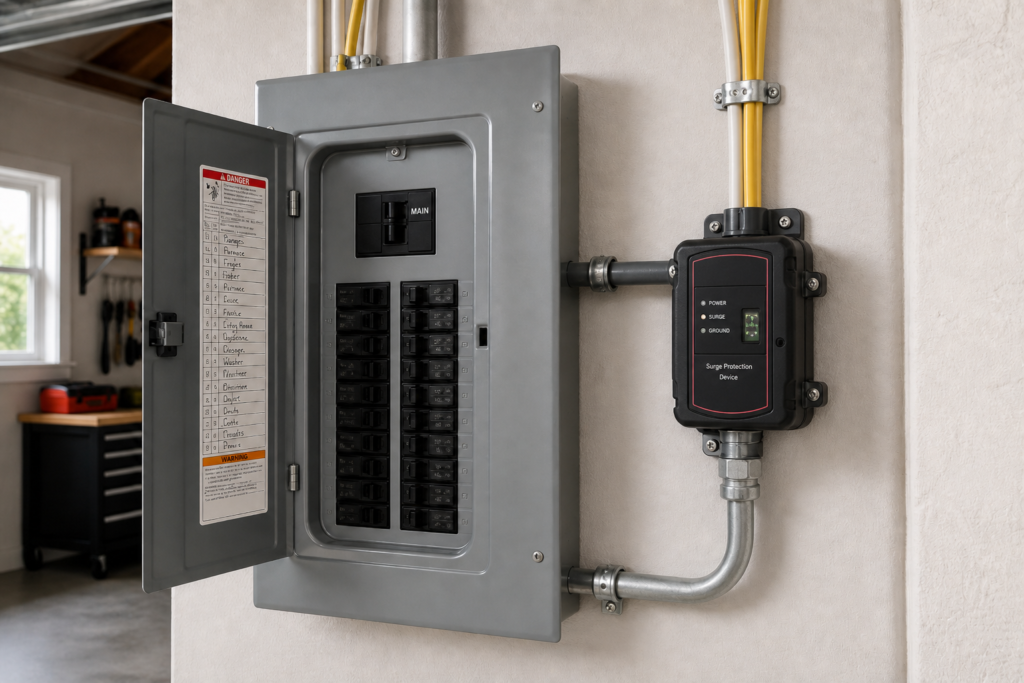
A whole house surge protector, also called a surge protective device, is installed at or near your home’s main electrical panel. Its job is to help divert excess voltage away from your home’s circuits when a surge happens.
Think of it like a pressure relief valve for your electrical system. Your home is built to handle normal electrical flow, just like plumbing is built to handle normal water pressure. But when a sudden spike comes through, that extra “pressure” needs somewhere safer to go.
A whole-home surge protective device helps reduce that spike before it reaches appliances, outlets, light switches, and connected electronics. The Electrical Safety Foundation International says whole-home surge protection must be installed by a qualified electrician and can help protect the entire home electrical system, including large appliances, outlets, and light switches. (ESFI)
That last part matters. This is not a weekend plug-and-play project. A licensed electrician should install it and check that your panel, grounding, and electrical setup are appropriate.
What Causes Power Surges?
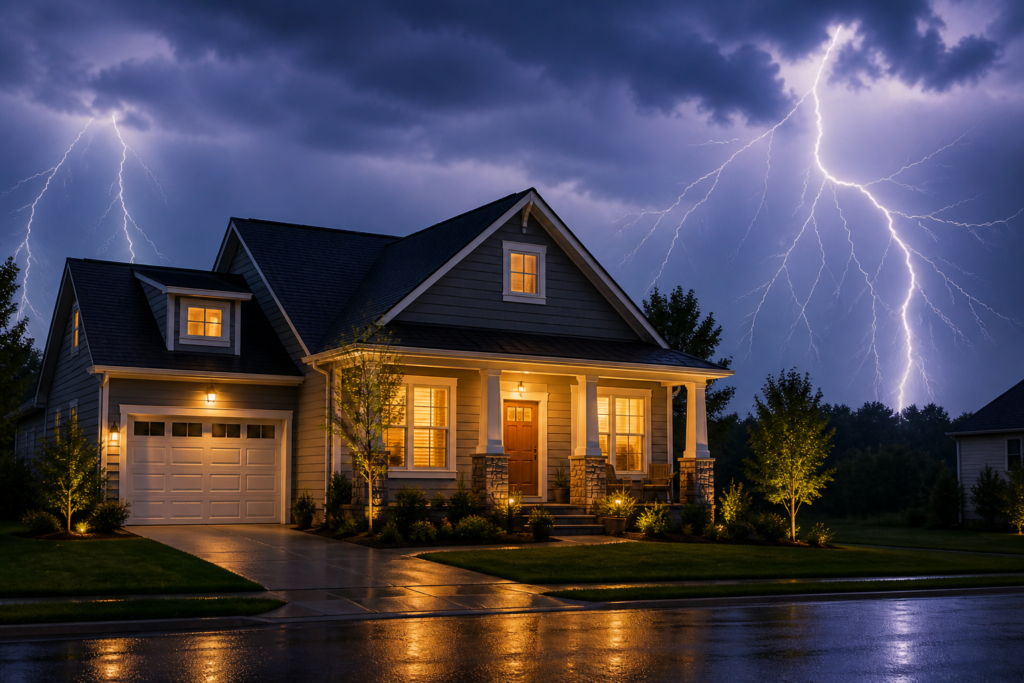
When most people hear “power surge,” they picture lightning.
Lightning can cause damaging surges, especially nearby strikes. But it’s not the only culprit. Some of the most common causes are much more ordinary: large appliances cycling on and off, utility grid switching, power being restored after an outage, storm-related electrical disruptions, and wiring or grounding issues.
Those smaller surges don’t always create a dramatic “pop” or a smoking outlet. More often, they’re like tiny dents in your electronics over time. One little hit may not ruin anything. But repeated stress can shorten the life of sensitive components.
And homes have more sensitive components than they used to. Heating and cooling systems often rely on control boards. Refrigerators, washers, and dryers may include digital electronics. Even everyday devices — your doorbell, thermostat, security cameras, router, television, garage door opener, and kitchen appliances — may all be connected in some way. It adds up.
It adds up.
The National Electrical Manufacturers Association says 60% to 80% of surges are created within a facility, often from electrical loads switching on and off. ESFI shares the same 60% to 80% range for power surges originating inside facilities. (NEMA Surge Protection Institute)
Does a Whole House Surge Protector Protect Against Lightning?
This is where the marketing can get fuzzy, so let’s be plain.
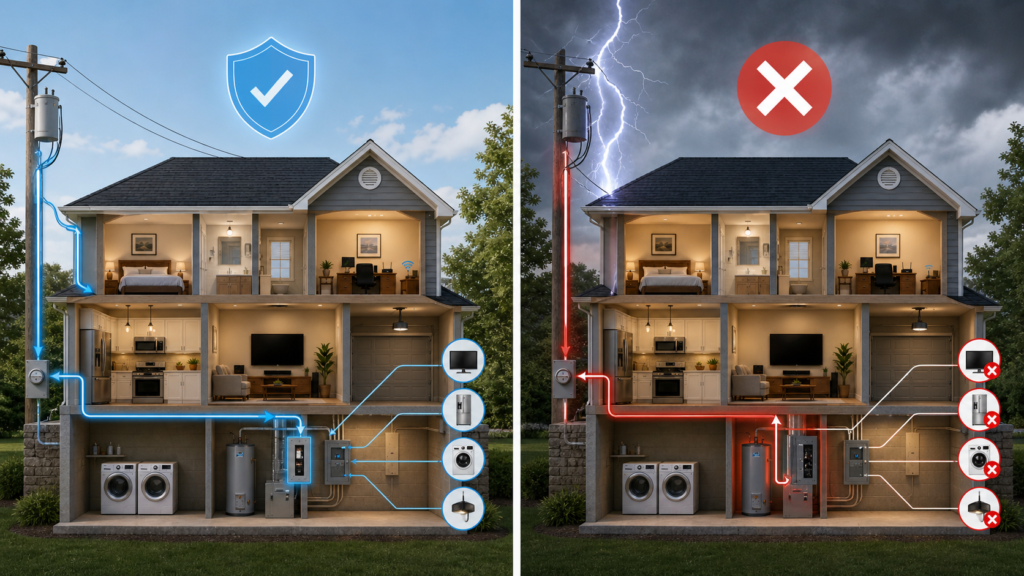
A whole house surge protector can help reduce damage from many power surges, including some surges related to storms or nearby lightning activity. But it does not make your home safe from a direct lightning strike.
That kind of energy is in a different category. If lightning directly hits your home, service equipment, or a very close connected pathway, a standard surge protective device may not be enough to prevent damage. ESFI is clear: no surge protection can handle a direct lightning strike. (ESFI)
So what are you actually buying?
You’re buying a layer of protection against the more common electrical surges homes experience — the smaller and moderate spikes that can wear down appliances, electronics, heating and cooling components, routers, smart devices, and control boards over time.
Some whole-home surge protectors also come with connected-equipment warranties. That can sound reassuring, and it may have value. But don’t treat it like homeowners insurance. Read the fine print, ask your electrician what documentation you’ll need, and understand what is excluded.
A good way to think about it: the device is the protection. The warranty is the parachute. You’d rather not need it.
Watch Out: A whole house surge protector is not the same thing as a lightning protection system. If your home is in a lightning-prone area, sits high on a lot, has tall nearby trees, or has had strike-related damage before, ask a qualified electrician or lightning protection specialist what level of protection makes sense.
What Does a Whole House Surge Protector Actually Protect?
A whole house surge protector can help protect many of the electrical items connected to your home’s wiring, including:
- Appliances like refrigerators, ovens, dishwashers, washers, and dryers
- Heating and cooling system components
- Garage door openers
- Smart thermostats and security systems
- Home office equipment
- Entertainment systems
- Routers, modems, and connected devices
- Lighting controls and outlets
That doesn’t mean every device is fully protected from every possible event. It means the surge protector gives the electrical system a first line of defense.
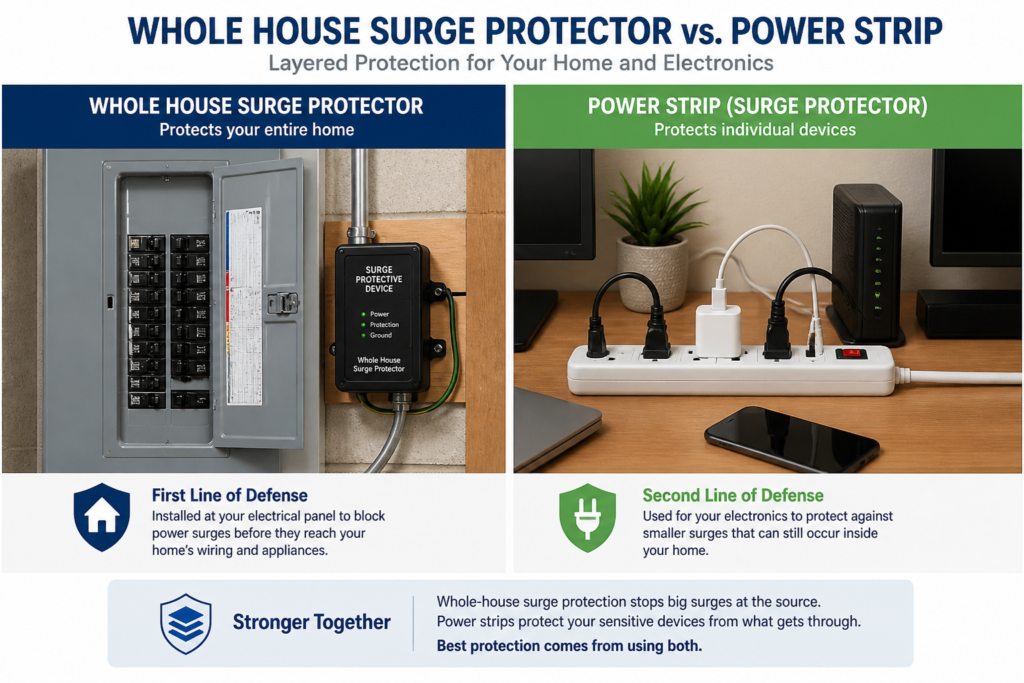
Whole-home surge protection works best as part of a layered setup. The panel-level device helps reduce larger incoming surges. Then point-of-use surge protectors — the kind you plug computers, televisions, and routers into — can add another layer for especially sensitive or expensive electronics.
It’s not either/or. It’s more like wearing a seat belt and having airbags. Different layers help in different ways.
What It Doesn’t Do
A whole house surge protector reduces risk. It does not erase risk.
Surge protection does not guarantee that everything in your home will be safe from electrical damage. It also won’t fix faulty wiring, replace proper grounding, or turn cheap power strips into protective devices. And again, it does not fully protect against a direct lightning strike.
That’s not a reason to dismiss it. It’s a reason to understand it.
Home protection products are often most useful when you know their limits. A smoke alarm doesn’t prevent a fire. A water leak sensor doesn’t repair a pipe. A surge protector doesn’t make electrical damage impossible. Each one gives you a better shot at avoiding a bigger, more expensive mess.
That’s the right lens here.
Watch Out: Don’t assume every power strip is a surge protector. ESFI notes that only surge protective devices protect against power surges; typical power strips, fuses, breakers, ground-fault circuit interrupters, wiring, and low-cost uninterruptible power supplies do not provide that same protection. (ESFI)
Whole House Surge Protector vs. Power Strip
This is one of the most common points of confusion.
A whole house surge protector is installed at the electrical panel and helps protect the home’s electrical system more broadly.
A plug-in surge protector protects only the devices plugged directly into it.
A standard power strip simply gives you more outlets. It may offer no surge protection at all.
| Protection Type | Where It Works | Best For | Main Limitation |
| Whole house surge protector | At or near the electrical panel | Broad protection for appliances, circuits, and home systems | Must be professionally installed |
| Plug-in surge protector | At the outlet | Computers, TVs, routers, gaming systems, office equipment | Only protects what’s plugged into it |
| Standard power strip | At the outlet | Adding more plug-in spots | Usually does not protect against surges |
For many homes, the smartest setup is both: whole-home surge protection at the panel, plus quality plug-in surge protectors for electronics you really don’t want to lose.
Pro Tip: Think of surge protection like layers of sunscreen. A whole house surge protector helps cover the big exposed areas, but sensitive electronics may still need point-of-use protection.
Is Whole House Surge Protection Required?
In many newer electrical code situations, surge protection is becoming part of the standard conversation.
The 2020 National Electrical Code added Section 230.67, which requires surge protective devices for services supplying dwelling units. NFPA describes this as a change affecting residential electrical services, and Leviton’s NEC summary states that the required device must be Type 1 or Type 2 and either integral to the service equipment or located immediately adjacent to it. (NFPA)
But here’s the homeowner-friendly reality: local code adoption varies.
Your state, county, or city may be using a different edition of the electrical code, or may have local amendments. So instead of assuming, ask a licensed electrician:
“Does my local code require surge protection for this project?”
This question is especially useful if you’re replacing your electrical panel, upgrading your service, adding a major circuit, installing an electric vehicle charger, adding solar equipment, or doing a significant renovation.
When Is a Whole House Surge Protector Worth Considering?
A whole house surge protector may be worth a closer look if:
- You live in an area with frequent storms or lightning
- Your neighborhood has regular power outages or flickering lights
- You work from home and rely on computers, routers, and monitors
- You’ve invested in smart-home devices or security equipment
- Your appliances have digital controls
- You recently upgraded your heating or cooling system
- You’re planning an electrical panel upgrade
- You have or plan to install an electric vehicle charger
- You’ve had unexplained electronics failures
It can also be a good “while you’re already there” upgrade. If an electrician is opening your panel for another project, that’s a natural time to ask about surge protection.
That doesn’t mean you should panic-order one today. It means this is worth putting on your smart-home maintenance list.
How Much Does a Whole House Surge Protector Cost?
Costs vary depending on your electrical panel, the device selected, local labor rates, permit requirements, and whether other electrical work is needed.
For many homeowners, the device itself may be relatively affordable compared with replacing a refrigerator control board, heating and cooling component, home office setup, or several smart devices. Installation is where the price can vary.
Be cautious with “average cost” numbers online. They can be useful as a rough starting point, but electrical work is local. A straightforward installation in a modern, accessible panel is one thing. An older panel with limited space, outdated grounding, or other issues is another.
The better question is not just, “What does it cost?”
It’s:
“What would this protect in my specific home, and is my electrical system ready for it?”
That’s a much better conversation to have with an electrician.
What Type of Surge Protector Do Homes Usually Need?
You may hear electricians talk about Type 1, Type 2, and Type 3 surge protective devices.
Don’t worry. You don’t need to memorize the categories before making the call.
In broad terms, Type 1 and Type 2 devices are commonly associated with service-level or panel-level protection. Type 3 devices are typically point-of-use devices, like plug-in surge protectors near electronics. For dwelling unit services under the 2020 National Electrical Code, Section 230.67 requires a Type 1 or Type 2 surge protective device. (Leviton)
What matters most for you is that the product is properly rated, compatible with your electrical system, correctly installed, and supported by a licensed electrician who understands local code.
This is one of those times where “the cheapest thing on the shelf” may not be the right deciding factor.
What to Ask an Electrician Before Installing One
When you call an electrician, you don’t need to sound like an electrical engineer. A few practical questions will get you most of the way there:
- Is my panel compatible with a whole house surge protector?
- Would you recommend a Type 1 or Type 2 device for my home?
- Does my local code require surge protection for this work?
- Is my grounding and bonding in good shape?
- Will I still need plug-in surge protectors for computers, TVs, and routers?
- Does the device have an indicator light or alert when it needs replacement?
- Is there a product warranty or connected-equipment warranty?
- What does that warranty actually exclude?
- Will this installation require a permit?
That grounding question is especially important. Surge protection depends on having a safer path for excess voltage. If your home’s grounding or bonding is outdated or incorrect, the electrician should address that before treating surge protection like a simple add-on.
Should You Still Use Plug-In Surge Protectors?
Yes, especially for sensitive electronics.
A whole house surge protector helps at the system level. Plug-in surge protectors help at the device level. For computers, televisions, routers, gaming systems, printers, and home office equipment, quality point-of-use surge protection still makes sense.
Look for plug-in protectors that are actually labeled for surge protection, not just “power strip.” Replace them if the indicator light shows they’re no longer protecting. And avoid overloading them, especially with high-draw appliances or space heaters.
A power strip should never become a permanent substitute for enough properly installed outlets. That’s a different electrical problem.
The Bottom Line
A whole house surge protector isn’t flashy. You won’t see it every day. It won’t make your kitchen prettier or your living room feel cozier.
But it can help protect the hidden electrical pieces your home now depends on — the control boards, smart devices, appliances, and systems that quietly keep everything running.
For many homeowners, especially those with newer appliances, smart-home equipment, home offices, storm exposure, or upcoming electrical work, it’s a smart question to ask. Not because you should be scared. Because being prepared is usually cheaper and calmer than being surprised.
Start with a licensed electrician. Ask whether your panel is compatible, whether your area’s code requires surge protection, and what level of protection makes sense for your home.
AHA members can use HomeAssist to get trusted guidance on next steps for electrical upgrades. You can also use the Home Savings Review to get a focused 5–7 minute review of your current home expenses to identify opportunities to reduce costs.