
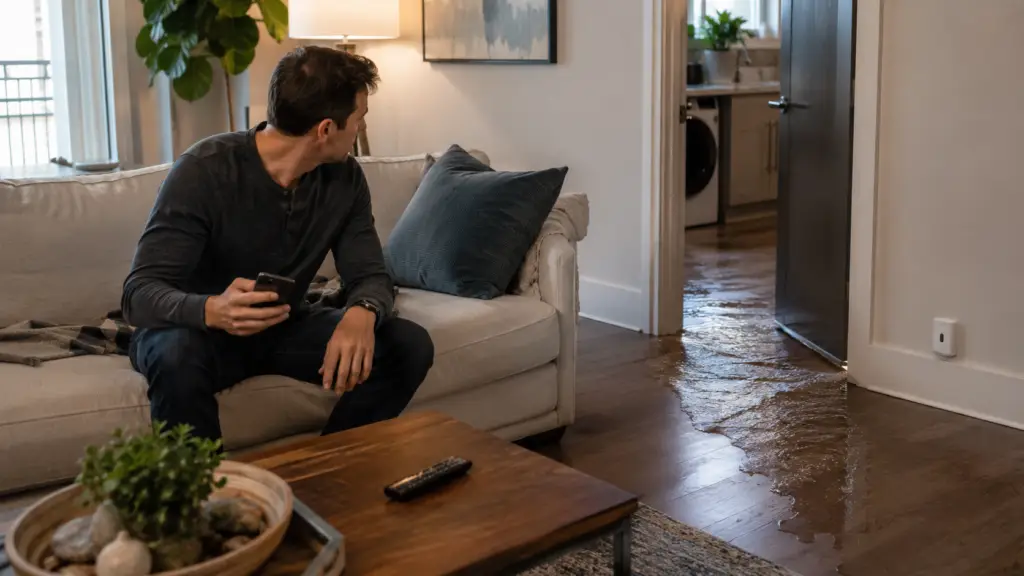
You’re catching up on your favorite show when one of the water-leak sensors you placed throughout your home suddenly starts sounding. You follow the alarm and find water flowing in from the unit next door and spreading across your wood floors.
The homeowners association (HOA) president contacts the neighboring owner, who is out of town and authorizes a locksmith to open the door. Inside, a ruptured toilet supply line has left the unit under about an inch of water that is now spilling into yours.
Your first thought may be, “Their plumbing failed, so they have to pay.” But the source of the water does not automatically determine who is financially responsible.
In many cases, you’ll report the damage to your own insurer first. The association’s master policy may cover shared or structural property, while the neighbor’s liability coverage generally matters only if the neighbor was negligent.
Before sorting that out, focus on four things: stop the water, protect your property, document the damage, and notify the right people.
First, Get the Water Stopped
When water is actively entering your home, don’t wait for the insurance questions to be resolved.
Contact the neighboring owner, HOA president, property manager, maintenance team, or association emergency contact. If the owner isn’t home, the association may need to reach them and arrange authorized access.
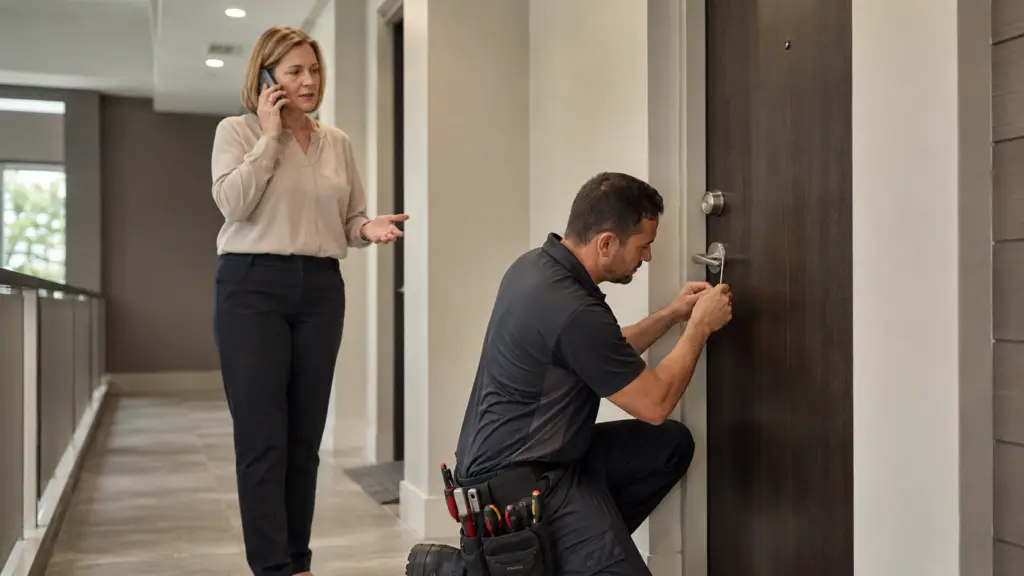
Don’t force your way into another home or arrange entry on your own. Follow the association’s procedures, obtain the owner’s authorization, or contact emergency responders when the situation requires it.
Once someone reaches the source, shut off the affected fixture or the home’s main water supply. A licensed plumber or building-maintenance professional may need to handle the shutoff if shared plumbing is involved.
Keep people away if water is near outlets, appliances, extension cords, ceiling fixtures, or an electrical panel.
Protect Your Property and Document the Damage
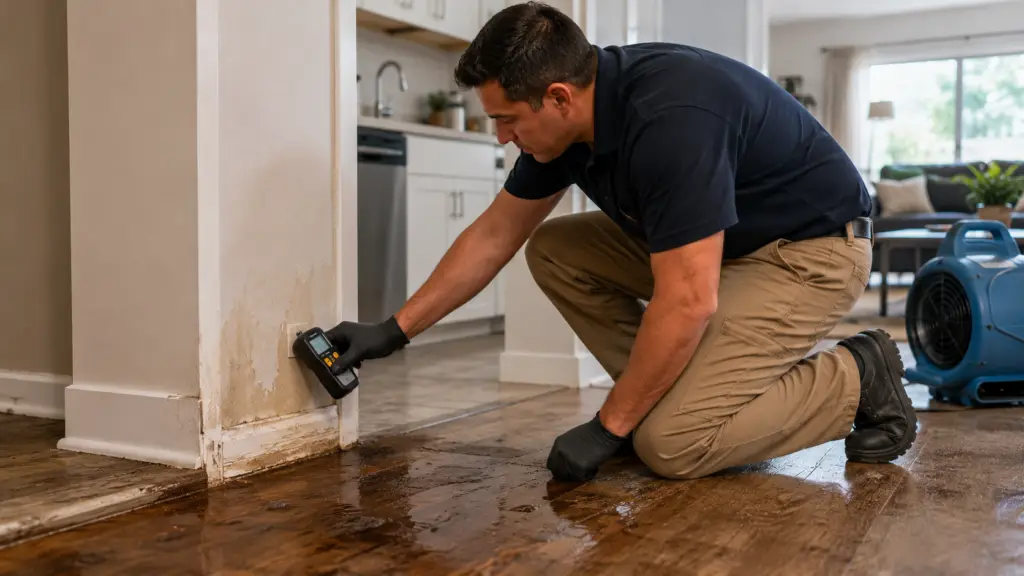
Move furniture, rugs, electronics, boxes, and other belongings away from the water when you can do so safely. Begin removing standing water and arrange professional drying when moisture has reached wood flooring, walls, cabinets, baseboards, or adjoining rooms.
Wood flooring can hold moisture beneath the visible surface, so wiping up the puddle may not be enough.
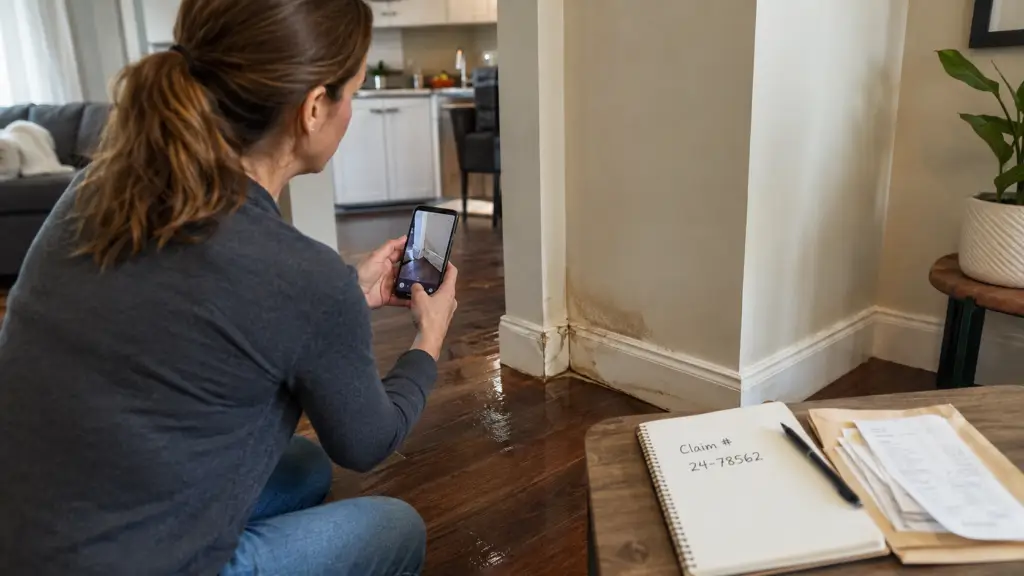
Create a record while events are still fresh:
- Photograph and record video of the water entering your home.
- Capture wide views and close-ups of damaged materials.
- Note when the sensor sounded and when you found the water.
- Record when the HOA was notified and when the water was shut off.
- Ask for the plumber’s findings and the association’s incident report.
- Keep locksmith, mitigation, extraction, and temporary-repair invoices.
- Save emails and texts from the neighbor, association, contractors, and insurers.
Watch Out: Don’t delay necessary drying while the owners, association, and insurers debate responsibility. Protecting your home does not mean you’re accepting financial responsibility for the loss.
Notify Your Insurer and the Association
Make two early notifications:
- Your own insurance company
- The condo association, HOA, or property manager
Contact your insurer even when the water clearly came from next door. You don’t need to wait for the neighbor to accept blame or for the association to decide whether it will open a master-policy claim.
Reporting the loss does not mean you’re admitting responsibility. It allows your insurer to inspect the damage, explain your coverage, and determine whether another insurer may also be involved.
For a condo or condo-style townhome, your individual policy and the association’s master policy may cover different parts of the same loss. For a fee-simple townhome, your individual homeowners policy may cover most or all of your structure, while the HOA policy covers only shared property or amenities.
What Will Probably Happen After You File the Claim?
Your insurer will open a claim and give you a claim number. A representative or adjuster will usually contact you to ask what happened, request documentation, review your coverage, and arrange an inspection if needed.
In the opening scenario, the process may look something like this:
- Your insurer inspects the wood flooring, baseboards, belongings, and other damage inside your home.
- The association reviews whether the master policy covers the subfloor, shared wall, or other building materials.
- The plumber or mitigation company provides reports showing where the water came from and how far it spread.
- The insurers review the governing documents to determine which policy may cover each part of the damage.
- The neighbor’s liability insurer may investigate if there is evidence of negligence.
- You may initially pay your own deductible.
- Your insurer may later seek reimbursement from another responsible party and may attempt to recover your deductible.
You may hear from more than one adjuster. One may represent your insurer, another may represent the master policy, and a liability adjuster may become involved if someone is alleged to have caused the loss.
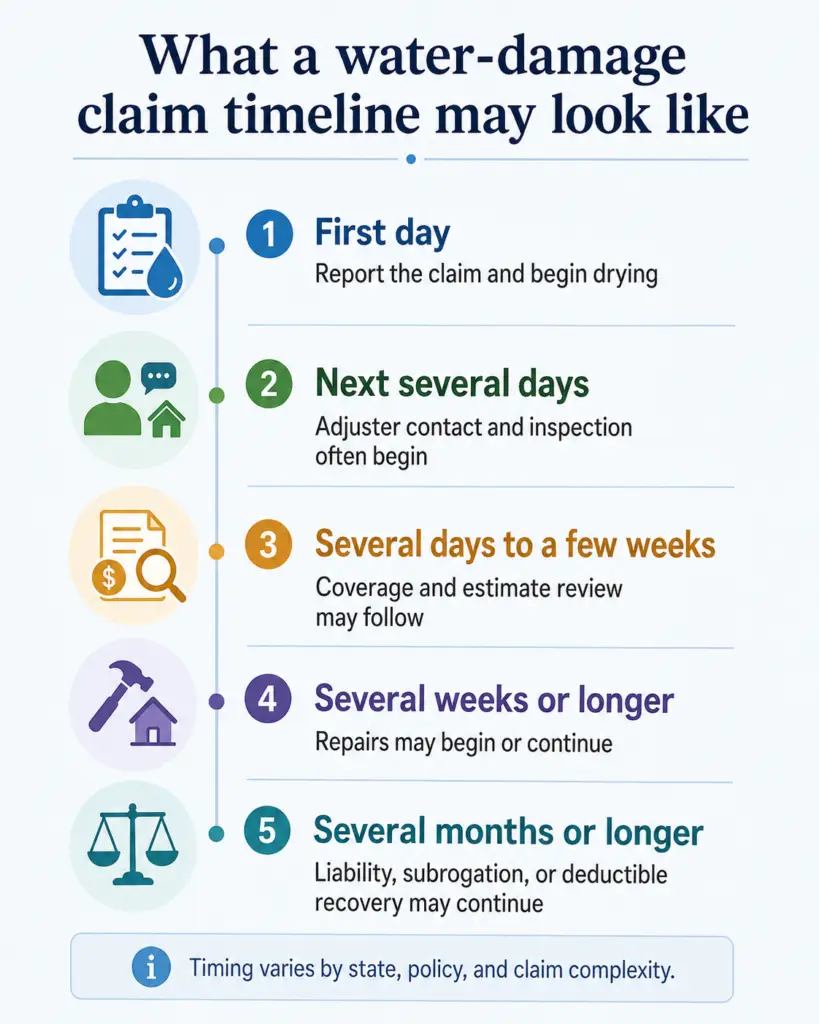
How Long Might the Claim Take?
There is no single nationwide timeline. The severity of the damage, number of insurers involved, contractor availability, state rules, and speed of the association’s response can all affect the process.
These are practical planning ranges, not guaranteed deadlines:
| Approximate Stage | What May Happen |
| The first day | You report the loss, receive a claim number, begin drying, and send initial photos. |
| The next several days | An adjuster contacts you, requests documents, and schedules an inspection. |
| Several days to a few weeks | The insurers review coverage, repair estimates, deductibles, and governing documents. |
| Several weeks or longer | Permanent repairs begin after the home is dry and the covered work is identified. |
| Several months or longer | Liability, subrogation, deductible recovery, or insurer disputes may continue after repairs are complete. |
A smaller loss with clear coverage may move more quickly. The process may take longer when hidden moisture is found, flooring is difficult to match, the association is slow to provide records, or insurers disagree about responsibility.
State law may set deadlines for acknowledging, investigating, or deciding claims. Ask your adjuster which deadlines apply and contact your state insurance department if the claim appears stalled.
Don’t Wait for the Adjuster to Prevent More Damage
You generally should not postpone reasonable emergency measures because the adjuster has not arrived.
Remove standing water, begin drying, and take temporary steps to protect the property. Photograph materials before they are removed and preserve samples when practical.
Ask the plumber or association to keep the failed toilet supply line. An insurer may want to inspect it while determining whether the failure involved wear, improper installation, a defective part, or another cause.
Avoid major permanent reconstruction until you understand the insurer’s inspection and estimate requirements, unless waiting would create additional damage or a safety concern.
Who May Pay for the Damage?

A neighbor water-loss claim may involve three separate insurance paths.
Your individual insurer may cover your belongings, interior finishes, upgraded materials, temporary living expenses after a covered loss, and the portions of the home assigned to you.
The association and its master insurer may cover common areas, shared systems, structural components, and certain materials inside individual units.
The neighboring owner and their liability insurer may become involved if evidence shows that the neighbor’s negligence caused the loss.
The most useful question is not simply, “Where did the water start?”
It is: What property was damaged, and which policy insures it?
Condo and Townhome Coverage Can Work Differently
A condo owner typically carries an individual unit-owner policy, often called an HO-6 policy. The condo association carries a separate master policy covering designated portions of the building and common property.
Townhome insurance can follow either model. Some townhome owners insure the entire structure through an individual homeowners policy. Others share responsibility with an association master policy, especially when the development is legally organized as a condominium.
Before assuming the HOA’s insurer will pay, check:
- Your deed and legal form of ownership
- Your individual policy’s declarations page
- The association declaration and bylaws
- The master-policy coverage summary
- The portions of the building assigned to the owner or association
- Any provisions addressing water damage and deductibles
When the HOA Master Policy May Apply
The association’s master policy may become involved when water damages:
- Hallways, garages, elevators, or other common areas
- Shared plumbing or another association-maintained system
- Framing, subfloors, roofs, exterior walls, or structural components
- Materials inside a home included within the master policy
- Multiple homes during the same incident
But saying “the HOA has insurance” does not tell you whether that policy covers your floors, walls, cabinets, or other interior finishes.
All-in coverage may include the building exterior and many interior finishes, such as flooring, cabinets, paint, trim, fixtures, doors, and windows.
Original-specification coverage may insure materials originally installed by the builder while excluding later upgrades.
Bare-walls or walls-out coverage may stop at unfinished drywall or the subfloor, leaving paint, flooring, cabinets, fixtures, and other finishes to the owner.
These labels are only starting points. The policy and governing documents control.
In the opening scenario, the master policy might cover part of the subfloor, while your individual policy handles the wood flooring. The result may depend on whether the flooring was original, upgraded, or specifically assigned to the owner.
Pro Tip: Ask for the declaration, bylaws, master-policy coverage summary, deductible amount, and any separate insurance or deductible-resolution document. Important rules may appear outside the general bylaws.
When the Neighbor May Be Responsible
A ruptured supply line does not automatically prove negligence.
If the line failed suddenly without warning, the neighbor may not have done anything unreasonable. Being out of town does not automatically make the owner responsible.
The answer could be different if the neighbor:
- Knew the line was leaking and ignored it
- Installed the line incorrectly
- Used an obviously damaged or unsuitable part
- Performed careless plumbing work
- Received repeated warnings but failed to act
Your insurer may pay for covered damage while it investigates whether someone else was responsible. If another party is found liable, your insurer may try to recover what it paid through a process called subrogation.
That process may also create an opportunity to recover your deductible, but reimbursement is not guaranteed.
The First Insurance Payment May Not Be the Last
A water claim may involve separate payments for emergency mitigation, building repairs, personal belongings, temporary living expenses, and additional damage discovered during construction.
Before accepting a payment, ask whether it is an advance, partial payment, or final settlement; which property and expenses it includes; whether depreciation was withheld; and whether the estimate can be revised if hidden damage is discovered.
What if the Neighbor Has No Insurance?
An uninsured neighbor does not automatically leave you without coverage.
Your individual policy may still cover insured damage to your flooring, belongings, improvements, and temporary living expenses. The association’s master policy may cover applicable building or shared property.
If the neighbor was negligent, they could potentially be personally responsible. Proving liability and collecting the money, however, are separate issues.
Start with your own insurer rather than trying to negotiate the entire loss directly with the neighbor.
Which Deductible Applies?
One incident may involve more than one deductible.
Your individual-policy deductible applies to a covered claim under your insurance.
The association’s master-policy deductible applies to its building or common-property claim and may be much larger.
A loss assessment may occur when the association charges owners for an uninsured community expense, an amount above a policy limit, or some portion of a deductible when the governing documents and applicable law allow it.
Loss-assessment coverage under your individual policy may help with certain assessments, but limits and exclusions apply.
Watch Out: Don’t agree to pay the master deductible, accept responsibility, or promise reimbursement before your insurer has reviewed the demand and governing documents.
Questions to Ask Your Insurer and Association
Ask your insurer:
- Which parts of my damage may be covered?
- Does my policy cover the wood flooring and upgrades?
- Which deductible applies?
- Do I have loss-assessment coverage?
- Will you inspect beneath the visible flooring?
- Will you coordinate with the master insurer?
- Can my deductible be recovered?
- What is the next claim milestone?
Ask the association:
- Does the master policy cover the homes or only common property?
- Is the failed supply line maintained by the owner or association?
- Has a master-policy claim been opened?
- What is the master deductible?
- Can that deductible be assessed to one owner?
- Who is coordinating drying and building repairs?
- Has the failed supply line been preserved?
Keep a contact log with names, dates, claim numbers, inspections, estimates, payments, and repair decisions. The AHA Homeowners Insurance Claim Toolkit can help you organize the records you may need.
The Source of the Water Is Only the Beginning
When water crosses into your condo or townhome from next door, it is understandable to think, “Their pipe broke, so they pay.”
Sometimes the neighbor or their insurer may ultimately be responsible. Other times, your individual policy, the association’s master policy, or a combination of policies may handle the damage—even when nobody was negligent.
Focus on four steps:
- Stop the water and begin drying.
- Photograph the damage and keep records.
- Notify your insurer and association.
- Let the insurers investigate before you accept responsibility for repairs or deductibles.