

Getting an HOA notice can feel oddly personal.
You open the envelope, read a sentence about your fence, lawn, paint color, trash cans, pet, parking spot, or solar panels, and suddenly your own home feels a little less like yours. It’s frustrating. Sometimes it’s embarrassing. And if there’s a fine attached, it can quickly go from annoying to stressful.
AHA already has a helpful guide on how to manage HOA disputes without losing your cool, which focuses on communication, documentation, mediation, and keeping conflict from spiraling. This article is the companion piece: it’s about figuring out whether the HOA can actually enforce the rule in the first place — and what to check before you comply, appeal, or push back.
The short version: HOAs often do have authority. But that authority is not unlimited. And the smartest response is usually not outrage, silence, or pride.
It’s paperwork.
First, A Quick Note
This article is general homeowner information, not legal advice. HOA laws vary by state, city, property type, and community documents. If your issue involves large fines, liens, foreclosure threats, disability accommodations, discrimination, or a lawyer’s letter, it’s worth getting local legal guidance.
What Gives An HOA The Right To Enforce Rules?
An HOA usually gets its authority from documents tied to the property before you bought it. These may include Covenants, Conditions & Restrictions, often called CC&Rs, bylaws, rules and regulations, architectural guidelines, board resolutions, fine schedules, and enforcement policies.
Think of these documents like the operating manual for the community. Not exciting reading, obviously. But in a dispute, they matter more than what a neighbor says, what a board member remembers, or what “everyone has always done.”
The safest first question is simple:
What rule gives the HOA authority to do this?
That’s not being difficult. That’s being organized.
The Most Common HOA Rule Disputes — And What To Check First
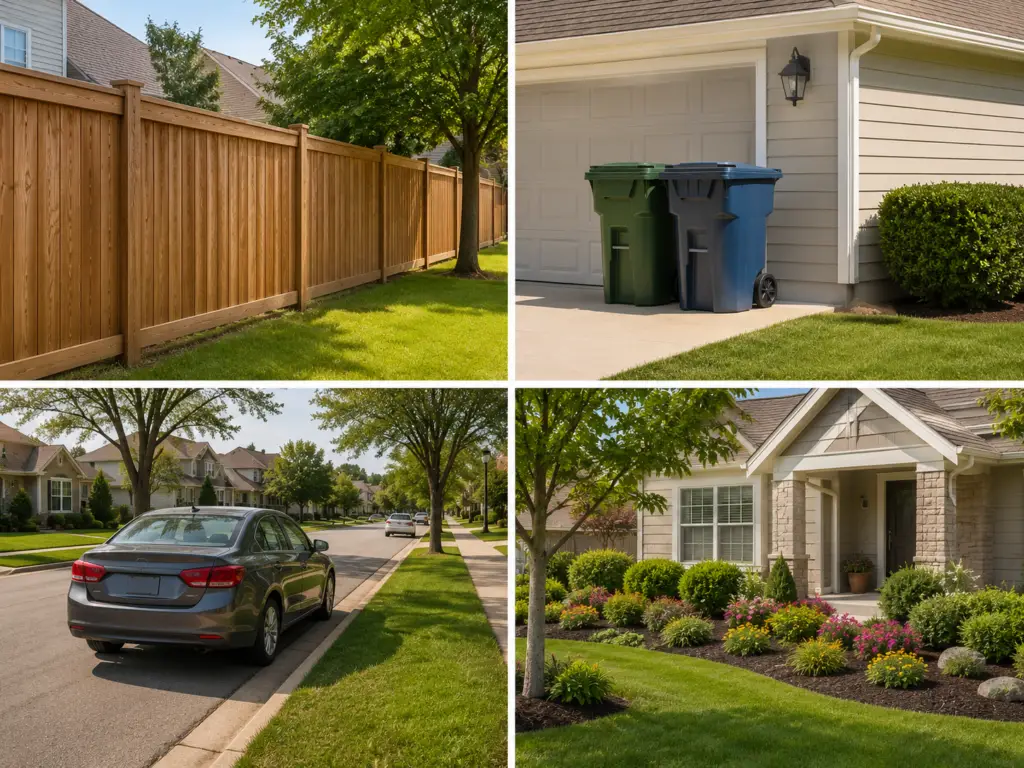
Most HOA fights don’t start with some grand legal principle.
They start with ordinary homeowner stuff.
A car parked on the street overnight. A lawn that went brown. A fence installed before approval came back. A dog that barks while the owner is at work. A trash bin left out after pickup.
Property-management sources consistently identify exterior modifications, landscaping, trash cans, parking, pet issues, and noise complaints among common HOA violation categories. (Buildium)
1. Landscaping And Lawn Rules
Landscaping disputes are easy to trigger because they often involve both appearance and judgment.
Maybe your grass got too tall after a rainy week. Maybe weeds popped up while you were traveling. Maybe shrubs died during a heat wave. Or maybe you replaced turf with drought-tolerant plants and someone on the board decided it didn’t “fit” the neighborhood.
The hard part is that words like “neat,” “healthy,” “attractive,” and “well-maintained” can be subjective.
What to check first:
Look for specific standards. Grass height. Weed-control language. Approved plant lists. Tree removal rules. Irrigation requirements. Landscape-change approval forms. If the rule is vague, ask the HOA to identify the exact standard you violated and provide any photos or inspection notes.
Where homeowner rights may matter:
Water restrictions and drought laws can limit what an HOA can require in some states. California Civil Code Section 4735, for example, restricts certain HOA fines or assessments against owners who reduce or eliminate watering during declared drought conditions. (Davis-Stirling)
Best first response:
“I’m reviewing the notice. Please send the specific landscaping standard, any supporting photos, and the deadline to correct the issue.”
Watch Out:
Don’t assume “I’m saving water” automatically ends the matter. The HOA may still be able to enforce reasonable maintenance or appearance rules, depending on state law and your governing documents.
2. Exterior Changes And Architectural Approval

This is one of the most expensive HOA dispute categories because homeowners often spend money before realizing they needed written approval.
Common triggers include fences, paint colors, roofs, windows, doors, sheds, decks, patios, solar panels, EV chargers, security cameras, exterior lighting, mailboxes, and major landscaping changes.
The homeowner’s mistake is usually understandable: you hired a contractor, got a city permit, paid real money, and assumed you were good.
Then the HOA says, “Not so fast.”
What to check first:
Look at the architectural guidelines. What projects require approval? What documents must be submitted? Are there approved colors, materials, heights, or styles? How long does the HOA have to respond? Does approval have to be written?
That last one matters. In many communities, silence does not mean yes.
Where homeowner rights may matter:
Some exterior projects have extra legal protections. Many states have solar access laws that limit whether HOAs can prohibit or unreasonably restrict solar installations. Some states also have laws limiting HOA restrictions on EV chargers, especially in designated parking spaces, while still allowing reasonable rules around installation, safety, insurance, and cost. (Irvine Ranch Water District)
Best first response:
If work hasn’t started, pause until you understand the approval process. If work is already done, ask whether you can submit a retroactive architectural application. Include photos, contractor documents, permits, product details, and proof that the work was professionally completed.
Watch Out:
A city permit does not automatically mean HOA approval. They are separate systems. The city may care whether the work meets code. The HOA may care whether it matches the community standards.
Annoying? Yes. Common? Very.
3. Parking And Vehicle Rules
Parking disputes get heated fast because they affect daily life.
Nobody wants to come home from work and wonder whether their car is about to be cited, booted, or towed. Common issues include street parking, guest parking, assigned spaces, commercial vehicles, recreational vehicles, boats, trailers, inoperable cars, driveway use, and overnight parking.
What to check first:
Find the exact parking rule. Is the issue location, timing, vehicle type, missing guest pass, repeat violation, or use of a restricted space?
Also check whether the HOA actually controls the street. Some roads are private and controlled by the association. Others are public and controlled by the city or county.
Where homeowner rights may matter:
Towing rules often depend on state and local law, signage, notice, and whether the HOA has authority over the parking area. If your vehicle was towed, document everything immediately: signs, photos, notices, dates, payment receipts, and who authorized the tow.
Best first response:
“Please clarify whether this violation is based on the vehicle type, parking location, overnight timing, guest-pass requirement, or another rule.”
Watch Out:
Do not rely only on phone calls after a towing issue. Ask for the written towing policy and keep every receipt.
4. Trash Cans, Storage, And Visible Clutter
This is the classic “really, we’re fighting about this?” HOA issue.
Trash bins left out too early or too long. Recycling containers visible from the street. Bulk pickup items placed out on the wrong day. Porch storage. Balcony clutter. Sports equipment. Tools. Holiday decorations.
These disputes happen because they’re easy to spot and easy to report.
What to check first:
Look for rules about pickup-day timing, where bins must be stored, whether they must be screened from view, how bulk trash works, and whether warnings are required before fines.
Best first response:
If it was a one-time mistake, correct it quickly and ask for a courtesy waiver.
Try:
“The bins have been moved. Since this was a first-time issue, would the association consider waiving the fine?”
Watch Out:
Small violations can become expensive if ignored. A $25 trash-can fine doesn’t always stay a $25 problem once late fees and collection costs enter the picture.
5. Pets, Barking, And Assistance Animals
Pet disputes mix rules, neighbor complaints, noise, cleanliness, and emotion. That’s a messy stew.
Common issues include pet limits, breed restrictions, weight limits, leash rules, pet waste, barking, use of common areas, and whether an animal is considered an assistance animal.

What to check first:
Review pet limits, leash requirements, waste cleanup rules, nuisance language, complaint procedures, and fine schedules. If the issue is barking, ask for specific dates and times. “Your dog barks” is very different from “your dog barked for 45 minutes on Tuesday at 10:30 p.m.”
Where homeowner rights may matter:
Assistance animals are not ordinary pets under fair housing rules. HUD says individuals with disabilities may request an assistance animal as a reasonable accommodation to pet restrictions, and housing providers cannot refuse reasonable accommodations in rules, policies, practices, or services when needed for a person with a disability to use and enjoy a dwelling. (HUD.gov)
Best first response:
Ask whether the notice is based on a specific incident, repeated reports, or a general rule violation. If there’s a disability-related accommodation request, make it in writing and keep copies.
Watch Out:
Don’t handle an assistance animal dispute casually. This is one of those areas where both homeowners and HOAs can make expensive mistakes.
6. Noise And Nuisance Complaints
Noise disputes are hard because they often come down to perception, timing, and repeat behavior.
One neighbor’s normal Saturday barbecue is another neighbor’s “constant disturbance.” Common issues include loud music, parties, barking dogs, short-term rental guests, construction noise, power tools, and repeated neighbor complaints.
What to check first:
Look for quiet hours, nuisance definitions, local noise ordinances, construction-hour rules, short-term rental rules, and whether complaints must be documented.
Best first response:
Ask for dates, times, and the nature of the complaint. If the notice is vague, say you’re willing to address a specific issue but need enough detail to understand what happened.
Watch Out:
Don’t escalate directly with the complaining neighbor if things already feel tense. Keep your response calm and documented through the HOA or management company. It may feel slower, but it’s usually safer.
7. Rentals And Tenant Behavior
If you rent out your home, your tenant’s HOA violation may still become your problem.
That surprises a lot of owners. The tenant parked wrong. The tenant had a loud party. The tenant left trash out. But the notice goes to the homeowner.
Common disputes include short-term rentals, lease minimums, rental caps, tenant registration, parking, pets, amenity use, noise, and trash violations.
What to check first:
Look for rental restrictions, lease-duration rules, tenant registration requirements, owner responsibility language, and whether your lease must include HOA rules.
Best first response:
Send the tenant the rule in writing, document that you did it, and respond to the HOA with your corrective steps. If you lease the property, attach HOA rules to the lease and require tenants to acknowledge them.
Watch Out:
Rental restrictions can affect your property’s financial value. Don’t assume you can use the home as a short-term rental, seasonal rental, or long-term rental without checking the documents first.
8. Fines, Daily Penalties, Liens, And Collections
This is where the tone changes.
A landscaping notice is annoying. A fine is more serious. A lien or collection letter is a different animal altogether.
The original issue may be small, but once money gets added, the dispute can grow quickly. Depending on your state and governing documents, unpaid balances may include fines, late fees, interest, attorney fees, collection costs, and potentially lien-related consequences.
What to check first:
Review the fine schedule, notice requirements, hearing rights, appeal deadlines, assessment rules, collection policy, lien authority, attorney-fee provisions, and state law.
Best first response:
Respond before the deadline, even if you disagree. Ask for an itemized balance, the rule authorizing the fine, the evidence supporting it, and the process to contest it.
Watch Out: Daily Fines Add Up Quietly
Daily fines are designed to create pressure. That pressure can feel unfair, especially if you believe the HOA is wrong. But don’t wait for the bill to become “worth fighting.” Ask immediately whether fines are accruing, what the daily amount is, whether fines can be paused during an appeal, and what written action is required to stop them.
A ProPublica and Rocky Mountain PBS investigation found that Colorado HOAs filed more than 2,400 foreclosure cases from January 2018 through February 2022, and at least 215 cases resulted in sheriff’s sales where homeowners lost possession of their homes. (Hoastart)
The Psychology Of HOA Overreach — And Homeowner Overreaction

HOA disputes can feel bigger than they look on paper.
A trash can notice is technically about a trash can. But emotionally? It can feel like someone is watching your home, judging how you live, or telling you that you don’t fully control the place you worked hard to buy.
That’s where things can go sideways.
On the HOA side, boards and management companies may over-enforce because they’re trying to keep standards consistent, avoid accusations of favoritism, or prevent one ignored violation from becoming ten. Sometimes that’s reasonable. Sometimes it turns into box-checking without much common sense.
On the homeowner side, the reaction can be just as powerful. A notice feels insulting, so the homeowner ignores it. Or fires off an angry email. Or assumes the HOA will eventually “see reason” without formally appealing.
That’s how a $50 problem becomes a $2,000 problem.
The hard truth? You can be right about the issue and still make a costly mistake in how you handle it.
Don’t Let Pride Make The Problem Bigger
HOA disputes have a way of poking at your pride.
It’s your home. Your yard. Your car. Your fence. Your money. So when a notice shows up saying you did something wrong, it can feel less like paperwork and more like an insult.
That reaction is normal.
But ignoring the notice because “they’re being ridiculous” doesn’t stop the deadline. Sending an angry email doesn’t create a better record. Refusing to fix something small on principle may feel satisfying for a day — right up until fines, late fees, attorney fees, or collection costs start stacking up.
The goal isn’t to let the HOA push you around.
The goal is to protect yourself.
Pro Tip:
Before you send your response, ask yourself: “Am I trying to solve this, or am I trying to win the feeling?” If it’s the second one, pause. Rewrite the message so it helps your case instead of just expressing your frustration.
Watch Out:
Pride can get expensive. If fines are accruing daily, ask immediately what amount is being added, what action stops the fines, and whether fines pause during an appeal.
When HOA Rules May Run Into Homeowner Rights
Sometimes the HOA rulebook isn’t the only rulebook.
Your HOA may have authority under its governing documents, but that authority can be limited by state law, local ordinances, and federal protections.
A few common examples:
Disability accommodations and assistance animals: Fair housing rules may require reasonable accommodations to rules, policies, practices, or services when needed for a person with a disability to use and enjoy their home. (HUD.gov)
Solar panels: Many states have laws that limit whether HOAs can prohibit or unreasonably restrict solar installations, though the details vary by state.
EV chargers: Some state laws limit an HOA’s ability to prohibit EV chargers in a homeowner’s designated parking space while still allowing reasonable restrictions around installation, safety, insurance, and costs. (The Free Speech Center)
Satellite dishes and antennas: The FCC’s Over-the-Air Reception Devices rule generally permits people to install covered antennas on property they own or control exclusively, and it limits restrictions that impair installation, maintenance, or use. (FCC)
U.S. flag display: The Freedom to Display the American Flag Act limits certain residential associations from restricting display of the U.S. flag, while still allowing reasonable time, place, or manner restrictions. (The Free Speech Center)
Drought and water conservation: Some states restrict HOA enforcement when homeowners reduce watering during declared drought conditions. California Civil Code Section 4735 is one example. (Davis-Stirling)
The big takeaway: don’t assume a rule is enforceable just because it’s printed in the handbook. But don’t assume it’s invalid either. Check the documents, then check whether state or federal protections apply.
Real HOA Overreach Stories: Why Process Matters
Most HOA issues don’t become headline material. Most are handled with a notice, a correction, maybe a hearing, and everyone moves on.
But the outlier stories are worth understanding because they show how small disputes can get out of hand.
Flag and flagpole disputes are one recurring example. Federal law protects certain U.S. flag displays, but it still allows reasonable time, place, and manner restrictions, which means these disputes often turn on details like placement, size, mounting, safety, or whether a flagpole is covered. (The Free Speech Center)
Drought landscaping disputes are another example. In California, state law restricts certain HOA fines when homeowners reduce or eliminate watering during declared drought conditions, but homeowners may still need to understand what maintenance standards remain enforceable. (Davis-Stirling)
And then there’s the money issue. The Colorado foreclosure reporting mentioned earlier is the clearest reminder that HOA disputes aren’t always just about paint colors and trash cans. Once unpaid amounts move into collections, the stakes change. (Hoastart)
Watch Out:
An HOA notice about a small issue can become much bigger once fines, late fees, attorney fees, liens, or collection costs are added. Even if the HOA is wrong, don’t ignore the notice. Respond in writing, ask for the rule, check your appeal rights, and keep a paper trail.
Your 5-Step HOA Rule Check

When an HOA notice lands in your mailbox, start by slowing down.
HOA letters have a way of pushing every homeowner button at once. You may feel accused, watched, or nickel-and-dimed. Still, the best response is usually calm, boring, and documented.
Boring wins a lot of homeowner disputes.
1. Read The Notice Carefully
Look for the rule cited, the date of the alleged violation, the deadline to correct it, any fine amount, whether this is a warning or final decision, and how to request a hearing or appeal.
If the notice doesn’t cite a specific rule, ask for it.
2. Identify The Dispute Category
Is this about landscaping, parking, exterior approval, pets, noise, rentals, trash cans, or money?
That helps you figure out which documents to pull and what kind of response you need.
3. Pull The Exact Rule
Don’t rely on memory. Find the actual language.
Look at the CC&Rs, bylaws, rules, architectural guidelines, and enforcement policy. If you don’t have them, ask the HOA or management company for current copies.
4. Check Whether Another Law May Apply
This is especially important if the issue involves disability accommodations, assistance animals, solar panels, EV chargers, antennas, flags, drought rules, towing, rentals, or fines.
State and federal protections don’t apply to every dispute. But when they do, they can change the conversation.
5. Respond In Writing Before The Deadline
Even if you plan to comply, respond in writing. Even if you disagree, respond in writing. Even if you had a friendly phone call with the manager, follow up in writing.
Try this:
“I received the notice dated [date]. Please send the specific governing document section, any supporting photos or records, the current balance or fine schedule if applicable, and the procedure for requesting a hearing or appeal.”
That one sentence can lower the temperature fast.
Pro Tip: Ask For The Rule, Not A Fight
A simple question can keep things focused:
“Can you please point me to the specific rule and appeal process you’re relying on?”
That keeps the conversation about documents and deadlines, not personalities.
When You Should Consider Professional Help
Some HOA issues are annoying. Others can affect your money, housing rights, or property value.
Consider getting legal or professional guidance if the issue involves a threatened lien or foreclosure, large or escalating fines, denial of a disability accommodation, assistance animal disputes, discrimination concerns, major architectural denials after you already spent money, solar panel or EV charger conflicts, selective enforcement that affects property rights, short-term rental restrictions with major income impact, or any notice from an attorney or collection agency.
This isn’t about “lawyering up” over every trash-can notice.
It’s about recognizing when the stakes have changed.
HOA Rules Vs. Homeowner Rights FAQ
Can An HOA Really Tell Me What I Can Do With My Own Home?
Often, yes — especially when it comes to exterior appearance, landscaping, parking, pets, rentals, noise, and shared community standards. But an HOA’s power usually comes from its governing documents and may be limited by state law, local ordinances, and certain federal protections.
What Are The Most Common HOA Rule Disputes?
Common HOA disputes often involve exterior changes, landscaping, trash cans, parking, pets, noise complaints, rentals, fines, and collections. These categories appear repeatedly in property-management guidance on HOA violations. (Buildium)
Can My HOA Deny My Fence, Paint Color, Or Exterior Project?
Often, yes, if your governing documents require architectural approval. But the HOA should follow its own written standards and review process. Before you spend money, get approval in writing.
Does A City Permit Override HOA Approval?
Usually, no. A city permit and HOA approval are different things. The city may be checking safety and code compliance. The HOA may be checking community rules, materials, colors, placement, or appearance.
Can An HOA Fine Me Without Warning?
Sometimes, but many HOAs must follow notice, hearing, or appeal procedures before imposing fines. Check your governing documents, fine schedule, enforcement policy, and state law. If the notice doesn’t explain the fine process, ask for it in writing.
What Should I Do If Daily HOA Fines Are Adding Up?
Ask in writing whether fines are currently accruing, how much is being added per day, what action stops the fines, whether fines pause during an appeal, and how to request a hearing. Don’t ignore daily fines just because you believe the HOA is wrong.
Can An HOA Make Me Remove Solar Panels, A Flag, Or A Satellite Dish?
Possibly, but HOA rules may be limited by state or federal protections. Solar laws vary by state, federal rules protect certain antennas and satellite dishes, and federal law protects certain U.S. flag displays while allowing reasonable time, place, or manner restrictions. (FCC)
When Should I Talk To A Lawyer About An HOA Dispute?
Consider legal help if the issue involves large fines, liens, foreclosure threats, disability accommodations, discrimination, major property restrictions, selective enforcement, or a letter from an attorney or collection agency.
The Bottom Line
HOA rules can feel personal because they touch the most personal place you own: your home.
But the smartest response is rarely the loudest one.
Keep a cool head. Read the rule. Respond before the deadline. Put everything in writing. Ask for the appeal process. And don’t let pride turn a small disagreement into a big bill.
You don’t have to roll over.
You don’t have to pick a fight either.
The win is protecting your home, your money, and your peace of mind.
For help keeping the conversation calm and productive once you understand the rule, read AHA’s guide to managing HOA disputes without losing your cool.
Use AHA homeowner tools to keep your governing documents, approvals, contractor records, insurance paperwork, and home improvement notes organized in one place. It’s a lot easier to respond calmly when you’re not digging through old emails at midnight.