
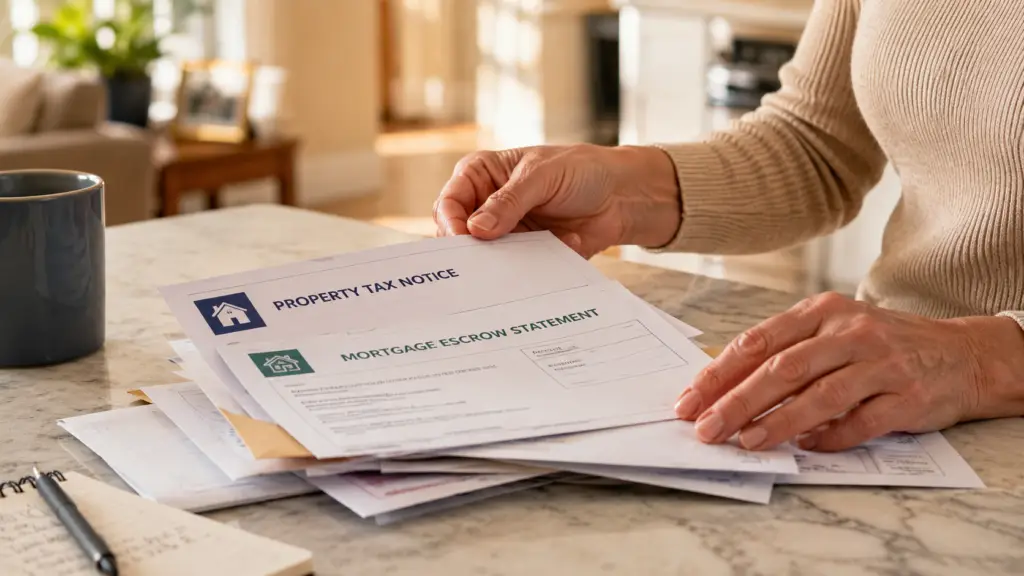
You open your mortgage statement and the number looks wrong.
Not a little wrong. Hundreds of dollars wrong.
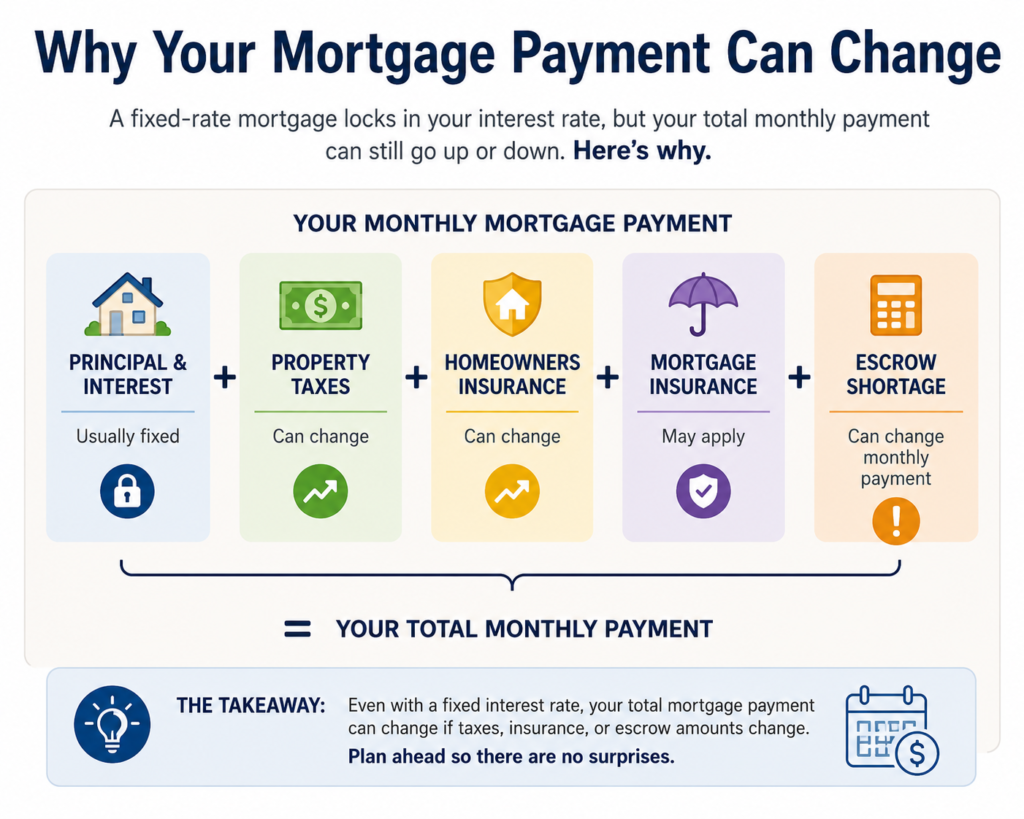
If you have a fixed-rate mortgage, that can feel almost impossible. Wasn’t the whole point of a fixed rate that your payment stayed steady? The answer is yes — but only the loan part. Your property taxes, homeowners insurance, and escrow account can still change. And when they do, your monthly mortgage payment can move with them.
That’s the part that catches a lot of homeowners off guard. Not because they weren’t paying attention, but because tax notices and escrow statements don’t exactly come with a friendly translation.
The good news: you’re not powerless. You can review what changed, check for errors, look for exemptions, appeal when appropriate, and plan ahead so next year’s bill doesn’t sneak up on you.
Your Fixed Mortgage Payment May Not Be Fully Fixed
A fixed-rate mortgage means the principal and interest portion of your payment stays the same over the life of the loan.
But many homeowners don’t just pay principal and interest each month. Their mortgage payment may also include property taxes, homeowners insurance, mortgage insurance, and escrow adjustments.
That’s why your lender’s monthly bill can change even when your interest rate doesn’t. (CFPB)
An escrow account is basically a holding account managed by your mortgage servicer. You pay a portion of your estimated annual property taxes and insurance each month. Then, when those bills come due, your servicer pays them on your behalf.
Think of it like your grocery budget. Your meal plan may be the same, but if eggs, milk, and chicken all cost more, the weekly total still goes up.
Same house. Same loan. Different tax bill.
Why Property Taxes Can Change From One Year to the Next
Once you understand that escrow can move your payment, the next question is simple: what changed?
Sometimes it’s the value your county assigned to your home. Sometimes it’s the local tax rate. Sometimes it’s an exemption that quietly expired. And sometimes it’s not just one thing — it’s two or three changes landing in the same year.
Most property tax increases come from a few common causes:
Your home’s assessed value may have gone up. That’s the value your local assessor uses to calculate your property tax bill. If home prices in your area rose, your assessment may rise too.
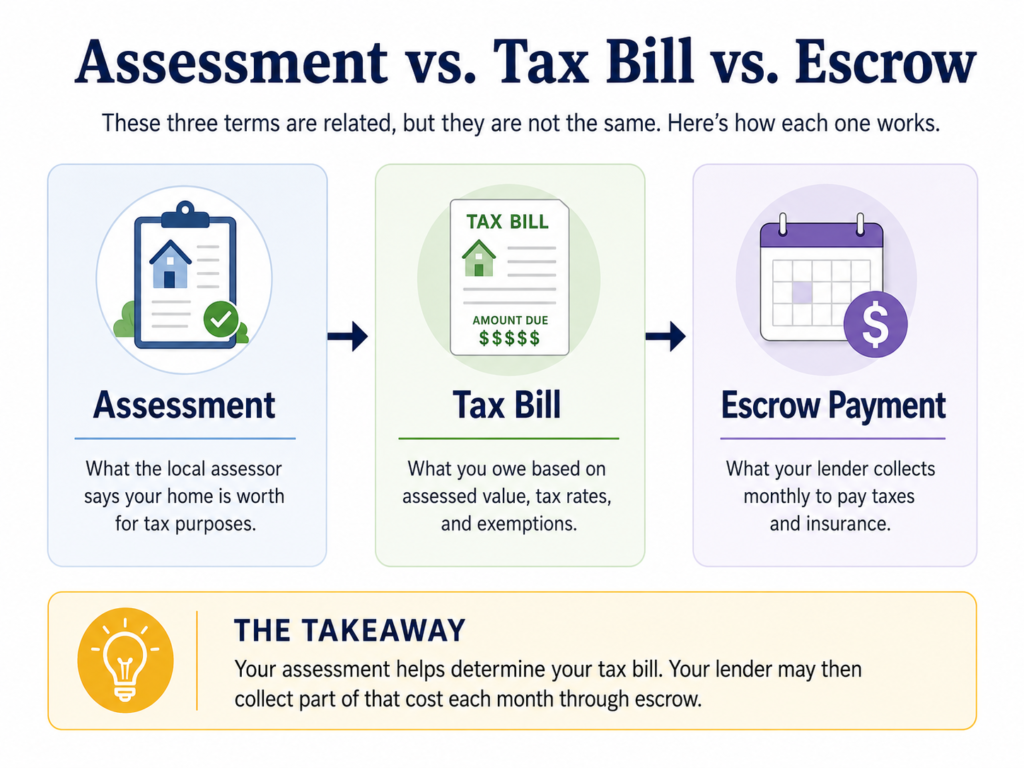
Your local tax rate may have changed. Even if your assessed value stayed flat, your bill can increase if your city, county, school district, or special tax district changes its rate.
You may have lost an exemption, credit, or abatement. Some tax breaks expire after a certain number of years. Others have to be renewed. Some applied to the previous owner but not to you.
Your home may have been reassessed after a sale. This is a big one for new buyers. The tax bill you saw when you purchased the home may have reflected the seller’s older assessed value, long-time owner cap, senior exemption, or homestead benefit.
Your escrow account may have had a shortage. This doesn’t mean the county raised your taxes twice. It means your lender didn’t collect enough last year, and now it has to collect more going forward while also making up the shortfall.
Messy? A little. But once you separate the pieces, it gets easier to understand.
The Escrow Shortage Problem That Makes a Tax Increase Feel Bigger
Here’s where homeowners often get blindsided.
Let’s say your lender estimated your property taxes would be $3,000 for the year. That works out to $250 a month in escrow for taxes.
But the actual bill comes in at $5,400.
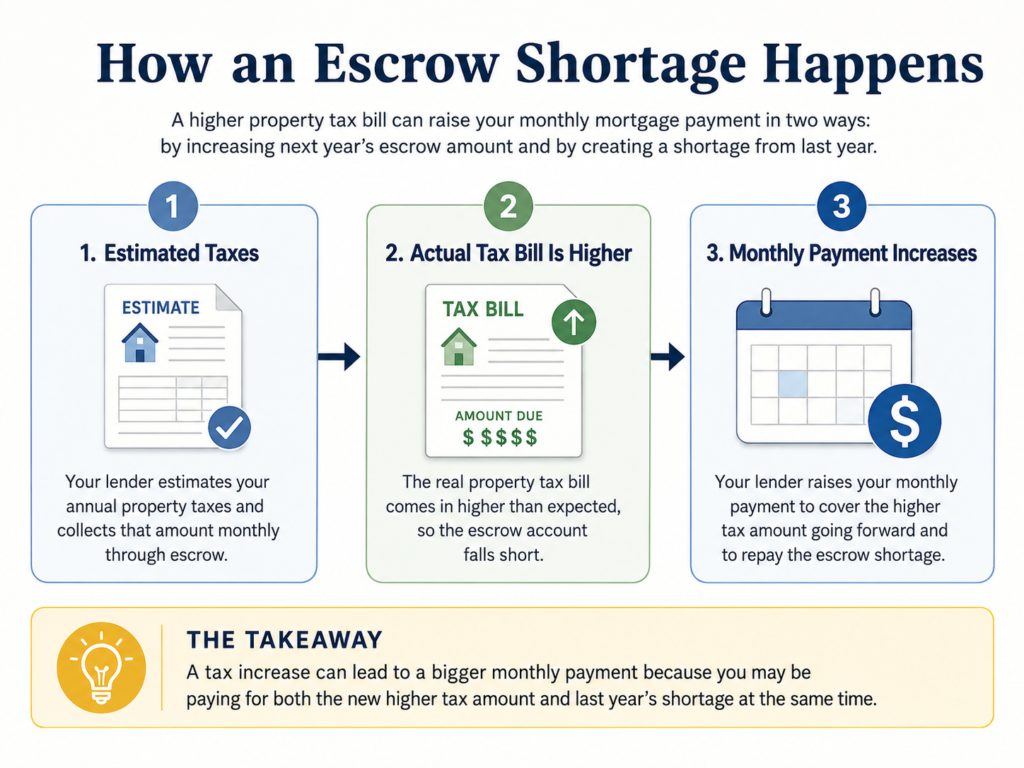
Now two things happen.
Your lender has to collect enough for the new, higher estimated tax bill going forward. It may also need to collect the $2,400 shortage from the prior year. You can read the CFPB’s escrow account rule here: 12 CFR § 1024.17 Escrow Accounts.
That can make the monthly increase feel much bigger than the tax increase alone.
It’s not just “next year will cost more.” It’s also “last year came up short.”
That’s a painful double tap, especially if you weren’t expecting it.
Watch Out: An escrow refund is not always extra money. Before spending it, ask your mortgage servicer whether your next property tax bill or insurance premium is expected to rise. Sometimes that “refund” is just money taking a temporary lap around the block.
New Homeowners Are Especially Vulnerable
If you recently bought your home, don’t assume the old tax bill is your future tax bill.
This is one of the most common traps in homeownership.
The seller may have had exemptions you don’t qualify for. The home may have been assessed years before you bought it. The prior bill may have reflected land only on a newly built home. Or the sale price may trigger a new assessment under local rules.
So the number you saw during the buying process may not be wrong exactly. It may just be incomplete for your situation.
Before buying — or as soon as possible after closing — call the local assessor or property tax office and ask:
“How often is this property reassessed?”
“Will my purchase price affect the assessed value?”
“Are the current taxes based on the prior owner’s exemptions?”
“Is this home receiving a homestead, senior, veteran, or other exemption?”
“What would the estimated taxes be based on my purchase price?”
“Are there local caps on annual assessment increases?”
You may not get a perfect prediction. But you’ll get a better picture than relying on the listing estimate alone.
First, Figure Out What Actually Changed
When your tax bill or mortgage payment jumps, it’s tempting to start with panic. Understandable. Not very useful, but very human.
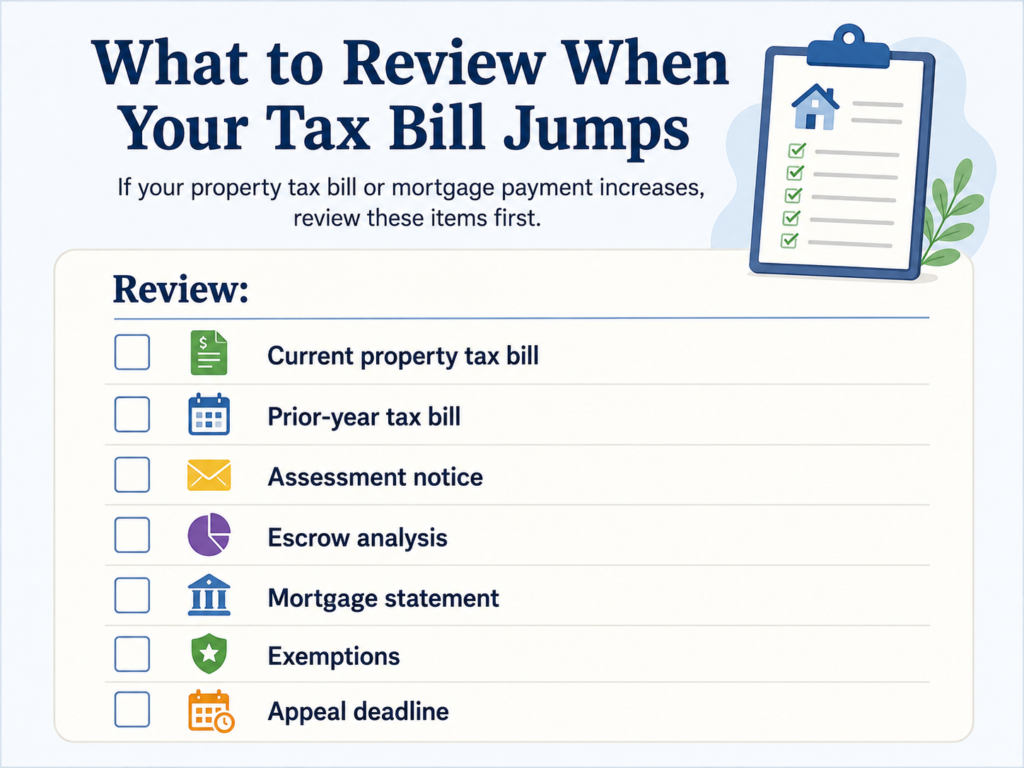
Start with paperwork instead. Not because paperwork is fun — it’s not — but because the paper trail usually tells you where the increase came from.
Gather:
- Your current property tax bill
- Last year’s property tax bill
- Your assessment notice
- Your mortgage escrow analysis
- Your latest mortgage statement
- Any exemption approval or denial notices
Then compare line by line.
Did the assessed value increase? Did the tax rate change? Did a special assessment appear? Did an exemption disappear? Did your insurance premium also increase? Is part of the new payment due to an escrow shortage?
This matters because the solution depends on the cause.
If your assessed value looks wrong, you may need to consider an appeal. If an exemption disappeared, you may need to reapply or correct your record. If the issue is an escrow shortage, you may need to ask whether you can pay it in a lump sum to reduce the monthly increase.
Not fun. But manageable.
Check Whether You’re Missing an Exemption
A lot of homeowners miss exemptions simply because no one taps them on the shoulder and says, “Hey, this one might apply to you.”
Property tax relief programs are local and often deadline-driven. Your neighbor may qualify for one program, your parents may qualify for another, and you may qualify for something only after a life change. The frustrating part? Many of these benefits are not automatic.
Common property tax relief programs may include:
- Homestead exemptions for primary residences
- Senior exemptions
- Veteran exemptions
- Disabled homeowner exemptions
- Income-based relief
- Assessment freezes
- Property tax deferrals
- Circuit breaker programs
Retirement, disability status, a spouse’s death, military service, income changes, or simply making the home your primary residence can all affect what programs may apply.
Don’t assume your local government automatically applies these. Many programs require an application. Some require annual renewal. Some have deadlines that pass quietly, with no dramatic warning bell.
Pro Tip: Put your local exemption deadline on your calendar every year, even if you already receive one. A five-minute reminder can protect real money.
When a Property Tax Appeal May Make Sense
A property tax appeal usually works best when you can point to something specific.
Not just “this feels too high,” even if it does. More like: “The county has the wrong square footage,” or “similar homes nearby are assessed for less,” or “this condition issue wasn’t reflected in the value.”
An appeal may make sense if your assessed value is higher than similar homes nearby, your property record has incorrect details, an exemption was denied or removed incorrectly, or recent comparable sales support a lower value.
This is where small errors can become expensive.
Maybe the county record says you have a finished basement, but it’s unfinished storage. Maybe it lists three bathrooms when you have two. Maybe it assumes a renovation that never happened. Maybe it doesn’t reflect a roof, foundation, or water damage issue that affects value.
Good evidence can include photos, repair estimates, recent comparable sales, appraisal reports, incorrect property record cards, or examples of similar homes assessed lower.
Appeal windows can be short, and the rules are local. That’s why opening every assessment notice right away matters.
It’s boring mail until suddenly it’s expensive mail.
How AHA’s DIY Property Tax Appeal Toolkit Can Help
If your assessment looks too high, don’t try to hold the whole process in your head.
That’s where homeowners get overwhelmed: one notice from the county, one escrow statement from the lender, a deadline somewhere in small print, and suddenly it feels like you need to become a tax professional by Friday.
The AHA DIY Property Tax Appeal Toolkit gives you a step-by-step way to review your assessment, look for possible errors or overvaluation, gather evidence, and prepare for a local appeal with more confidence.
It won’t promise that every appeal will succeed. No honest resource can do that.
But it can help you ask better questions, collect the right documents, and avoid walking into the process cold.
Use the toolkit when you want help with:
- Reviewing your assessment
- Checking for common property record errors
- Gathering comparable sales and condition evidence
- Understanding what questions to ask
- Preparing your appeal documents
- Feeling less overwhelmed by the process
You don’t need to become the neighborhood property tax expert. You just need to know enough to spot when something looks off.
How to Plan So Property Taxes Don’t Surprise You Again
You can’t control every local tax decision. You can’t control every reassessment. You can’t control whether your neighborhood suddenly becomes the “hot” place to buy.
But you can build a buffer.
Review your property tax notice the day it arrives. Don’t let it sit in the “later” pile.
Check your escrow analysis every year. If there’s a shortage, ask whether paying it upfront would reduce the monthly increase.
Keep escrow refunds in a home reserve account until you know next year’s taxes and insurance are stable.
Ask your local tax office how reassessments work before buying or refinancing.
Budget as if property taxes and insurance will rise. Even a modest cushion is better than assuming nothing changes.
Recheck exemptions annually, especially after retirement, disability status changes, military status changes, income changes, or a spouse’s death.
Keep a simple home file with tax bills, assessment notices, insurance renewals, escrow statements, and major repair receipts.
This isn’t about becoming a full-time paperwork person. Most people do not dream of spending Saturday reading assessment rules.
It’s about not being surprised by the house you already worked so hard to afford.
Tax Note: Can You Deduct Property Taxes?
Some homeowners may be able to deduct state and local real estate taxes if they itemize deductions, subject to federal limits. This is separate from whether your property tax bill is accurate or appealable. Check current IRS guidance on tax benefits for homeowners or talk with a qualified tax professional before assuming a higher property tax bill creates a federal tax benefit.
If You’re Buying a Home, Look Beyond the Mortgage Approval
Getting approved for a mortgage is not the same as being comfortable with the full cost of owning the home.
Your real housing cost may include:
- Principal and interest
- Property taxes
- Homeowners insurance
- Mortgage insurance
- Homeowners association fees
- Maintenance
- Repairs
- Utilities
- Future tax and insurance increases
Before you buy, ask your lender to run a payment scenario using a higher property tax estimate. Ask what happens if taxes rise after reassessment. It may feel overly cautious in the moment.
Later, it may feel like wisdom.
Pro Tip: Don’t rely only on the seller’s current property tax bill. Ask the local tax office what the bill may look like after the sale, especially if the current owner has exemptions or has owned the home for a long time.
The Bottom Line
Property taxes may be local, complicated, and occasionally frustrating. But they don’t have to be a complete mystery.
Open the notice. Check what changed. Confirm your exemptions. Review your escrow statement. And if the assessed value looks wrong, don’t just absorb the increase without asking questions.
You may not be able to stop every tax increase. But you can make sure you understand the bill, use the relief programs available to you, and challenge mistakes when the facts support it.
That’s the goal here: not panic, not blame, just a little more control over one of the most expensive parts of owning a home.
If something looks off, download the AHA DIY Property Tax Appeal Toolkit to review your assessment, organize your evidence, and prepare your next step with more confidence.