

Something breaks. Usually at the worst possible time.
The HVAC stops cooling during the first hot week. The water heater starts leaking before work. A roof stain appears after a storm. Then comes the estimate — and the sentence every homeowner quietly dreads:
“We can repair it, but you may want to think about replacing it.”
That’s when the repair vs. replace decision gets expensive fast. Not just because of the money, but because you’re being asked to make a major home decision with limited information.
Before you say yes, step back and sort the problem. Is this a Protect issue that needs attention now? A Prevent issue you should plan before it gets worse? Or an Improve project that can wait until it fits your budget?
That one shift can save you from two expensive mistakes: replacing something too early, or repairing something that’s already telling you it’s done.
Why Repair vs. Replace Feels So Hard

Homeowners are often expected to make repair decisions before they have the full picture.
The repair estimate tells you what today’s fix will cost. What it usually doesn’t tell you is how much life the system has left, whether the failed part is a simple one-off or a warning sign, or whether another contractor would see the problem differently. That uncertainty is normal.
That uncertainty is normal.
Your home is made up of systems that age at different speeds. The roof, HVAC system, water heater, appliances, windows, plumbing, electrical components, exterior materials, and structural connections all have their own timelines. Some parts fail suddenly. Others slowly wear down until one small problem becomes the clue that the whole system is tired.
So no, you’re not supposed to know the answer immediately.
The goal isn’t to become a contractor overnight. The goal is to slow the decision down long enough to ask better questions.
Start With AHA’s Protect–Prevent–Improve Framework
The repair vs. replace question gets easier when you stop treating every home problem like the same kind of problem.
AHA’s Protect–Prevent–Improve Framework helps homeowners separate urgent repairs from normal aging and optional upgrades. It’s designed to help you prioritize home repairs, avoid overreacting, and decide what truly needs attention — and what can wait.
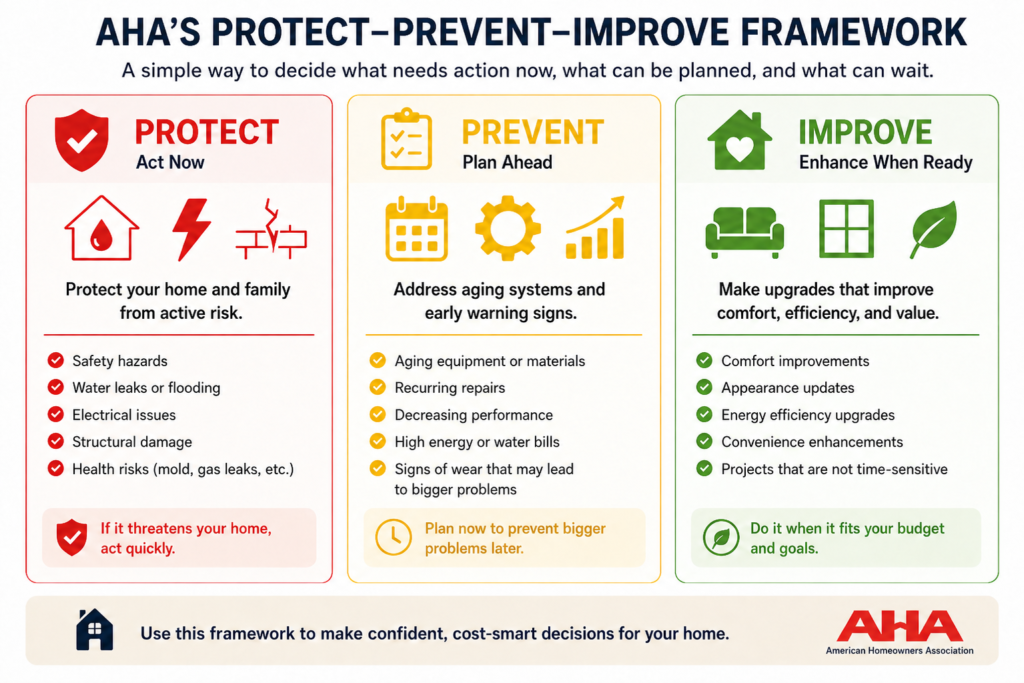
Here’s the simple version:
- Protect means the issue affects safety, water intrusion, structure, electrical risk, security, or your ability to safely live in the home.
- Prevent means the issue may not be an emergency today, but ignoring it could lead to bigger damage or higher costs.
- Improve means the project may add comfort, efficiency, appearance, convenience, or value — but it’s not urgent in the same way.
That distinction matters. A contractor may be talking about replacement because it’s the cleanest technical solution. But your job as the homeowner is different. You’re deciding what your home truly needs now, what should be planned, and what can wait.
Protect: When You Should Act Quickly
Some repair vs. replace decisions need a faster response because the risk is bigger than the broken part.
A leaking water heater is not just a water heater problem. It can become a flooring, drywall, mold, and insurance problem. An overheating electrical panel is not a “watch it for a while” situation. A roof leak during heavy rain deserves more urgency than a cosmetic ceiling stain that’s been dry for years.
Protect issues usually involve:
- Water actively entering the home
- Electrical hazards
- Gas, combustion, or carbon monoxide concerns
- Structural movement or unsafe supports
- Major plumbing failures
- Roof leaks
- HVAC failure during extreme heat or cold
- Security or access problems
In these cases, the first decision is not “What’s the prettiest long-term upgrade?” It’s “How do we protect the home and the people in it?”
Sometimes that means a repair. Sometimes it means replacement. But either way, the priority is stopping damage or reducing risk.
Watch Out: Urgency does not mean you should skip basic protections. Even when the problem is pressing, ask for the scope of work, cost, warranty, and payment terms in writing. The Federal Trade Commission recommends getting a written contract and reading it carefully before signing; contract requirements vary by state, but asking for one is still a smart baseline. (Consumer Advice)
Prevent: When Repair Buys You Time to Plan
Prevent issues are where homeowners can save a lot of money by acting before the emergency.
This is the aging HVAC system that still works but needs repairs more often. The roof that has a few damaged areas but is clearly getting older. The exterior caulk that’s cracking before water gets behind the trim. The slow plumbing issue that hasn’t caused damage yet, but probably won’t improve on its own.
Prevent is the middle zone.
It’s not panic. It’s planning.
A repair may make sense if it safely buys you time to budget, compare estimates, research incentives, or schedule work during a better season. But that repair should come with clear expectations. Are you buying five more good years? Or just hoping to limp through another few months?
There’s a big difference.
Pro Tip: A repair that buys you time can be a smart financial move — as long as you use the time. Set a reminder, start a repair reserve, gather replacement quotes, and watch for warning signs instead of mentally filing the issue under “fixed forever.”
Improve: When Replacement Is Optional, Not Urgent
Improve projects can absolutely matter. Comfort matters. Efficiency matters. A quieter dishwasher, better windows, a more reliable HVAC system, or upgraded fixtures can make daily life easier.
But Improve projects shouldn’t be sold to you as emergencies unless there’s a real Protect or Prevent issue underneath.
For example, replacing drafty windows may improve comfort and energy performance. But if the frames are solid, there’s no water damage, and basic air sealing could help, full replacement may be something to budget for — not something to rush into this week.
The U.S. Department of Energy notes that a home energy assessment can help homeowners understand energy use, comfort, safety, inefficient areas, and which fixes to prioritize before making energy-saving improvements. That can be especially useful when deciding whether an efficiency-related replacement is urgent or simply worth planning. (The Department of Energy’s Energy.gov)
Improve decisions are where it helps to ask:
- Does this solve a real problem?
- Will it lower future costs?
- Will I stay in the home long enough to benefit?
- Is there a less expensive repair or maintenance step that gets me most of the way there?
Not every upgrade is a mistake. But not every upgrade is a need.
The Real Question: What Are You Buying?
A repair buys time.
A replacement buys a reset.
That’s the simplest way to think about it.
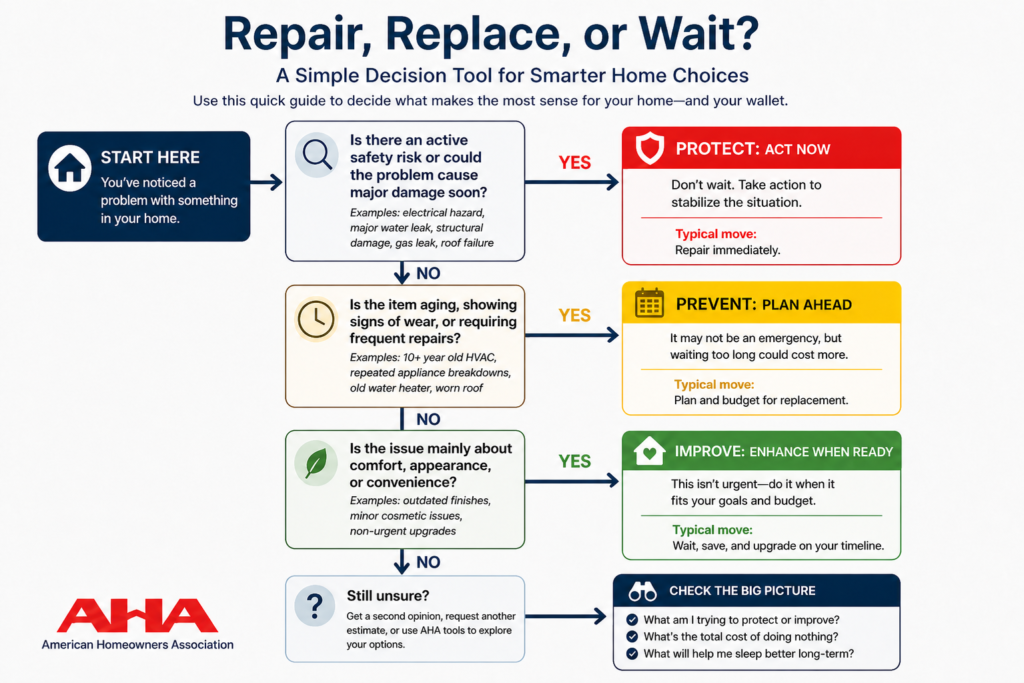
A repair may be the right choice when the item is still in decent shape, the problem is isolated, and the cost is reasonable. For example, an HVAC system might only need a small electrical part, a dishwasher may need one replaceable component, or a roof leak could be traced to damaged flashing instead of a failing roof.
In those cases, repair can be calm and practical. You fix the problem, keep money in your pocket, and move on.
Replacement starts to make more sense when the repair is expensive, the system is near the end of its useful life, or the problem keeps coming back. One repair is annoying. Three repairs in two years starts to feel like the house is trying to tell you something.
And houses do that. Not politely, usually.
When Repair Usually Makes Sense
Repair often makes sense when the issue is limited and the rest of the system is working well.
Think of it like one loose board on an otherwise solid fence. You repair the weak spot, keep watching for signs of broader wear, and save your bigger dollars for the work that actually needs them.
Repair may be the better choice when:
- The item is relatively new or still within its expected service window.
- The repair is minor compared with replacement.
- This is the first major issue you’ve had.
- Parts are available and reasonably priced.
- The repair does not create a safety concern.
- There is still warranty coverage.
- The contractor can explain the problem clearly.
That last one matters. A good repair recommendation should make sense when it’s explained in plain English. If the explanation feels rushed, vague, or overly dramatic, pause before approving the work.
When Replacement Usually Makes More Sense
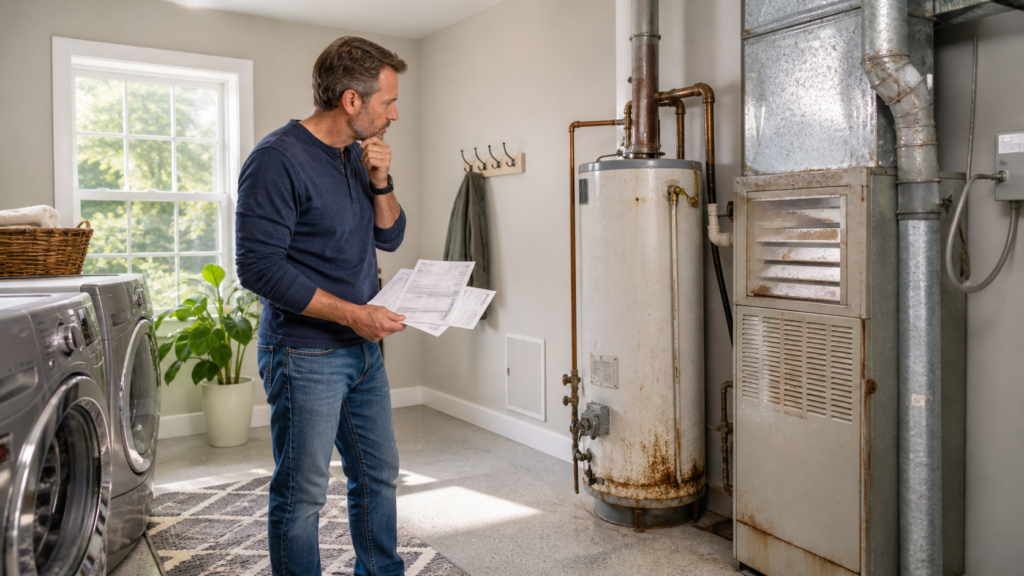
Replacement deserves serious consideration when the repair is not really solving the problem — it’s propping up a system that’s already declining.
That might look like an older HVAC system that keeps needing service. A water heater with visible tank corrosion. A roof with multiple leak points. Windows with rotted frames. An appliance that has already had two expensive repairs and now wants a third.
At some point, repeated repair bills become a slow-motion replacement. You just pay for it in pieces first.
Replacement may make more sense when:
- The item is near the end of its expected life.
- The repair cost is a large share of the replacement cost.
- The same issue keeps returning.
- Failure could cause water, fire, mold, or safety damage.
- Parts are discontinued or hard to get.
- The system is inefficient and raising monthly costs.
- You plan to stay in the home long enough to benefit from the upgrade.
This is where PPI helps again. Replacement may be the right move when it reduces an active risk to your home. If the issue is predictable but not urgent, you may have time to plan. And if the project is mostly about comfort or appearance, waiting may be the smarter choice.
The 50% Rule Can Help — But Don’t Let It Decide for You
You may hear a common rule of thumb: if a repair costs around half as much as replacement, replacement may be the better choice.
That can be useful. But it’s not law.
A $700 repair on a fairly new refrigerator may be reasonable if replacement would cost $2,500 and the appliance has been reliable. A $700 repair on an older refrigerator that already failed twice may be money you never see again.
The same logic applies to HVAC, roofing, plumbing, appliances, windows, and exterior repairs.
A better version of the rule is:
Compare the repair cost with replacement cost, then weigh that against age, reliability, safety, efficiency, warranty, and future risk.
That’s not as neat as a simple percentage. But it’s much closer to how real home decisions work.
Common Repair vs. Replace Examples
| Home Item | Repair Often Makes Sense When… | Replacement May Make Sense When… |
| HVAC System | The issue is isolated, such as a thermostat, capacitor, sensor, or minor component. | The system is older, inefficient, leaking refrigerant, or failing repeatedly. |
| Water Heater | A valve, thermostat, igniter, or heating element can be replaced safely. | The tank is leaking, rusting, or showing signs of major failure. |
| Roof | Damage is limited to one area, such as flashing, a few shingles, or a small leak source. | Leaks are widespread, shingles are deteriorating, decking is damaged, or repairs keep returning. |
| Appliances | The part is affordable and the appliance has otherwise been dependable. | The repair is expensive, parts are hard to find, or the appliance has become unreliable. |
| Windows | Air leaks can be improved with caulking, weatherstripping, or minor hardware repair. | Frames are rotted, seals have failed widely, or water intrusion is damaging surrounding materials. |
| Plumbing | The leak is localized and the surrounding materials are sound. | Pipes are corroded, leaks are recurring, or hidden damage is likely. |
| Decks and Exterior Wood | A few boards, fasteners, or rail sections need work. | Structural supports, posts, joists, railings, or ledger connections are compromised. |
Use this table as a starting point, not a final verdict. Your climate, home age, local labor costs, warranties, code requirements, and how long you plan to stay in the home can all change the answer.
When to Get a Second Opinion
A second opinion is not an accusation.
It’s just good judgment when the decision is expensive, urgent, or unclear.
If one contractor says, “You need a full replacement,” and another says, “This can be repaired safely for now,” you’ve learned something important. If both say replacement is the right move, you can move forward with more confidence.
A second opinion is especially wise for roofing, HVAC, structural repairs, electrical work, plumbing, foundation concerns, and anything involving water damage.
For emergency repairs, you may not have much time. Still, ask for the basics in writing: scope of work, estimated cost, payment schedule, warranty details, and what happens if additional damage is found. After weather emergencies, the FTC warns homeowners to be skeptical of anyone promising immediate repairs, to check contractors before committing, and to get a written contract. (Consumer Advice)
Questions to Ask Before You Say Yes
Before you approve a repair or replacement, ask:
- What exactly failed?
- Is this a normal wear issue, or a sign of a larger problem?
- Is this a Protect, Prevent, or Improve issue?
- If I repair it, what else is likely to fail next?
- How long should this repair reasonably last?
- What would replacement cost?
- Is there any safety risk if I wait?
- Are parts still available?
- Is anything covered by warranty?
- Do I need a permit?
- Would you make the same recommendation if this were your home?
A trustworthy professional should be able to explain the tradeoff without making you feel foolish for asking. You’re not being difficult. You’re making a financial decision about your home.
If you need help asking the right questions before you say yes, use AHA’s SmartHire Contractor Kit. It can help you compare estimates, understand the work being proposed, and get the important details in writing before you approve a repair or replacement.
The Bottom Line
Repair vs. replace is not about choosing the cheapest option.
It’s about choosing the option that gives you the best mix of safety, reliability, cost control, and peace of mind.
Sometimes that means repairing the part and moving on. Sometimes it means replacing the system before it drains your budget one service call at a time. And sometimes it means buying yourself a little breathing room while you gather better information.
When a repair estimate makes your stomach drop, don’t start with panic. Start with priority.
Use the AHA Protect–Prevent–Improve Framework to sort the issue, understand the risk, and decide whether your home needs you to protect, prevent, or improve. That one step can help you slow down the decision — and avoid spending thousands for the wrong reason.