
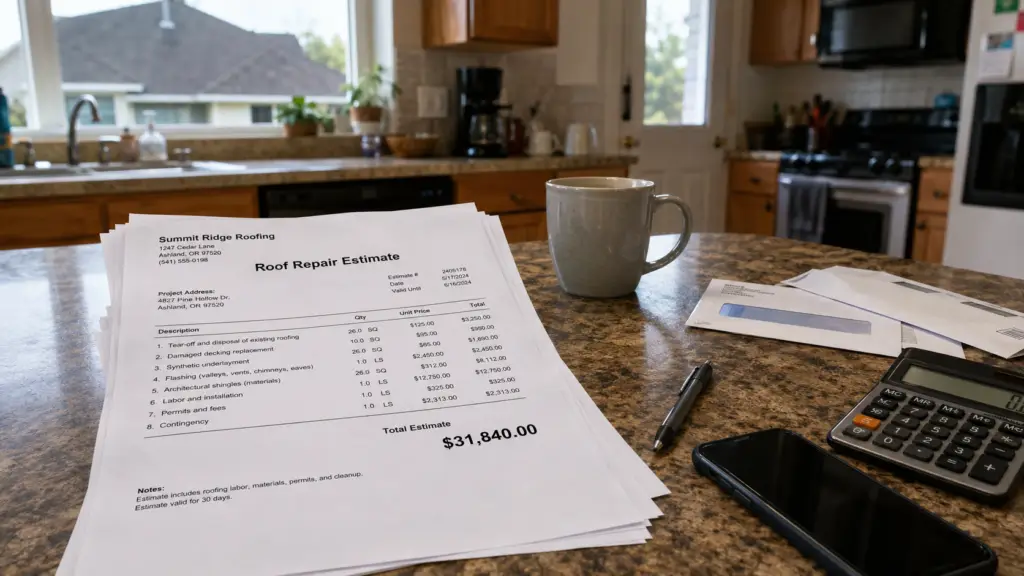
The roof estimate is sitting on the kitchen counter. It’s more than you hoped, but waiting could turn a manageable problem into a much more expensive one.
You have equity in your home, and a lender says a home equity line of credit could make the money available. That answers one question: Can you borrow?
It doesn’t answer the harder one: Should you use a HELOC for this particular expense?
A HELOC can fit when costs arrive in stages, the final amount is uncertain, and the project provides a lasting benefit. But its variable rate, changing payment structure, fees, and connection to your home deserve a closer look.
This guide focuses on that decision. For the broader foundation—including how equity builds and the main ways homeowners can access it—read Understanding Home Equity—and What You Can Do With It.
How a HELOC Actually Works
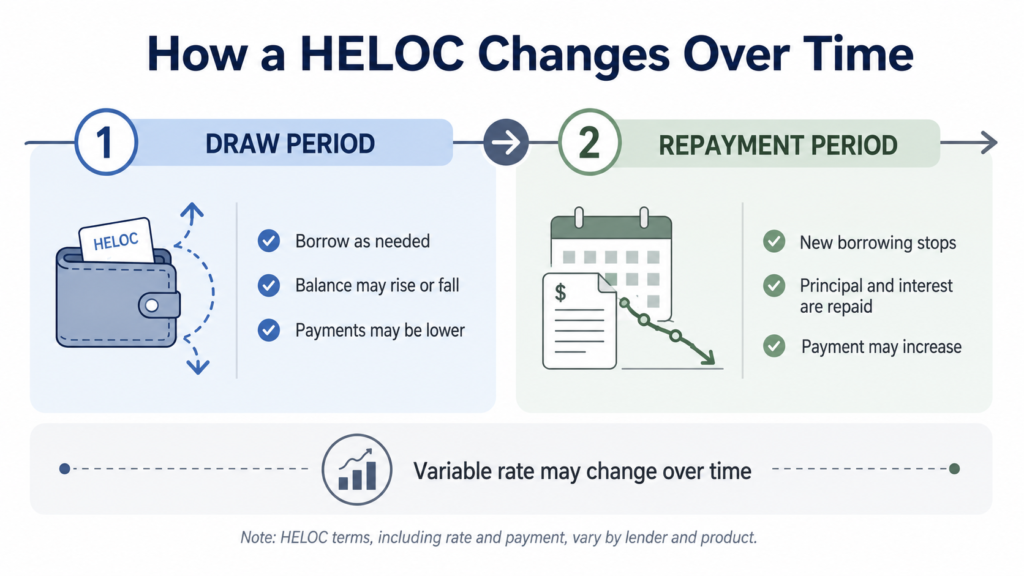
A home equity line of credit, or HELOC, is revolving credit secured by your home. A lender approves a credit limit, and you can generally borrow, repay, and borrow again during a set draw period.
Unlike a home equity loan, which provides a specific lump sum, a HELOC lets you draw money as needed. If you already have a mortgage, either option is generally an additional loan secured by the property. (CFPB)
Most HELOCs have two phases:
The draw period: You can access the line, often over several years. Depending on the agreement, minimum payments during this period may cover only interest or a small amount of principal.
The repayment period: New borrowing stops, and the remaining balance must be repaid according to the loan terms.
That transition matters. A payment that feels comfortable during the draw period may increase when principal repayment begins.
HELOCs also commonly use variable interest rates. When the underlying rate changes, your interest cost and required payment can change with it. The lender’s disclosures should explain how the rate is calculated, how payments are determined, and how long each phase lasts. (CFPB)
Pro Tip: Ask the lender to show you estimated payments during both the draw period and the repayment period. Request an example using a higher interest rate, too—not only the rate offered today.
When the Structure of a HELOC Fits the Expense
A HELOC tends to fit best when the expense unfolds over time or the final cost cannot be known precisely at the beginning.
That may include:
- A renovation with several contractor payments
- An older-home repair where hidden damage could change the cost
- Accessibility work completed in phases
- A resilience project involving several connected upgrades
Suppose you’re modifying a bathroom for safer, more accessible use. The work may involve design, demolition, plumbing, flooring, a curbless shower, grab bars, and finish carpentry. The bills won’t necessarily arrive at once.
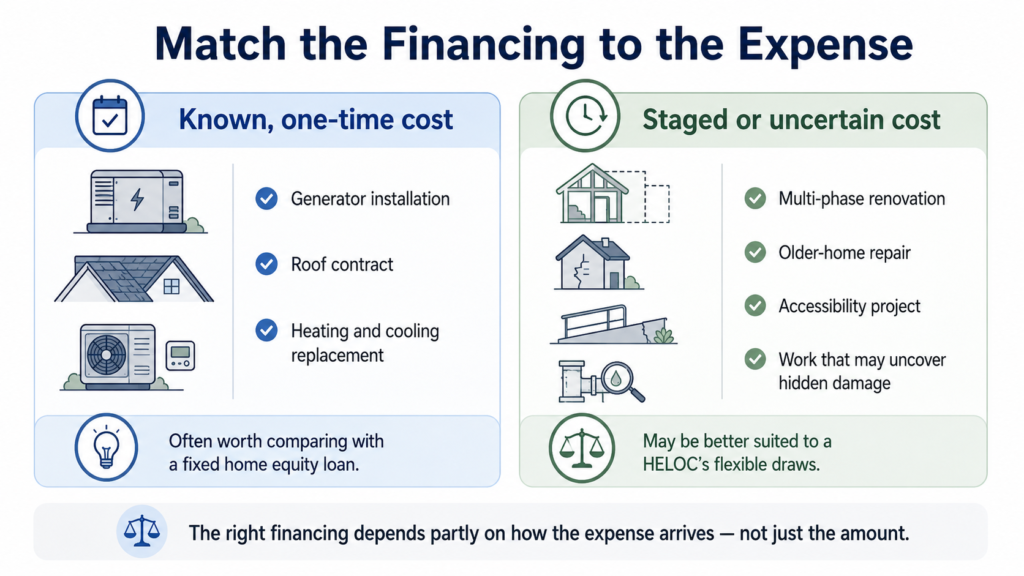
A HELOC may allow you to draw money as each phase is completed rather than borrowing the entire estimated amount on day one.
The same may be true when opening a wall or floor could reveal additional damage. Having access to a reasonable contingency can be useful.
But flexibility isn’t the same as affordability.
Even a necessary roof, sewer repair, drainage project, or heating-system replacement can become a poor financing decision when the resulting payment leaves no room for insurance, taxes, maintenance, or the next home surprise.
A needed repair can still be financed in an unsafe way.
When a Home Equity Loan May Fit Better
A fixed home equity loan may be easier to manage when the cost is known and the money is needed once.
Consider a professionally installed generator with a signed contract price. If the total is firm, a lump-sum loan with a predictable payment may match the project better than an open, variable-rate credit line.
A HELOC may be a better structural fit when:
- Costs will arrive in several stages
- The final total includes some uncertainty
- You want to borrow only as work progresses
A home equity loan may fit better when:
- The full cost is already known
- You need one disbursement
- Predictable payments matter
- You don’t want ongoing access to additional credit
The question isn’t which product is universally better. It’s which borrowing structure most closely matches the expense.
Still deciding whether you should access equity at all? AHA’s Understanding Home Equity guide explains the broader choices, including home equity loans, HELOCs, and cash-out refinancing.
The Payment You Start With May Not Be the Payment You Keep
A low initial payment can make a HELOC look easier to carry than it eventually will be.
Here’s an illustration—not a current rate quote.
Suppose you borrow $30,000, and your agreement temporarily allows interest-only payments.
At an 8% annual rate, the interest-only payment would be about $200 per month.
At 10%, it would be about $250 per month.
If that $30,000 balance later had to be repaid over ten years at 10%, the principal-and-interest payment would be about $396 per month.
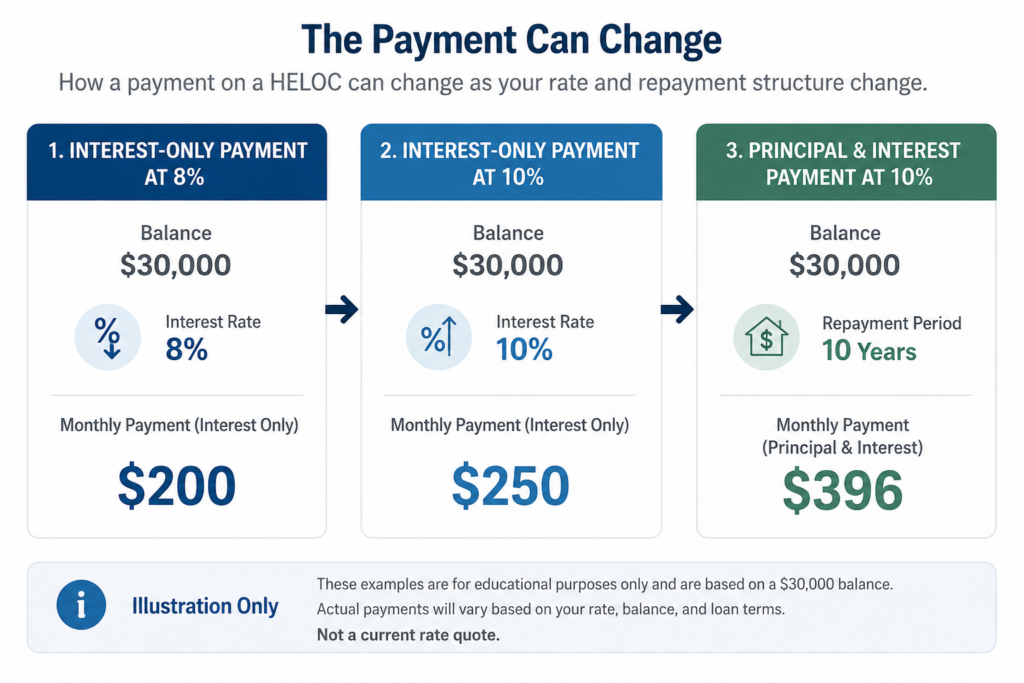
The exact figures will depend on the lender, loan balance, rate, repayment term, and fees. The lesson is simpler: the first monthly payment may not reflect the long-term cost.
Ask for four numbers before signing:
- The initial payment
- The payment at a higher rate
- The estimated repayment-period payment
- The total amount paid if you follow the scheduled repayment plan
The Draw-Period Trap
During the draw period, the HELOC may feel almost like a flexible household fund. You borrow for the roof, repay a little, then draw again for the electrical panel or bathroom project.
That’s convenient. It can also make the balance harder to see as one complete obligation.
The problem becomes clearer when the draw period ends. New borrowing stops, but the outstanding debt remains. If earlier payments covered mostly interest, much of the original principal may still be waiting.
Before using the line, decide:
- The maximum total you’re willing to draw
- Which expenses qualify
- Which expenses do not
- The month and year you expect the balance to reach zero
Without those boundaries, a project-financing tool can slowly become long-term household debt.
Watch Out: Don’t build your plan around the minimum payment alone. A minimum payment tells you what the lender requires now—not whether the balance will be gone when you need it to be.
Fees Can Change the Real Cost
The interest rate is only one part of a HELOC’s cost.
Depending on the lender and agreement, you may encounter:
- Application or origination charges
- Appraisal and title costs
- Annual fees
- Inactivity fees
- Early account-closure fees
- Fixed-rate conversion charges
Some lenders waive certain upfront expenses but require repayment of those costs if you close the line within the first few years. Others charge annual or transaction-related fees even when the balance is small. The Consumer Financial Protection Bureau advises borrowers to compare these costs alongside the interest rate and payment terms. (CFPB)
Ask the lender:
“What will this line cost if I open it, use only part of it, and pay it off within two years?”
That question can reveal costs that an advertised introductory rate doesn’t.
Can a Lender Reduce or Freeze the Line?
A HELOC shouldn’t be treated as guaranteed emergency savings.
Under federal rules, a lender may be allowed to suspend additional advances or reduce a credit line under certain circumstances. These can include a significant decline in the property’s value or a material change in the borrower’s financial circumstances. (CFPB)
You would still owe the existing balance even if access to additional funds were restricted.
That matters when a homeowner plans to open a HELOC “just in case.” The line may be useful, but it is not a substitute for cash reserves that you control.
When the Expense and the Debt Don’t Match
A useful rule is:
The longer you’ll carry the debt, the longer the benefit should last.
That can make a HELOC easier to justify for a durable roof, accessibility improvement, serious drainage correction, or resilience upgrade than for a vacation, short-lived electronics, ordinary bills, or a loosely planned cosmetic project.
The issue isn’t whether you deserve the purchase. It’s whether the benefit is likely to be gone while the debt secured by your home remains.
A HELOC is also a poor long-term answer to a recurring monthly shortfall. When borrowed money is covering groceries, utilities, and routine expenses, the credit line may be delaying a cash-flow problem rather than fixing it.
Using a HELOC for Debt Consolidation
Debt consolidation is one of the more complicated possible uses.
The appeal is easy to understand. If the HELOC rate is substantially lower than several credit-card rates, combining the balances may reduce interest costs and simplify the payments.
But the risk changes.
Credit-card debt is generally unsecured. A HELOC is secured by your home. If the consolidation plan fails, the property is now tied to debt that previously wasn’t secured by it. The Federal Trade Commission warns that home-secured consolidation loans may involve additional costs and can put the home at risk if payments aren’t made. (Consumer Advice)
Consolidation deserves serious consideration only when:
- New credit-card spending has stopped
- The household budget is sustainable
- Fees don’t erase the expected savings
- The payment remains affordable if the HELOC rate rises
- There is a firm payoff date
Paying off the cards and then rebuilding the card balances leaves you with both kinds of debt. That’s not consolidation. It’s multiplication.
HELOC or Home Equity Loan?
| Decision Factor | HELOC May Fit | Home Equity Loan May Fit |
|---|---|---|
| How costs arrive | Several stages or uncertain total | One known amount |
| Borrowing need | Draw funds as needed | Receive the full amount once |
| Rate preference | Comfortable managing variable-rate risk | Prefer a fixed, predictable payment |
| Main caution | Payment and borrowing cost can change | Interest generally begins on the full amount borrowed |
| Budget control | Requires firm limits on future draws | Naturally limits borrowing to the original loan amount |
Cash-out refinancing is a larger mortgage decision rather than simply another way to pay one contractor. It replaces the existing mortgage, so homeowners need to compare the new rate and closing costs across the entire mortgage balance—not just the cash they want to receive.
AHA’s equity guide provides the broader comparison among these access methods.
Five Questions Before Opening a HELOC
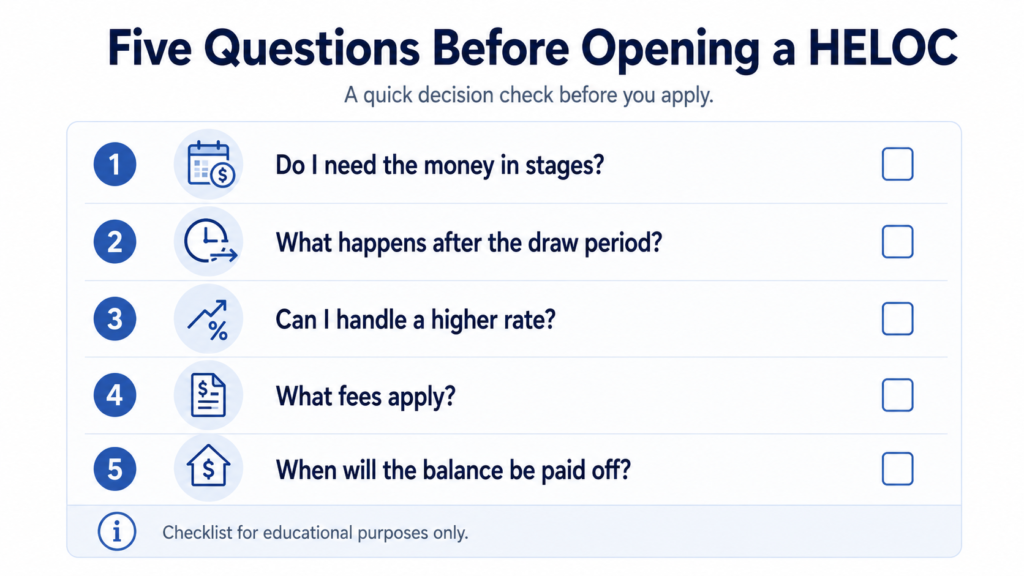
Before signing, ask yourself:
- Will I need the money in stages, or is the full cost already known?
- What will the payment look like when the draw period ends?
- Could I still afford the payment if the interest rate rises?
- What fees apply if I use little of the line or close it early?
- What exact month and year do I expect the balance to be paid off?
A “no” or “I don’t know” doesn’t always mean you should abandon the project.
It may mean you need another estimate, a smaller scope, a fixed-rate alternative, more time to save, or a clearer payoff plan.
That pause isn’t falling behind. It’s part of protecting the home you worked to build equity in.
Frequently Asked Questions
Is HELOC interest tax-deductible?
Sometimes, but not simply because the loan is secured by your home.
Under current federal guidance, interest may qualify when the proceeds are used to buy, build, or substantially improve the qualified home securing the debt, subject to itemizing and other mortgage-interest rules and limits. Interest on HELOC funds used for personal expenses or credit-card debt generally does not qualify under those rules. Tax circumstances vary, so confirm your situation with a qualified tax professional. (IRS)
Does opening a HELOC affect your credit?
Applying may involve a credit inquiry, and the new account, balance, and payment history can affect your credit profile. Ask the lender whether an initial rate check uses a soft inquiry and when a hard inquiry will occur.
Can a lender freeze a HELOC?
A lender may be permitted to suspend new advances or reduce the available line in certain circumstances, including a significant decline in the home’s value or a material change in the borrower’s ability to repay. (CFPB)
Should you use a HELOC for a roof?
It may fit when the roof needs replacement, costs are uncertain or paid in stages, income is stable, and the payment remains comfortable under a higher-rate scenario.
When the contractor price is firm, compare the HELOC with a fixed home equity loan before deciding.
Should you use a HELOC for a generator?
Home-equity financing may be easier to justify when backup power protects medical equipment, a sump pump, a private well, refrigeration, or safe indoor temperatures during frequent outages.
For a known installation price, compare a fixed-rate loan and a smaller essential-load system with the HELOC’s total projected cost.
Can you pay off a HELOC early?
Many HELOCs allow early repayment, but some lenders charge an early termination or account-closure fee if the line is closed within a certain period. Review the agreement rather than assuming early payoff is free.
What happens to a HELOC when you sell the house?
Because the HELOC is secured by the property, the outstanding balance generally must be paid as part of the sale and closing process. Request a payoff statement and ask about account-closing fees before listing or closing.
A HELOC Should Fit More Than the Project
A HELOC can be useful for a phased renovation, an uncertain repair, or another lasting home need. Its flexibility is the appeal.
That same flexibility can hide the full commitment.
Before opening the line, compare the draw-period payment with the later repayment amount, test your budget at a higher rate, review every fee, and choose a specific payoff date. Then compare the HELOC with a fixed loan, a smaller project, available savings, or waiting long enough to borrow less.
You don’t need to reject home-equity borrowing altogether. You need the expense, the loan structure, and your household budget to work together.
For the bigger picture, read AHA’s guide to what your equity represents and what it costs to use it.