

You thought your mortgage payment was the steady part of owning a home.
Then the letter showed up.
Your payment went up $300. Or $700. Or maybe even more. And suddenly you’re staring at a number that does not fit the budget you built when you bought the house.
If your mortgage payment went up, take a breath. A higher payment doesn’t automatically mean your loan changed or that you did something wrong. In many cases, the increase comes from property taxes, homeowners insurance, or an escrow shortage — costs that often sit inside your monthly payment even when you have a fixed-rate mortgage. The Consumer Financial Protection Bureau says a common reason mortgage payments change is that the homeowner has an escrow account and property taxes or homeowners insurance premiums changed. (CFPB)
Let’s figure out what changed, what might be temporary, and what you can do next.
Quick Answer: Why Your Mortgage Payment Went Up
Your mortgage payment may have gone up because your property taxes increased, your homeowners insurance premium rose, your escrow account had a shortage, or your loan terms changed.
If you have a fixed-rate mortgage, your principal and interest may still be the same. But the taxes and insurance collected through escrow can change your total monthly payment.
That’s the part that surprises a lot of homeowners. The loan feels fixed. The full payment? Not always.
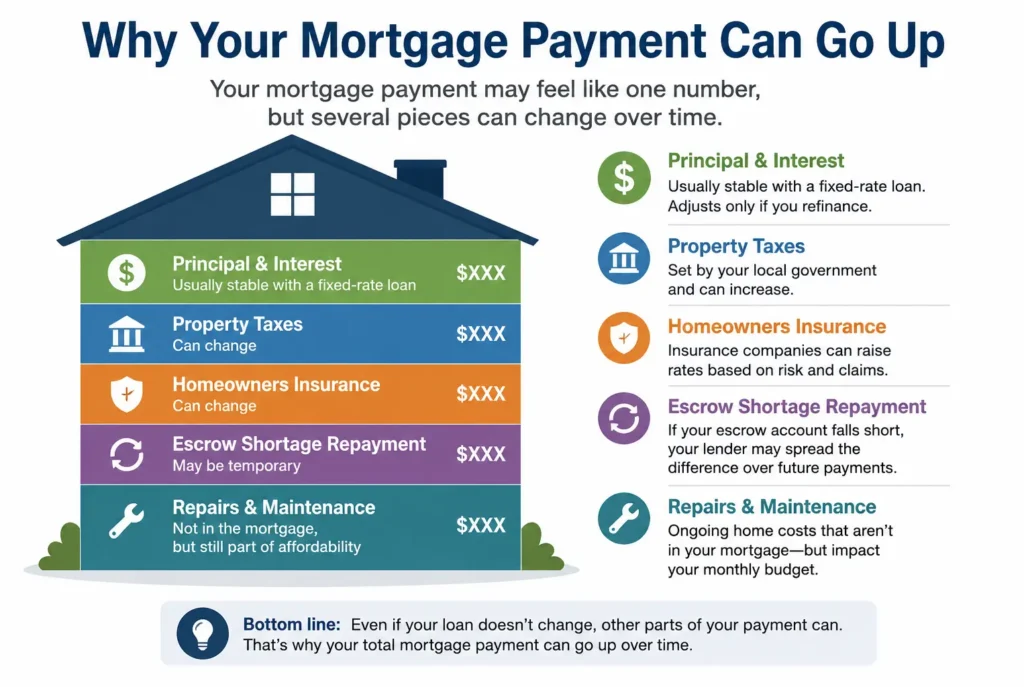
First: Find Out Which Part of Your Payment Changed
Before you panic, separate the payment into pieces.
Your monthly mortgage payment may include:
| If This Changed | What It Usually Means | What to Do Next |
| Property taxes | Your home may have been reassessed, tax rates changed, or seller exemptions disappeared | Compare your tax bill and review whether an appeal makes sense |
| Homeowners insurance | Your premium increased and your escrow payment adjusted | Shop carefully and ask your agent about discounts |
| Escrow shortage | Your servicer paid more for taxes or insurance than it collected from you | Ask how much is temporary shortage repayment |
| New-construction taxes | Your first estimate may have been based on land only, not the completed home | Ask for the completed-home tax estimate before buying |
| Loan terms | Adjustable rate, mortgage insurance, or another loan-related item may have changed | Review your mortgage statement and call your servicer |
Your Fixed Mortgage May Not Be as Fixed as It Feels
When people say they have a fixed mortgage, they usually mean their principal and interest payment is fixed.
That’s the loan part.
But many mortgage payments also include:
- Property taxes
- Homeowners insurance
- Mortgage insurance, if required
- Flood insurance, if required
- Escrow shortage repayment, if your escrow account came up short
So your interest rate may not have changed at all… but your total monthly payment still can.
Think of your mortgage payment like a dinner bill. Your entrée stayed the same price. But the tax, tip, and service charge changed. You’re still paying more at the end.
Use the AHA Home Mortgage Calculator to see how principal, interest, taxes, insurance, and loan terms affect the full monthly payment.
How Escrow Can Raise Your Monthly Payment
An escrow account is money your mortgage servicer collects each month to pay certain bills for you, usually property taxes and homeowners insurance. It’s meant to keep you from getting slammed with one big tax or insurance bill once or twice a year.
Helpful? Often, yes.
Perfect? Not exactly.
Escrow is based on estimates. Your servicer estimates what your taxes and insurance will cost over the next year, divides that amount into monthly payments, and collects it with your mortgage.
If the actual bills come in higher than expected, your escrow account can come up short.
That shortage can make your monthly payment jump because your servicer may need to collect money for two things at once:
First, the new higher amount needed for next year’s taxes or insurance.
Second, the shortage from the previous year.
So you’re not just paying the new normal. You’re catching up too.
The CFPB explains that a shortage is the amount by which your escrow account balance falls short of the target balance at the time of escrow analysis. Federal escrow rules also allow servicers to maintain a cushion, generally no more than two months of escrow payments unless state law or your mortgage documents require less. (CFPB)
That’s why the math can feel bigger than expected. You might think, “My taxes only went up $600. Why did my payment go up so much?” The answer may be: new estimate, shortage repayment, and escrow cushion.
Pro Tip: Separate the Escrow Increase From the Escrow Shortage
Ask your mortgage servicer this exact question: “How much of my new payment is the updated escrow estimate, and how much is temporary shortage repayment?” That one question can tell you whether the whole increase is permanent — or only part of it.
Then ask one more: “Do I qualify for an escrow waiver?”
If your lender allows it, you may be able to request an escrow waiver once you have at least 20% equity in your home. Be prepared to show proof of timely payments, and ask whether your loan type, mortgage terms, state rules, or servicer requirements limit your eligibility.
Just remember: removing escrow doesn’t lower your property taxes or homeowners insurance premium. It only means you’ll pay those bills yourself instead of spreading them through your monthly mortgage payment. Before you waive escrow, make sure you have a reliable savings plan for those larger tax and insurance bills.
Property Tax Reassessment: The Surprise Many Buyers Don’t See Coming
This is one of the biggest “why didn’t anyone tell me?” moments in homeownership.
When you buy a home, the tax bill shown in the listing or early loan estimate may reflect what the previous owner paid — not what you’ll pay after the sale.
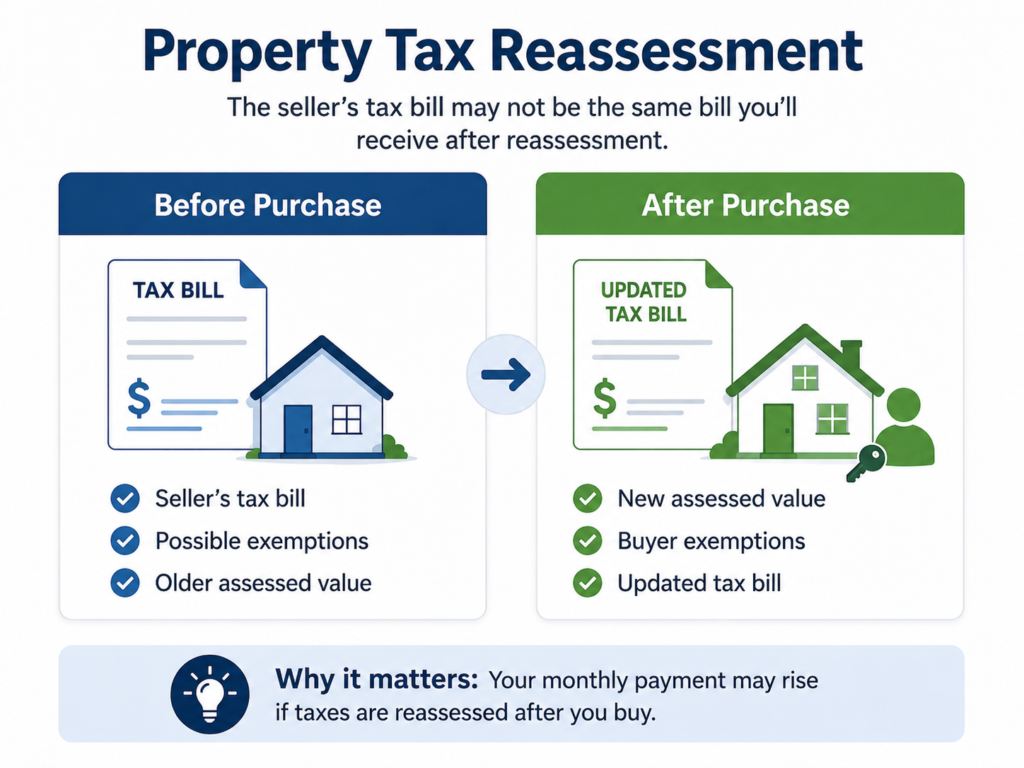
Your taxes may change because:
- The sale triggers reassessment
- The previous owner had exemptions you don’t qualify for
- The taxable value was capped until the home changed hands
- Local tax rates changed
- A school, city, county, or special district levy increased
- The home was renovated, expanded, or newly built
That’s why “What are the current taxes?” is useful, but it’s not enough.
The better question is: What will the taxes likely be after I own it?
Property taxes are also rising in many areas. ATTOM’s 2024 U.S. property tax analysis found that the average tax bill for single-family homes rose 5.3% to $4,300, with some of the highest effective tax rates concentrated in parts of the Northeast and Midwest. (ATTOM)
If your mortgage payment went up because of a tax reassessment, check whether the assessed value, exemptions, or property details look correct. If something seems off, use the AHA DIY Property Tax Appeal Toolkit to review your assessment and gather the right documents.
Watch Out:
Don’t assume the seller’s tax bill is your future tax bill. In some places, the purchase price, reassessment cycle, or loss of prior-owner exemptions can change the number dramatically.
New Construction Can Come With a Tax Surprise
Buying new construction has a lot of appeal.
Everything feels fresh. The roof, appliances, plumbing, electrical, and heating and cooling systems are all new. You’re not wondering what the last owner patched, painted over, or “fixed” with duct tape and optimism.
But taxes can get tricky.
Many new-construction buyers initially see taxes based mostly on the land. Then, after the home is completed and assessed as a finished property, taxes can jump because the house and land are now valued together.
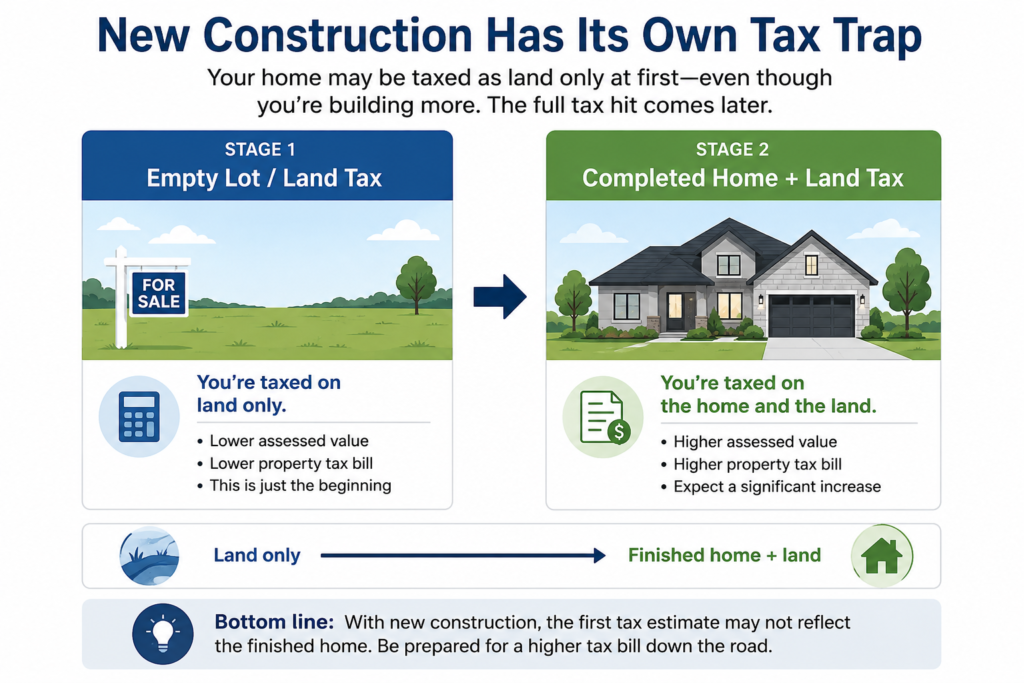
That doesn’t mean new construction is bad. It means the first payment estimate may not show the full long-term cost.
Before buying new construction, ask the builder, lender, and local tax assessor for an estimate based on the completed home. Not just the lot. Not just last year’s parcel tax. The finished property.
And get as much as you can in writing.
Homeowners Insurance Can Raise Your Mortgage Payment Too
Property taxes aren’t the only reason mortgage payments are rising.
Homeowners insurance has become a bigger part of the affordability conversation, especially in areas affected by storms, wildfire risk, rising repair costs, and insurance market changes.
ICE Mortgage Monitor data showed average property insurance payments rose 11.3% year over year in 2025 and were up 70% over five years, faster than increases in principal, interest, and property taxes over the same period. (Intercontinental Exchange) Harvard’s Joint Center for Housing Studies has also reported that rising insurance premiums are contributing to the growing cost of homeownership. (Joint Center for Housing Studies)
If your insurance is paid through escrow, your servicer pays the premium and then collects the money from you monthly. So when your premium goes up, your mortgage payment can go up too.
This is one place where you may have some control.
You can shop your policy, ask about discounts, review your deductible, update home details, and make sure you’re not missing savings for things like security systems, water leak sensors, roof improvements, or storm protection.
Just don’t slash coverage blindly. A cheaper policy that leaves you exposed after a major loss is not a bargain.
Before calling your agent, use the AHA Home Insurance Savings Call Guide so you know what to ask.
What to Do If Your Payment Just Went Up
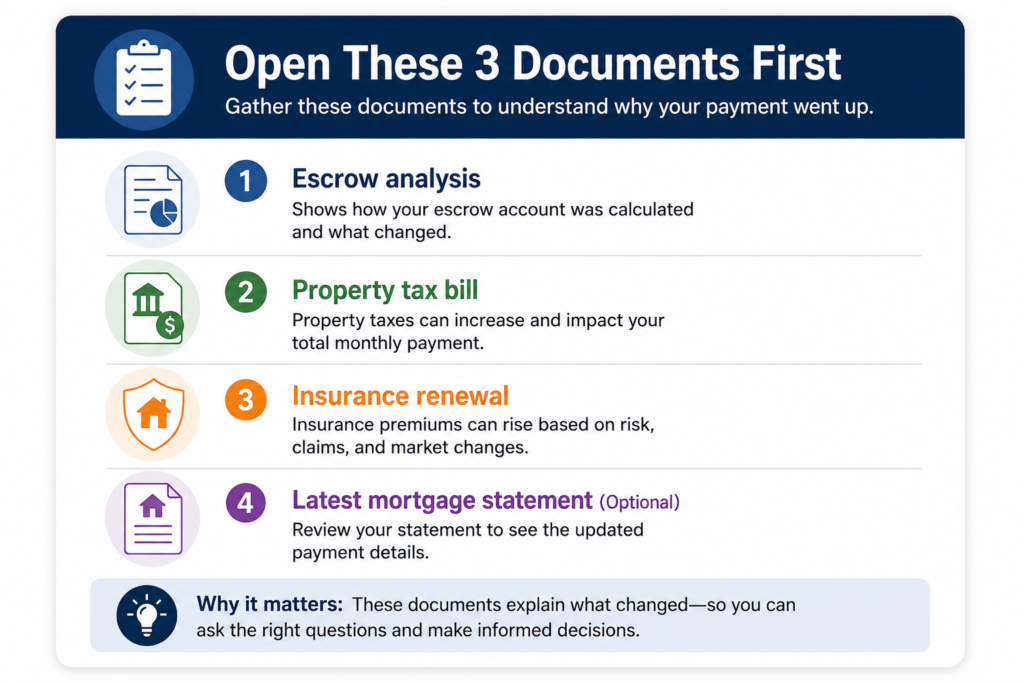
Start with your escrow analysis.
Yes, it looks boring. It may feel like it was designed by someone who believes “clear communication” means eight boxes and a footnote.
Read it anyway.
You’re looking for:
- Your old monthly payment
- Your new monthly payment
- Your projected property taxes
- Your projected insurance premium
- Your escrow shortage, if any
- Your shortage repayment period
- Your escrow cushion
- The date the new payment begins
Then compare the escrow analysis against your actual property tax bill and insurance renewal.
If your tax bill doesn’t match the number in your escrow analysis, ask your servicer to explain the difference. If your insurance premium increased, confirm they’re using your current policy amount — not an old estimate. And if your county or city still shows a balance due, verify that your servicer sent the payment and ask for confirmation in writing.
The CFPB says homeowners with escrow account problems should contact their mortgage servicer right away and may need to send an information request or notice of error if something looks wrong. (CFPB)
When you call your servicer, don’t just ask, “Why did my mortgage go up?”
That can lead to a vague answer like, “Taxes and insurance.”
Ask for the breakdown.
Try this:
“Can you walk me through my escrow analysis line by line?”
Then ask:
- What was my previous escrow payment?
- What is my new escrow payment?
- Did my property taxes increase? By how much?
- Did my insurance premium increase? By how much?
- Do I have an escrow shortage or deficiency?
- How long is the shortage being spread out?
- Can I make a voluntary payment toward the shortage?
- If I pay some or all of the shortage, what would my monthly payment become?
- When will my payment be recalculated again?
Write down the date, time, representative’s name, and what they told you.
Old-school? Yes. Useful? Very.
If Something Looks Wrong, Put It in Writing
A phone call is fine for a first pass.
But if something looks wrong — the wrong tax amount, insurance paid twice, taxes not paid, an unexplained shortage, or a payment calculation that doesn’t match the bills — put your request in writing.
The CFPB says writing to your servicer at the proper address can give you more protection and help ensure a timely written response. (CFPB)
Keep copies of:
- Your escrow analysis
- Property tax bills
- Insurance renewal notices
- Mortgage statements
- Emails or letters from the servicer
- Notes from phone calls
- Proof of payments
You don’t need to become a mortgage attorney overnight. You just need a paper trail.
If the New Payment Is Correct but You Can’t Afford It
This is the hard part.
Sometimes the increase is accurate. The taxes really did go up. The insurance premium really did renew higher. The escrow shortage really does have to be repaid.
That doesn’t make it easy.
If the new payment doesn’t fit your budget, contact your mortgage servicer before you miss a payment. Ask about escrow repayment options, hardship options, repayment plans, or loss mitigation options.
You can also contact a HUD-approved housing counselor. HUD provides resources for homeowners trying to avoid foreclosure, including a toll-free number to find a housing counselor near you. (HUD)
This is not the moment to hide from the mail.
That’s human. Truly. But it usually makes the problem heavier.
Open the letter. Make the call. Get help early.
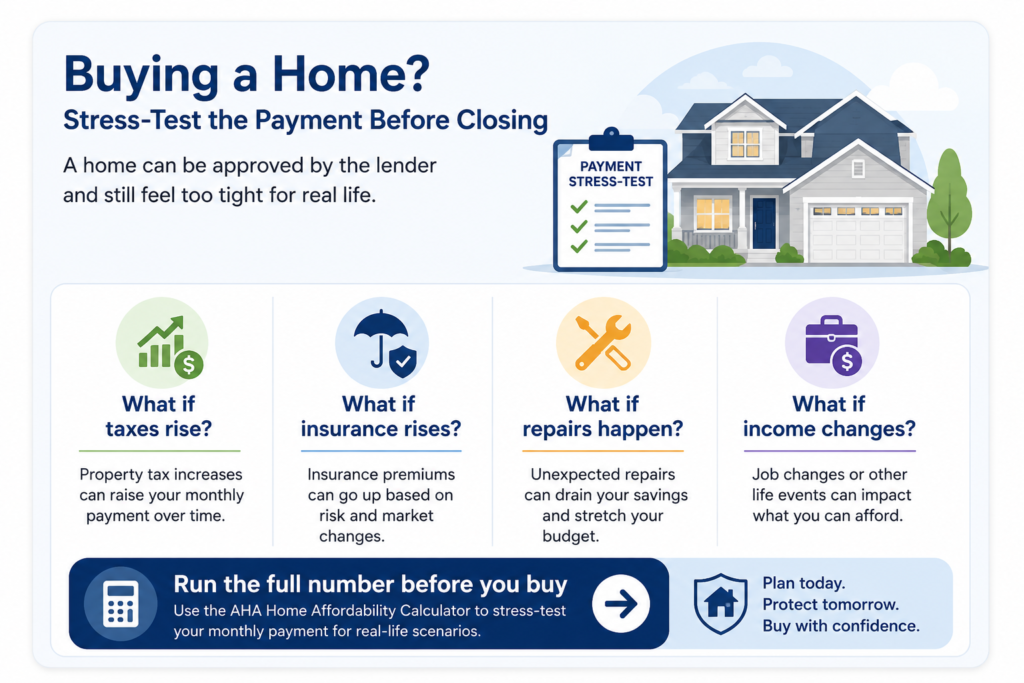
Buying a Home? Stress-Test the Payment Before Closing
The biggest lesson from the homeowner stories isn’t “don’t buy a house.”
It’s this: don’t confuse approval with affordability.
A lender approval tells you what you may be allowed to borrow. It does not always tell you whether the home will still feel manageable after taxes, insurance, repairs, savings, and regular life all show up at the same time.
The real question isn’t just “Can I get approved?” It’s whether you can comfortably afford the home long-term if circumstances change — because taxes change, insurance changes, and repairs happen.
Before buying, use the AHA Home Affordability Calculator to estimate what you can truly afford after real-life costs. This is especially important if your budget already feels tight at the payment shown on the loan estimate.
A smart affordability check includes:
- Principal and interest
- Property taxes after purchase
- Homeowners insurance
- Mortgage insurance, if any
- Flood insurance, if needed
- Homeowners association dues
- Utilities
- Repairs and maintenance
- Emergency savings
- Normal life — groceries, childcare, cars, healthcare, travel, and breathing room
That last one matters.
You’re not buying a spreadsheet. You’re buying a place to live.
Pro Tip:
Before closing, ask your lender: “Is this payment estimate based on the seller’s current taxes, or my likely taxes after purchase?” If they can’t answer clearly, pause and get the number verified.
Questions to Ask Before You Buy
Before closing, call the local tax assessor or property appraiser’s office and ask:
- Will this sale trigger reassessment?
- Are the current taxes based on exemptions I may not receive?
- What would taxes likely look like at my purchase price?
- How often are properties reassessed?
- Are there upcoming local levies, bonds, school taxes, or special assessments?
- For new construction, are current taxes based on land only or the completed home?
Then ask your lender to run the payment using the likely post-purchase property taxes — not only the seller’s current tax bill.
That’s not being difficult.
That’s being a grown-up with a very expensive future bill.
Don’t Forget Repairs — They Don’t Wait for Escrow to Calm Down
Have you considered the updates and/or repairs that will be needed? That’s the part of homeownership that doesn’t always show up in the preapproval conversation.
The roof doesn’t care that your escrow went up.
The water heater doesn’t wait until your tax appeal is done.
And the dishwasher has a strange talent for breaking right after you’ve paid for something else.
That’s why a repair reserve matters. Use the AHA Home Repair Reserve Calculator to estimate how much to set aside based on your home’s age, value, and major systems.
Can Refinancing Help?
Maybe. But it’s not magic.
Refinancing can sometimes lower your principal and interest payment if rates, loan terms, closing costs, and your financial situation line up.
But refinancing does not erase higher property taxes. It does not make insurance premiums disappear. And if you roll closing costs into the loan, you may pay for that relief over time.
Use the AHA Refinance Calculator to compare the numbers before assuming a new loan will fix the problem.
Refinancing may be worth exploring. Just don’t use it as a bandage for a budget that was stretched too thin from the start.
Related AHA Resources
Use these tools based on what changed in your payment:
- Use the AHA Home Affordability Calculator before buying so you can stress-test taxes, insurance, repairs, and real-life costs.
- Try the AHA Home Mortgage Calculator to see how payment pieces fit together.
- Review your assessment with the AHA DIY Property Tax Appeal Toolkit if your tax bill looks too high.
- Use the AHA Home Insurance Savings Call Guide before calling your agent.
- Plan for repairs with the AHA Home Repair Reserve Calculator.
Frequently Asked Questions About Mortgage Payment Increases
Why did my mortgage payment go up if I have a fixed-rate loan?
A fixed-rate loan usually means your principal and interest stay the same. But your total monthly payment can still rise if your property taxes, homeowners insurance, mortgage insurance, or escrow shortage repayment changes
What is an escrow shortage?
An escrow shortage means your escrow account didn’t have enough money to cover bills like property taxes or homeowners insurance. Your servicer may increase your monthly payment to collect enough for next year and repay the shortage from last year.
Will my mortgage payment go back down after an escrow shortage?
It might. If part of your higher payment is only for shortage repayment, that portion may drop after the shortage is paid off. But if your property taxes or insurance premium increased permanently, your payment may still stay higher than it was before.
Can I pay my escrow shortage in one lump sum?
Often, yes, but it depends on your servicer and situation. Ask whether making a voluntary lump-sum payment would reduce your monthly payment, and request the new payment amount in writing before sending money.
Why did my property taxes go up after I bought my house?
Your taxes may have changed because the home was reassessed after sale, the previous owner had exemptions you don’t qualify for, local tax rates changed, or the purchase price affected the taxable value. Rules vary by state, county, and city.
Why did my mortgage payment go up on a new-construction home?
New-construction buyers sometimes start out paying taxes based mainly on the land. Once the completed home is assessed, the tax bill can rise sharply — and if taxes are escrowed, your monthly mortgage payment can jump too.
Can homeowners insurance make my mortgage payment go up?
Yes. If your insurance premium is paid through escrow, your mortgage servicer collects that cost monthly. When your premium increases, your escrow payment may increase too.
Should I refinance if my mortgage payment went up?
Maybe, but refinancing won’t fix higher property taxes or homeowners insurance. It may help if your principal and interest payment can be improved enough to offset costs, but you’ll want to run the numbers carefully first.
The Bottom Line
When your mortgage payment goes up, it can feel personal.
It usually isn’t.
Most of the time, the answer is hiding in one of four places: property taxes, homeowners insurance, escrow shortage repayment, or a change in the loan itself. The trick is not to panic-scroll, guess, or assume the worst.
Pull the documents. Compare the numbers. Ask your servicer for the breakdown. Then decide what can be corrected, reduced, appealed, shopped, or planned around.
And if you’re still shopping for a home, take this as a gift from the homeowners who told their stories out loud: don’t just ask whether you can buy the house.
Ask whether you can keep enjoying your life after you buy it.
Start with the AHA Home Affordability Calculator and build the full payment picture before the letter shows up.