

You receive a property alert or search your address in the county’s online records and find a document you have never seen before. It may be labeled “assignment,” “release,” “lien,” “easement,” or something even less familiar. It is natural for your mind to jump ahead: Did someone change my ownership? Is there a debt against my home? Did I miss an important notice?
Take a breath first.
Over time, your home develops a public paper trail. A purchase, refinance, mortgage payoff, loan transfer, estate change, utility right, contractor claim, tax matter, or routine correction may add another filing. Some require attention. Many are expected parts of owning a home. The key is not to assume the best or worst from the document name alone. Start with the official record, understand what the filing appears to do, and bring the remaining question to the right office or professional.
What Is a Property Record Filing?
A property record filing is a document, notice, or record entry connected to real estate. It appears in an official land-record system maintained by a county, city, parish, borough, state office, or another local recording authority.
Depending on where you live, the office may be called the recorder of deeds, county recorder, register of deeds, county clerk, clerk of court, land-records office, or something similar. Search tools and access rules vary. One jurisdiction may let you search by address and view the complete document online. Another may require an owner name, parcel number, document number, account, copy request, or in-person visit. USAGov’s local-government directory can help you find the official local website when you are not sure where to start.
A property filing may show that an office recorded or indexed something. It may identify the document type, recording date, named parties, property description, and earlier filing references.
By itself, however, one filing usually cannot prove every fact a homeowner cares about. It may not establish that a transfer was authorized or legally valid, a debt is accurate or enforceable, a lien was properly released, fraud did or did not occur, or the property’s title is clear. Every relevant document may not appear in the same database.
Think of a filing as one page in your home’s larger public file—not the entire story.
Pro Tip: Start with the official record rather than a third-party summary, email alert, postcard, or search-result snippet. Alerts can be useful, but they may not show the complete document or explain its context.
A Filing Is Not the Same as a Title Search
Finding one document in an online land-record system is not the same as completing a title search or title examination. New York City’s property-record guidance, for example, explicitly distinguishes reviewing recorded documents from a title search.
A broader title review may involve deeds, mortgages or deeds of trust, assignments and releases, tax records, court records, judgments, liens, easements and restrictions, surveys and maps, and name or property indexes. That wider review may occur during a purchase, refinance, title-insurance claim, estate matter, ownership dispute, or another transaction involving legal rights.
Your goal as a homeowner is not to become your own title examiner. It is to gather enough context to understand the basic filing and ask the right person the right next question.
What an Unfamiliar Filing Does Not Automatically Mean
An unfamiliar record can look more alarming than it really is. It does not automatically mean someone has taken your home, a new loan was opened, a lien will lead to an immediate sale, or an easement gives someone ownership of part of your yard.
It also does not mean you must immediately pay a private company to monitor your title. The Federal Trade Commission warns that products marketed as “home title locks” generally monitor records; they do not lock a title or prevent an unauthorized filing. The FTC also notes that some local offices offer free notification programs. For more check out: Do Homeowners Really Need Title Lock Protection?
A better first response is simple: Notice it. Verify it. Put it in context. Then decide what comes next.
What Details Should You Check First?
Recorded documents are not written for easy reading. One page may contain legal phrases, several dates, unfamiliar parties, abbreviations, stamps, and a property description that looks nothing like your street address.
You do not have to decode every sentence. Start with five basic details.
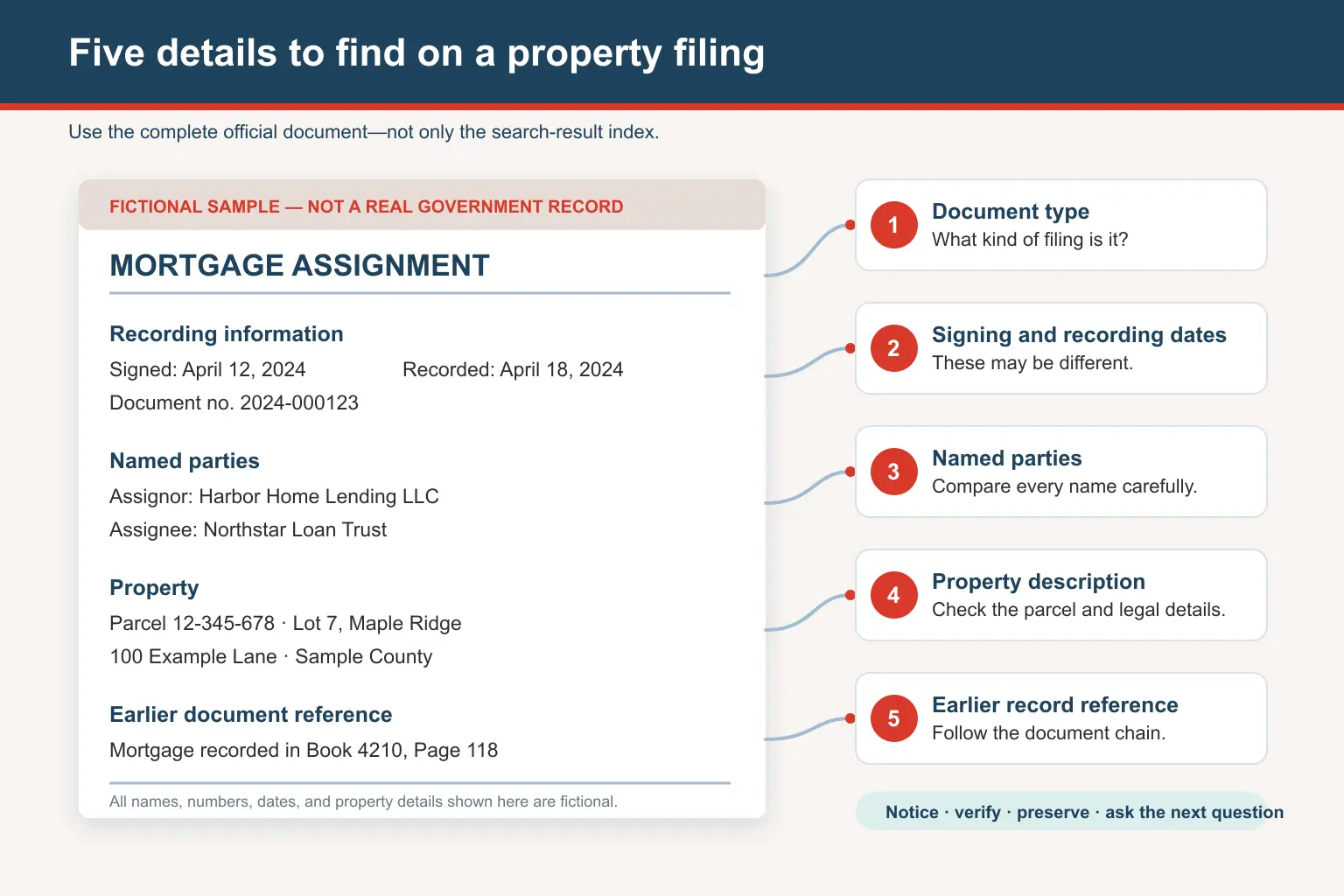
The Document Type
Look for a title such as deed, mortgage, deed of trust, assignment, satisfaction, release, reconveyance, lien, easement, affidavit, notice, or lis pendens. The title is a clue, not a complete explanation. Read the body and note any earlier records it mentions.
The Signing and Recording Dates
The signing date shows when the document was executed. The recording date shows when the office added it to the public record. Those dates may be separated by days, weeks, or longer. A later recording date does not necessarily mean the underlying event happened that day.
The Named Parties
You may see labels such as grantor and grantee, borrower and lender, assignor and assignee, claimant and owner, or trustee and beneficiary. Compare the names carefully. Former names, middle initials, trusts, estates, business entities, spelling differences, and people with similar names can create confusion.
The Property Description
The property may be identified by a street address, parcel number, lot and block, subdivision reference, survey reference, or legal description. The address helps, but the legal description or parcel identifier may matter more. A filing deserves closer review when the description appears to identify the wrong property or more land than expected.
References to Earlier Records
Look for an instrument number, book-and-page citation, document number, or earlier recording date. The online index entry is only the label on the folder. Open the document itself, then review the records it references and any related filings recorded afterward.
Together, those documents may show what was created, transferred, changed, corrected, or released.
Common Property Record Filings and What They May Mean
Document names and legal effects vary, but most filings serve one of several broad purposes.

Filings That Affect Ownership
A deed is commonly used to transfer an ownership interest in real estate. Depending on the state and transaction, you may see names such as warranty deed, grant deed, special warranty deed, quitclaim deed, trustee’s deed, or personal representative’s deed. A deed-related filing may also involve a correction, estate, trust, name change, or transfer between family members or entities.
The document deserves prompt attention when you do not recognize the person receiving an interest, your name was removed unexpectedly, it appears to transfer the entire property, the signature looks unfamiliar, the legal description appears wrong, or the transaction was not something you authorized.
Watch Out: Be cautious when anyone asks you to sign a deed to “clean up,” “protect,” or “correct” the record. Even a corrective deed may affect legal rights. Review it as carefully as any other ownership document. If an unexpected deed or notice led you here, see How Property Alerts Work—and What to Do When You Receive One.
Filings Connected to a Mortgage or Home Loan
A mortgage or deed of trust secures a home loan with the property. The structure, parties, and terminology vary by state. Seeing one after a purchase, refinance, or home-equity transaction is generally expected.
An assignment commonly reflects a transfer of an existing mortgage, deed of trust, or other recorded loan interest from one entity to another. Imagine finding an assignment six years after refinancing. The receiving company’s name is unfamiliar, but the record lists you as the borrower, describes your property, and refers to the mortgage signed during that refinance. That may point to a transfer involving the existing loan rather than a new loan—but confirm the document and account details before drawing a conclusion.
The company that owns your loan may be different from the servicer that collects your payments. The Consumer Financial Protection Bureau explains how to ask a servicer who owns a mortgage. For questions about ownership, servicing, balances, or payoff status, the lender or servicer is generally a better source than the recording office.
Filings That Create a Claim
A lien is a legal claim against property connected to a debt or obligation. Examples may include mortgage liens, property-tax liens, federal tax liens, judgment liens, contractor or mechanic’s liens, and homeowners association liens. The IRS, for example, describes a federal tax lien as the government’s legal claim against property after a tax debt remains unpaid and explains that it may file a public Notice of Federal Tax Lien.
A recorded lien does not, by itself, answer every question about the claim. The document may not tell you whether it is valid, enforceable, paid, expired, released, or connected to the correct person or parcel. A lien is also not the same as a completed foreclosure, tax sale, levy, or seizure. Those are different processes, and the rules vary.
Lien notices, filing deadlines, enforcement rights, release requirements, and priority rules vary substantially by state. When a contractor lien appears, preserve the contract, change orders, invoices, proof of payment, notices, correspondence, and lien waivers. For a broader overview, see Understanding Property Liens and What Homeowners Should Do Next.
Filings That Remove a Claim
A satisfaction, release, discharge, or reconveyance often appears after a mortgage, deed of trust, judgment, tax claim, or other lien has been paid or resolved.
Suppose you are preparing to sell and discover that a mortgage paid off eight years ago still appears open in the county index. That does not necessarily mean the debt still exists. The release may have been recorded under a different reference, indexed under another party’s name, delayed after payoff, recorded in a separate system, or never properly submitted or indexed.
The Consumer Financial Protection Bureau advises homeowners to check state or local property records and contact the company that received the payoff to confirm whether the mortgage lien was released. It also notes that a delay may occur between payoff and release. A missing release becomes especially important before a sale, refinance, or new home-equity loan.
Pro Tip: Follow the mortgage chain. One property’s records may show an original mortgage, one or more assignments, a payoff, and a later satisfaction or reconveyance. Reviewing only one piece can create an incomplete picture.
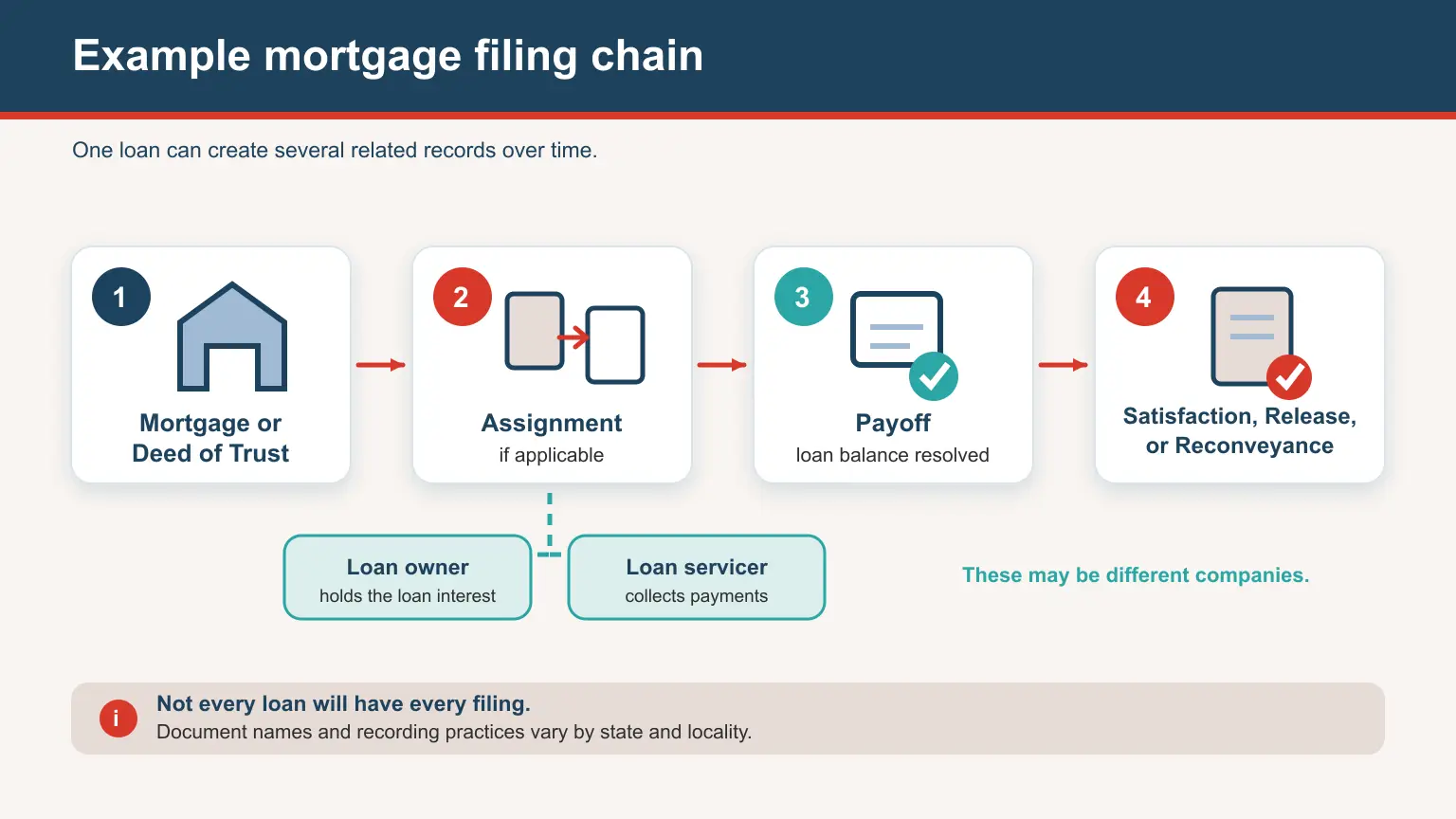
Mortgage or Deed of Trust → Assignment, if applicable → Payoff → Satisfaction, Release, or Reconveyance
The loan servicer and loan owner may be different entities, so the payment relationship does not always tell you who owns the loan.
Tax-Related Filings
A tax-related record may involve an assessment, unpaid tax claim, tax lien, exemption, correction, tax-sale process, or another administrative notice. The assessor, tax collector, treasurer, and recording office may be separate agencies. The office displaying the record may not be the office that calculated the amount, sent the bill, or can explain a payment issue. For related context, see Why Did My Property Taxes Go Up?.
Easements, Restrictions, Maps, and Other Encumbrances
An easement generally provides limited rights to use or access land owned by someone else. It may involve utility access, a shared driveway, drainage, maintenance, road access, or conservation. The exact effect depends on the document, applicable law, and the rest of the property record.
An easement generally does not transfer ownership of the affected area, but it may influence how part of the property can be used. A survey or site plan may help show where a recorded easement appears to sit. Ask a qualified local professional before making a construction, boundary, or ownership decision based on the filing.
Corrective, Administrative, and Indexing Filings
Some filings exist to correct, clarify, connect, or index information. They may fix a name or spelling, add a missing legal description, correct a document reference, clarify an estate or marital fact, connect a release to an earlier lien, or address an indexing problem.
These documents can look unfamiliar even when they are routine. Still, do not assume that a “corrective” label makes the filing harmless. Confirm what changed and whether the correction matches your records.
Filings That Signal a Legal Matter
An affidavit, notice, memorandum, judgment, or notice of pending action may signal a claim, legal event, or dispute involving the property. Terminology and legal effect vary by state. A filing that refers to pending litigation does not decide the outcome, but it deserves prompt review by a qualified local professional.
The same is true when a record refers to foreclosure, a tax sale, bankruptcy, probate, divorce, a judgment, an ownership dispute, or a court deadline.
How to Check an Unfamiliar Property Record Filing
You do not have to solve every possible title, loan, tax, or legal issue in the first five minutes. Work through the filing in a calm order.
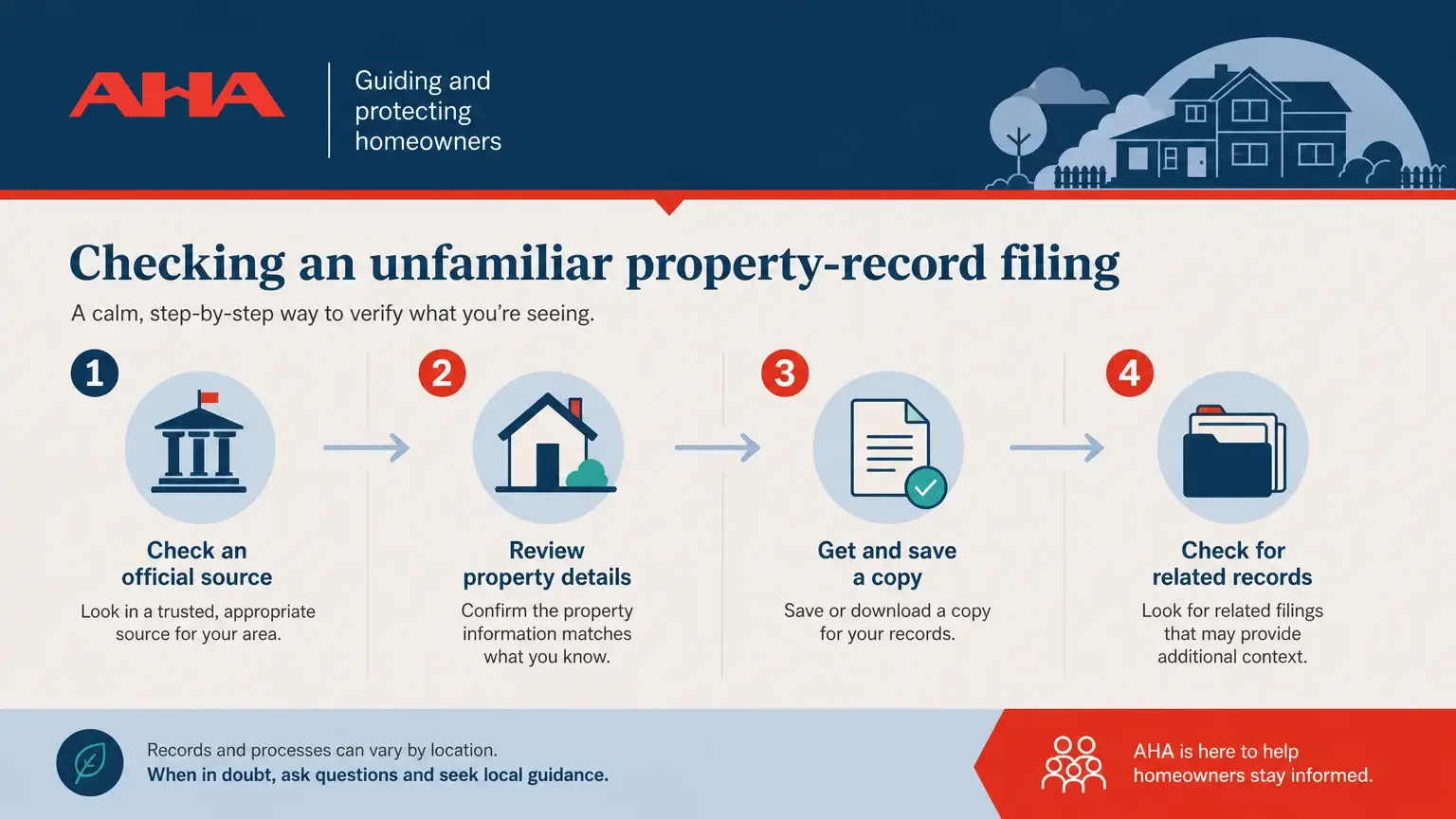
1. Start With the Official Record
Find the government recording office serving the property’s location. Be careful with private sites that resemble government databases or charge for documents the official office provides free or at a lower cost.
2. Open the Complete Document
An index entry may show only a title, names, dates, abbreviations, and a document number. Open or request the full image before deciding what the filing means.
3. Confirm the Property and Parties
Compare the owner or borrower names, parcel number, legal description, street address, prior document references, and related filing dates. A similarly named person, prior owner, or neighboring parcel may explain an apparent mismatch.
4. Ask What the Filing Appears to Do
Does it appear to transfer an interest, secure a loan, transfer an existing loan interest, create or release a claim, grant access or use rights, correct an earlier record, or provide notice of litigation? That question is usually more helpful than trying to translate every legal phrase.
5. Connect It to the Life of Your Home
Consider whether it relates to a purchase, refinance, payoff, home-equity loan, trust, inheritance, divorce, contractor project, tax issue, or lender or servicer change. Many unfamiliar filings become understandable once you connect them to a known event.
6. Check Related Records
Look at the earlier document referenced in the filing and any documents recorded afterward.
- For a mortgage-related filing, compare the public record with loan documents, refinance paperwork, payoff letters, and servicer notices.
- For a tax-related filing, compare it with tax bills, assessment notices, payment records, and exemption paperwork.
- For a title-related question, compare it with your deed, closing documents, owner’s title-insurance policy, title-company communications, and survey.
7. Verify the Filer Independently
Contact the lender, servicer, title company, attorney, contractor, government agency, or other filer using contact information from a source you already trust. Do not rely only on a phone number, QR code, email address, or website printed on an unexpected notice.
8. Save the Filing and Your Notes
Keep the complete document, related earlier and later records, the date you found it, the people or offices you contacted, case or reference numbers, explanations you received, remaining next steps, and the date the issue was resolved. That record may save time during a sale, refinance, insurance claim, estate transfer, or future dispute.
Which Office or Professional Should You Contact?
Different questions belong in different places. The office that recorded the document may not have created it, calculated the amount, serviced the account, released the claim, or have authority to interpret your rights.
Contact the Recorder or Land-Records Office When You Need
- Help locating the official filing
- A complete document copy
- A document or instrument number
- Assistance using the search system
- Information about recording or indexing procedures
- General correction procedures for an office error
Recording staff may explain process. They generally cannot give legal advice or decide whether a claim or transfer is valid.
Contact the Lender or Servicer When the Filing Involves
- A mortgage or deed of trust
- An assignment or refinance
- A payoff, satisfaction, or release
- A servicing or loan-account question
Contact the Tax Office, Assessor, or Treasurer When It Involves
- Property taxes or assessments
- Exemptions or delinquent amounts
- Tax liens or tax-sale notices
- Payment-account questions
Contact the Title Company or Title Insurer When It Involves
- Your closing
- A possible title defect
- An older unreleased lien
- A deed or ownership-history concern
- A possible claim under an owner’s title policy
Coverage depends on the policy, the type of defect, and when the problem arose.
Contact a Qualified Local Professional When It Involves
- An unauthorized deed or forged signature
- Disputed ownership or a lien dispute
- Probate, inheritance, divorce, or bankruptcy
- Foreclosure, a court judgment, or a tax sale
- A title defect or legal response deadline
Depending on the issue, the appropriate person may be a real-estate attorney, title professional, tax professional, estate attorney, or another qualified local adviser.
Watch Out for Official-Looking Property Mail
Because ownership, mortgage, and recording information may be public, marketers and scammers can use real property details to make a letter look official. An envelope marked “Property Notification,” “Recorded Deed Information,” “Final Notice,” “Response Requested,” “Mortgage Protection,” or “Title Monitoring” does not prove the sender is your recorder, lender, title company, tax office, or another government agency.
Pause before calling the printed number, scanning a QR code, paying for a deed copy, buying a title-monitoring product, sharing sensitive information, signing a deed or correction form, or paying someone who promises to remove a lien immediately. Verify the sender through an official website or contact information you already know is genuine.
If you suspect an unauthorized transfer or identity theft, preserve the documents and use independently verified contact information. The FTC directs consumers who suspect identity theft to IdentityTheft.gov for a recovery plan. AHA’s guide to How Property Fraud Happens can help you understand the warning signs.
When Should You Act Promptly?
Many record questions can be resolved by locating the full document and contacting the appropriate office. A smaller group deserves faster attention because ownership, money, or a legal deadline may be involved.
Act promptly when:
- A deed appears to transfer your property without permission.
- An unfamiliar mortgage or home-equity loan appears.
- Your name has been removed unexpectedly.
- The legal description identifies the wrong parcel.
- A signature appears forged.
- A filing refers to foreclosure, bankruptcy, a tax sale, or pending litigation.
- A lien is blocking an upcoming sale or refinance.
- A document conflicts with your closing or payoff records.
- You suspect identity theft or property fraud.
- A court or government notice contains a response deadline.
Preserve every related document and communication. Then contact the appropriate recording office, lender, title insurer, attorney, tax authority, law-enforcement agency, or identity-theft reporting channel based on the circumstances.
Keep a Simple Property Record File
A new filing is much easier to understand when you can compare it with the documents you already have. Keep one paper or digital folder containing your:
- Recorded deed and closing documents
- Owner’s title-insurance policy
- Mortgage, home-equity, and refinance documents
- Payoff statements and recorded satisfactions or releases
- Survey and easement documents
- Property-tax notices
- Major contractor contracts, change orders, invoices, proof of payment, and lien waivers
- Trust or estate documents involving the home
- Notes from calls about record questions
Your system does not need to be elaborate. It just needs to be complete enough to help you follow your home’s paper trail.
A Calm Review Is Usually the Best First Step
Property-record systems can make an ordinary transaction look intimidating. The documents are formal because they may affect valuable legal and financial rights—not because every filing is an emergency.
Start with four questions: What is the document? Who filed it? Which property does it describe? What interest does it appear to create, transfer, change, or release?
Then compare it with the other records connected to your home.
Many unfamiliar filings turn out to be routine. Others require a call to the recorder, lender, tax office, title insurer, or another professional. A few deserve prompt action because ownership, money, identity, or a legal deadline may be involved.
You are not expected to speak fluent recorder-office language. Your job is to notice, verify, preserve the record, and ask the right next question.