
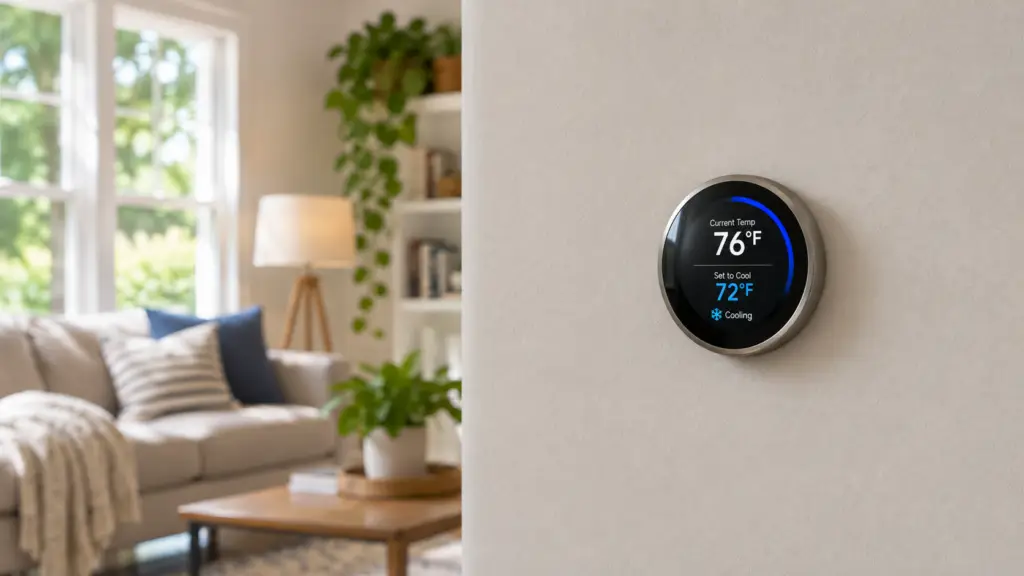
You set your thermostat to 72°F, but the screen still says 76°F. The AC seems to be running, so why isn’t the house getting any cooler?
Maybe you’ve already checked the thermostat twice. Maybe you’ve lowered the setting another degree, hoping that will help. And somewhere in the back of your mind, you’re wondering whether this is about to turn into an expensive service call.
When your AC isn’t reaching the set temperature, there are several possible explanations, and not all of them mean something is broken. Some are relatively simple to address. Others need a professional’s attention.
The trick is knowing where to start. Four straightforward checks can help you understand what’s happening, whether to give the system more time, and when it’s worth making that call.
Why Your AC Isn’t Reaching the Set Temperature
Start with four checks: your thermostat settings, fan setting, air filter, and blocked vents or return-air grilles. Then watch whether cooling improves. If the temperature isn’t moving toward your setting or the problem keeps returning, arrange a professional assessment.
Your thermostat shows the temperature you’ve asked your home to reach and the temperature it’s currently detecting. If you’ve selected 72°F but it reads 76°F, you know the room is warmer than you’d like. You don’t yet know why.
The AC might be cooling without keeping up with the home’s cooling needs. Restricted airflow or an equipment problem could be reducing its performance. Or the indoor fan could be running without the cooling equipment actually operating.
That last possibility is easy to overlook.
On many central air conditioning systems, the indoor fan can circulate air even when the equipment isn’t actively cooling. Hearing air moving through a vent doesn’t necessarily mean your AC is producing cool air.
And while lowering the thermostat another five degrees might feel like the obvious solution, it generally won’t make a conventional AC cool the house faster. Set it to the temperature you want, then focus on what the system is doing.
This guide focuses on ducted central AC and heat pumps in cooling mode. Your equipment’s instructions should guide the checks for your particular system.
4 Things to Check First
Before assuming there’s a problem with the equipment, start with the things that are easy to overlook.
1. Check the Thermostat Mode, Temperature and Schedule
Make sure your thermostat is set to Cool, with a target below the current room temperature. If you have a programmable or smart thermostat, check whether a schedule has changed the setting you intended.
2. Check the Fan Setting
Look at the fan setting. On many systems, Auto runs the blower with heating or cooling cycles, while On allows the fan to run continuously. Follow your system’s instructions if it has a separate circulation or ventilation setting.
This distinction can explain why you hear the system running even when the house isn’t getting cooler. These basic thermostat checks are a useful starting point before arranging service. If you’ve just changed a setting, check the manual for any startup delay.
3. Check the Air Filter
A dirty filter can restrict airflow, making it harder for your air conditioner to cool the house. If the filter needs attention, clean or replace it as directed, using the type and size specified for your equipment. Follow the instructions for access and any shutdown steps; leave checks that require equipment disassembly to a technician.
ENERGY STAR recommends monthly filter attention. That doesn’t mean every filter needs monthly replacement—its condition and the equipment’s instructions should guide you.
For a broader routine, see AHA’s seasonal home maintenance checklist.
4. Check for Blocked Vents and Return-Air Grilles
Notice whether furniture or curtains are blocking vents or return-air grilles. Supply vents deliver conditioned air into the rooms; returns draw room air back through the system. Keep those obvious paths clear without turning this into a furniture-moving project.
If the settings and filter look right, you’ve given yourself a better starting point for deciding what comes next.
What If the AC Is Running but the Temperature Still Won’t Drop?
This is where paying attention to what the system is doing becomes more useful than changing the thermostat again.
Stand near a supply vent while the system is calling for cooling. Does the air feel noticeably cooler than the room? Is the airflow about what you’re used to?
You don’t need special equipment for these observations. They’re clues to describe, rather than a diagnosis.
If the air feels cool but your home isn’t reaching the setting, the system may be removing some heat without keeping up. If the air feels closer to room temperature, or airflow is much weaker than usual, that gives a technician a different symptom to investigate.
Dirty coils, refrigerant problems and equipment faults can all interfere with cooling. You don’t need to work out which component is responsible before requesting an assessment.
What you can notice is whether the problem affects the whole home or certain rooms, whether it started suddenly, and whether cooling is becoming less effective. Those details are more useful than trying to name a failed part.
Sometimes the House Is Part of the Picture
It’s easy to think of air conditioning as a simple transaction: set the temperature, and the AC delivers it.
But the amount of heat your home gains affects the cooling it needs. Extreme outdoor heat, sunlight through windows and heat-producing activities such as cooking or clothes drying can add to that demand. Closing sunny-window shades or postponing the dryer can help reduce the added heat while you assess what’s happening.
The useful comparison is with your home’s usual pattern.
A room that has always been difficult to cool is a different observation from an entire house that suddenly won’t reach the temperature it maintained last week. Mention that difference when you arrange service. Also note whether direct sunlight or a nearby heat source reaches the thermostat, since it can affect the reading.
Hot weather is useful context, but it doesn’t automatically explain away a new cooling problem. The question is whether the system is making progress and how its behavior compares with what you’re used to.
When Can You Monitor the Problem, and When Should You Call?

Not every difference between the thermostat setting and the indoor temperature requires an immediate service appointment.
If the indoor temperature is moving toward your setting, airflow seems normal, there are no warning signs and your household is comfortably cool, it may be reasonable to give the system more time. Follow any startup guidance in your equipment’s instructions, and notice whether progress continues.
A temperature that stays stubbornly above the setting deserves more attention, particularly if the system previously maintained that temperature without difficulty.
Consider arranging service if:
- The AC keeps running without bringing the temperature closer to your setting.
- Air from the vents isn’t noticeably cool during a cooling request.
- Airflow has become unusually weak, or cooling has noticeably worsened.
- The system repeatedly starts and stops in short bursts, or the problem keeps returning.
Watch Out: If you see ice on the equipment or refrigerant tubing, turn cooling off and contact a technician. Don’t try to remove the ice yourself. An electrical burning smell also calls for stopping the system if safe and getting prompt professional help.
During extreme heat, make other cooling arrangements if your home isn’t staying adequately cooled rather than waiting for it to recover.
You don’t need to keep monitoring indefinitely or rule out every possible cause. If the basic checks don’t help, calling is a reasonable next step.
Before Agreeing to an Expensive AC Repair
A little preparation can make the service conversation more useful. Note the selected and current temperatures, when you first noticed the problem, and whether the reading is falling, steady or rising. Include changes in airflow, affected rooms and any displayed error code.
If you need to choose a contractor, AHA’s contractor hiring guide explains how to find candidates and compare written bids. The SmartHire Contractor Kit provides worksheets for organizing the scope and bid details.
If it helps, start with this:
“My AC isn’t reaching the temperature I’ve set. It’s set to ___, and the current reading is ___. I first noticed it ___. I checked ___. Since then, ___. What should I do while waiting for service?”
Then ask the technician to walk you through the diagnosis. It should connect what they found with the work they’re recommending.
If refrigerant is part of the explanation, ask whether a leak or another cause has been identified and what the recommended work will address. Refrigerant and electrical servicing belong with qualified professionals.
Pro Tip: Ask, “Can you explain what isn’t working and how this repair will solve the problem?” For substantial work, request a written scope and price before deciding.
If replacement is recommended, AHA’s guide to what to check before replacing your HVAC system can help you evaluate the diagnosis, equipment condition and proposed solution. A missed thermostat setting alone doesn’t settle that decision.
Know What to Check and When to Get Help
Start with the thermostat settings, air filter and obvious airflow obstructions. Then pay attention to whether the AC is cooling and whether the temperature is moving in the right direction.
If those checks don’t explain the problem, a technician can help you understand what’s happening before you commit to a repair.
You don’t need to figure out every component of your air conditioner. You need enough information to choose the next step—and a clear explanation of what any recommended work would accomplish.