

Home insurance covers disasters. Home warranties function partly like insurance — offering some financial protection — but for everyday breakdowns. And most homeowner stress and expense still lives in between.
Different Tools for Very Different Problems
Most homeowners assume insurance, warranties, and repair plans are all meant to solve the same problem: something broke — now what?
In reality, these tools exist to manage very different kinds of risk. Confusing them is one of the main reasons homeowners end up frustrated, overpaying, or caught off guard.
At a high level:
- Homeowners insurance is built for rare but devastating events.
- Home warranties are really service contracts, not technically a warranty. They are typically meant to cover common but inconvenient breakdowns.
Understanding this distinction changes how you think about protecting your home.
Homeowners Insurance: Low-Frequency, High Cost Risk
Why doesn’t homeowners insurance cover normal repairs?
Homeowners insurance is designed for events that could financially wipe you out.

Your home burns down. A major storm tears off part of the roof. A tree crashes through the structure. These are low-frequency, high-severity losses — often costing tens or even hundreds of thousands of dollars.
Because the stakes are so high, mortgage lenders almost always require homeowners insurance. From the lender’s perspective, your house is collateral. If it’s destroyed, insurance is what ensures the loan can still be repaid.
What insurance is not meant to do is cover the normal aging of a house. Mechanical systems wear out. Seals fail. Materials degrade. When damage happens slowly or predictably, insurers classify it as maintenance — not an accident.
That’s why claims tied to wear and tear, deferred maintenance, or gradual leaks are among the most commonly denied.
Insurance is essential. It’s just intentionally narrow.
Home Warranties: High-Frequency, Inconvenient Breakdowns
Are home warranties worth it?
Home warranties target a different category of risk: the everyday breakdowns that disrupt your life but don’t destroy your house.
An HVAC system stops working. A refrigerator dies. A water heater fails without warning. These are high-frequency, lower-severity events — usually costing hundreds to a few thousand dollars.
In theory, a warranty offers predictability. You pay an annual fee, and when something breaks, the warranty company coordinates service.
In practice, the experience can be uneven.
Most warranties come with:
- Coverage exclusions buried in the contract
- Limits on how much they’ll pay
- Service fees required every time a technician is dispatched
- Slower response times than hiring a local contractor directly
Many homeowners are surprised to learn that even after paying the annual premium, they still owe $75–$150 per service call — sometimes multiple times for the same issue.
Denials are also common. Claims are frequently rejected due to pre-existing conditions, maintenance standards, or disagreements about what caused the failure. For homeowners, this often feels less like protection and more like negotiation.
Why Home Warranties Are So Common in Home Sales
Despite the drawbacks, home warranties remain popular — especially during real estate transactions.
Sellers often include a warranty to increase buyer confidence, particularly when selling older homes. It reassures buyers that if something fails shortly after closing, there’s at least some backstop.
This is a key point: warranties are frequently used as a transactional confidence tool, not necessarily as a long-term ownership strategy.
Once the home is no longer “new to you,” many homeowners reassess whether the ongoing cost and friction still make sense.
Who Home Warranties Tend to Work For — and Who They Don’t
Home warranties tend to appeal to homeowners who value convenience and predictability over control.
They’re often a better fit for:
- First-time buyers in their first year
- Homes with older appliances
- Owners who prefer a single phone call over managing repairs
They tend to frustrate homeowners who:
- Want to choose their own contractors
- Care about repair quality and longevity
- Are comfortable managing repairs directly
- Dislike fine print and coverage disputes
Many of the latter eventually decide to skip warranties altogether.
When Home Warranties Don’t Make Financial Sense
One of the most common critiques of home warranties is straightforward: over time, many homeowners pay more into the warranty than they ever get back in covered repairs.
Home warranties are a form of risk smoothing, not a guaranteed financial win. And for many households, the math simply doesn’t work out.
A Realistic Financial Example
Consider a common scenario:
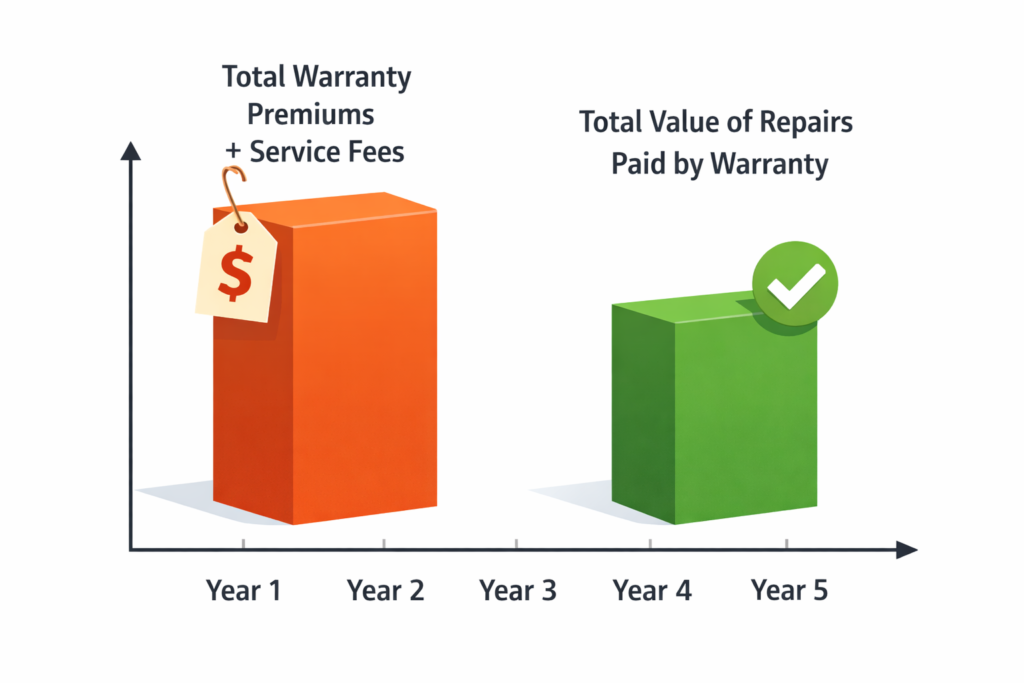
A homeowner buys a home warranty that costs $65 per month, or about $780 per year. The plan also charges a $100 service fee every time a technician is dispatched.
Over five years, here’s what happens:
- Warranty premiums paid: $780 × 5 = $3,900
- Two service calls over five years: $100 × 2 = $200
- Total out-of-pocket cost: $4,100
During that same five-year period, the homeowner experiences two covered issues:
- A refrigerator repair that the warranty contributes $350 toward
- A minor HVAC repair covered up to $600
Total benefit received: $950
Even with legitimate claims approved, the homeowner paid over $4,000 to receive less than $1,000 in actual repair value.
That difference — more than $3,000 — could have stayed in the homeowner’s own repair fund, earning interest and remaining fully under their control.
Why This Happens So Often
This outcome isn’t unusual. It happens because:
- Many homes don’t experience major covered failures every year
- Service fees reduce the net value of each claim
- Coverage limits cap what the warranty will actually pay
- Some issues are partially covered or excluded entirely
Over time, the warranty functions more like a subscription for peace of mind than a cost-saving tool.
How to Figure Out If a Home Warranty Makes Sense for You
The right question isn’t “Is a home warranty good or bad?” It’s “What problem am I trying to solve?”
A warranty may make sense if:
- A single large repair would seriously strain your finances
- Your home has multiple aging systems likely to fail soon
- You value predictability and coordination more than flexibility
It may not make sense if:
- You can comfortably absorb a few thousand dollars in repair costs
- You prefer choosing your own contractors
- You’re willing to save monthly instead of paying premiums
A useful exercise is to compare:
- What you pay annually for the warranty (including service fees)
- The realistic cost of the most likely repairs
- How often you expect to actually use the coverage
If the math only works when everything goes wrong, the warranty is functioning more as costly peace of mind than financial value.
The Self-Insurance Approach: Saving for Repairs
Some homeowners choose to self‑insure instead.
Rather than paying premiums and service fees, they set aside money each month into a dedicated home repair fund. When something breaks, they pay for it directly.
Over time, this can be the most cost‑efficient approach. You avoid denials, delays, and restrictions.
The tradeoff is timing risk. Repairs don’t happen on schedule. A single HVAC failure can wipe out years of savings if it hits at the wrong moment.
Self‑insurance works best for homeowners with strong cash flow and a high tolerance for volatility.
Where AHA Membership Fits
Homeowners insurance, home warranties, and AHA Membership can all help when something goes wrong with your home — but they help in different ways.
Insurance is primarily financial protection against covered losses. A home warranty or service contract may help pay for certain covered repairs or replacements when a home system or appliance breaks down.
AHA Membership helps you deal with the breakdown itself — even though it doesn’t cover the repair cost.
Through AHA HomeAssist, members can get guidance when a critical home system or major appliance stops working, including heating and cooling, plumbing, electrical systems, and major appliances. HomeAssist helps you understand what may be happening, how urgent the problem is, what your next step should be, and when it makes sense to bring in professional help.
That fills an important gap in homeownership. When the air conditioner quits, the water heater starts leaking, or an appliance suddenly stops working, the first question usually isn’t just, “Who’s paying for this?”
It’s, “What do I do now?”
HomeAssist is designed to help you answer that question with less guesswork.
AHA Membership also supports you between breakdowns. HomeOS helps you organize and understand your home over time, while membership includes tools and guidance around property records, taxes and assessments, home risks, maintenance, and other homeowner decisions.
Pro Tip: Think of AHA Membership as support around the financial protections you already have. Insurance or a warranty may help with an eligible cost. AHA helps you understand the problem, make a smarter decision, and figure out what comes next.
How the Options Work Together
For many homeowners, this isn’t an either-or decision.
Homeowners insurance helps protect you financially from covered events such as certain fires, storms, theft, and other sudden losses.
A home warranty or service contract may help pay for certain covered breakdowns of appliances or home systems, subject to the contract’s exclusions, limits, and service fees.
A home repair reserve gives you your own money to handle repairs and replacements, with the freedom to choose how it’s spent.
AHA Membership helps you manage the homeownership decisions surrounding those problems — including getting guidance through HomeAssist when an important system or appliance breaks down.
The key difference is simple: AHA doesn’t pay the repair bill. It helps you take care of your home and provide support every step of the journey.
That can mean understanding whether something needs immediate attention, knowing what questions to ask, avoiding unnecessary guesswork, or getting help finding the right next step.
No single option handles every part of homeownership. The goal is to understand what each one does so you can build the combination that works for your home, your budget, and the amount of uncertainty you’re comfortable handling.