
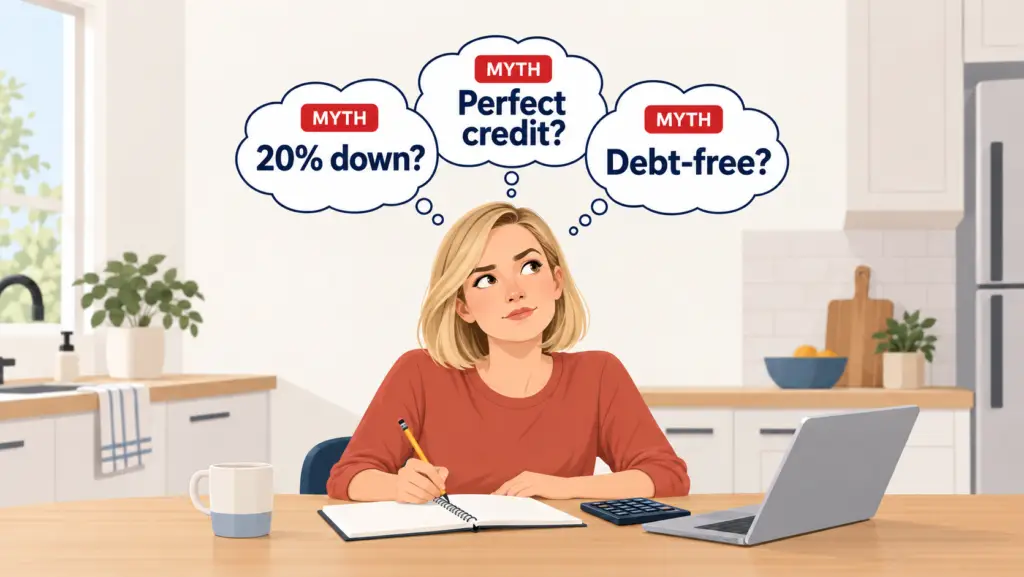
You find a home listing you can actually picture yourself living in. Then you calculate 20% down on the $300,000 price tag: $60,000. You close the tab.
Maybe you’re still paying student loans, your credit score isn’t perfect, or you work for yourself. Suddenly, buying a home feels like something reserved for people whose finances look nothing like yours.
But some of the rules you’ve heard aren’t rules at all.
These common homebuying myths can discourage people before they’ve explored their options. Others can lead buyers to underestimate the real costs of ownership.
Buying a home is a major financial decision, and it isn’t right for everyone. But you deserve to make that decision based on facts, not assumptions.
Here’s what actually matters—and how to decide whether homeownership makes sense for your life.
Homebuying Myths About Qualifying for a Mortgage
For many prospective buyers, the first obstacle isn’t necessarily a mortgage application. It’s the long list of things they believe they must accomplish before they can even apply.
Perfect credit. A substantial salary. No debt. Years of savings.
Some of those things can certainly help. But they’re not all universal requirements, and understanding the difference may change how you think about your options.
Myth #1: You Need 20% Down to Buy a House
You may have heard this one more than once.
That $300,000 house you were looking at? A 20% down payment would require $60,000. It’s a significant amount of money, especially when you’re already paying rent and covering everyday expenses.
But here’s what surprises many prospective buyers: 20% is not a universal down payment requirement.
Some conventional mortgage programs allow qualified buyers to put down as little as 3%. Federal Housing Administration (FHA) loans can require as little as 3.5%.
Eligible borrowers may qualify for a Department of Veterans Affairs (VA) loan without a down payment, subject to appraisal, entitlement and lender requirements. The U.S. Department of Agriculture (USDA) Guaranteed loan program also offers no-down-payment financing for eligible borrowers purchasing qualifying homes in eligible rural areas.
On that same $300,000 home, a 3% down payment would be $9,000 instead of $60,000.
That’s a meaningful difference.
But there’s a tradeoff. Putting less money down generally means borrowing more, increasing your potential monthly payments and total interest costs. With many conventional loans, a down payment below 20% also means paying private mortgage insurance. FHA loans require mortgage insurance, and USDA Guaranteed loans have program fees. VA loans may have a funding fee.
A 20% down payment can still offer financial advantages. It just isn’t the only path to buying a home.
The better question isn’t whether you’ve saved exactly 20%. It’s which financing options you qualify for and whether the resulting costs fit your finances.
Explore Fannie Mae’s HomeReady mortgage to see how one lower-down-payment program works, and read AHA’s guide to private mortgage insurance to understand how a smaller down payment may affect your costs.
Myth #2: You Need Perfect Credit to Qualify for a Mortgage
Maybe you checked your credit score recently and weren’t thrilled with the number.
It’s tempting to assume anything short of excellent credit puts homeownership out of reach. But mortgage qualification doesn’t work quite that way.
Your credit score matters. It helps lenders evaluate your borrowing history and determine which loan terms they may offer. A stronger score can mean more financing options and potentially lower borrowing costs.
But you don’t need a perfect credit score to explore getting a mortgage.
Different lenders and mortgage programs have different requirements. Some offer options for qualified borrowers whose credit isn’t excellent.
That doesn’t mean every credit score will qualify. A lower score can affect approval chances, interest rates, and loan costs. Improving your credit before applying may save you money.
Still, don’t assume you’re automatically disqualified because your score isn’t where you’d like it to be.
Start by reviewing your credit reports for errors and learning which mortgage programs may fit your circumstances.
Myth #3: You Can’t Buy a House If You Have Student Loans or Other Debt
Student loans, car payments, and credit card balances are familiar parts of financial life.
And while existing debt affects your ability to qualify for a mortgage, having debt doesn’t automatically eliminate that possibility.
Lenders generally consider your debt-to-income ratio, which compares your required monthly debt payments with your gross monthly income—what you earn before taxes and other deductions. For mortgage qualification, that calculation includes the proposed housing payment as well as other required debt payments.
Think of two people who each owe $20,000 on a car loan. One has a relatively low monthly payment and substantial income. The other has a much higher payment relative to their earnings.
The same outstanding balance can affect their mortgage applications very differently.
Mortgage programs also have specific rules for calculating student loan obligations. A deferred loan or a reported $0 payment doesn’t necessarily mean the lender will leave it out of the calculation.
Paying down debt can improve your borrowing position and free up room in your monthly budget. But you don’t necessarily need to eliminate every balance before considering homeownership.
The question is whether your existing obligations leave enough room for a mortgage payment and the additional costs of owning a home.
For a clearer picture of how lenders evaluate borrowing, AHA’s Home Loan Basics guide explains the major factors that affect financing.
Myth #4: You Have to Earn a Six-Figure Salary to Become a Homeowner
With home prices and mortgage payments stretching household budgets in many parts of the country, it’s understandable why people assume homeownership requires a six-figure income.
But there’s no universal $100,000 salary requirement for purchasing a home.
Someone earning $80,000 in one housing market may have very different buying options from someone earning the same amount in a significantly more expensive area.
Your purchasing power depends on local home prices, mortgage rates, savings, other debts, and household expenses.
And earning six figures doesn’t automatically mean someone can comfortably afford a home.
A buyer with substantial debt or other financial commitments may have less room in their budget than someone earning less with fewer obligations.
That’s why focusing on income alone can be misleading.
The better question isn’t whether you’ve reached a particular salary. It’s whether the home you’re considering fits the life you can comfortably afford.
Myth #5: You Need a Traditional Salaried Job to Get a Mortgage
Not everyone receives a predictable paycheck every other Friday.
Maybe you’re a freelance designer, run a small business, work on commission, or earn income from several sources.
If you’ve heard that lenders only want borrowers with traditional salaried jobs, there’s good news: that isn’t universally true.
Mortgage lenders generally want to verify that your income is sufficient and reasonably reliable. Depending on your circumstances, qualifying income may include self-employment earnings, commissions, or other eligible sources.
The difference is often documentation. How much income a lender can count—and the records needed to establish it—depends on the program and your circumstances.
For example, a self-employed photographer may need to provide tax returns and business records to demonstrate income over time rather than simply handing over a recent pay stub.
That process can take more preparation, particularly if earnings fluctuate or the business is relatively new.
But working for yourself doesn’t automatically mean a mortgage is off the table.
Finding out how lenders evaluate your particular income is more useful than assuming you don’t qualify. Ask which records they would need for your income sources before you start gathering paperwork.
Homebuying Myths About Savings and Household Finances
Finding out that you might qualify for a mortgage is encouraging.
But qualifying is only the beginning.
Before you start picturing where the couch will go, there’s another question worth understanding: How much money will you actually need to purchase the home?
The answer involves more than the down payment, and some options may be different from what you’ve heard.
Myth #6: You Have to Save the Entire Down Payment Yourself
Saving for a house can feel like trying to fill a bucket while everyday expenses keep taking water out.
Rent, groceries, transportation, and unexpected bills all compete with your homebuying goals.
But your personal savings aren’t necessarily the only funds that can be used toward a down payment.
Depending on the mortgage program, eligible buyers may use documented gifts from family members or other permitted sources.
There are also down payment assistance programs offered through state and local housing agencies and other organizations. Some provide grants, while others offer loans with particular repayment terms or conditions.
These programs aren’t available to everyone. Eligibility may depend on income, location, property type, homebuyer education, and other requirements.
And assistance isn’t always free money. Some programs must be repaid when the home is sold, refinanced, or another specified event occurs.
Still, it’s worth exploring legitimate assistance options before assuming you must save every dollar yourself.
A lender or a housing counselor approved by the U.S. Department of Housing and Urban Development (HUD) can help you understand what might apply to your situation.
Myth #7: You Need to Be Married or Have Two Incomes to Buy a House
There’s a familiar image of first-time homebuyers: a smiling couple standing on the front porch, proudly holding a set of keys.
But buying a home isn’t reserved for married couples or two-income households.
Single people can apply for mortgages and purchase homes using their own qualifying income, savings, and credit history.
Federal fair lending protections also prohibit lenders from discriminating against mortgage applicants because of marital status. State property-law considerations can still affect loan documentation, but being single isn’t a mortgage disqualification.
Of course, purchasing on one income can affect your budget. Without another earner contributing to household expenses, maintaining emergency savings and financial flexibility may be especially important.
But you don’t need to wait for a spouse or partner to begin understanding your homebuying options.
Myth #8: The Down Payment Is the Only Major Upfront Cost
This misconception can lead to an unwelcome surprise.
Let’s return to that $300,000 home.
A qualified buyer putting 3% down might need $9,000 toward the purchase price.
But that doesn’t mean $9,000 is all they’ll need to complete the purchase.
There are also closing costs, which can include lender fees, appraisal charges, title-related expenses, and prepaid taxes or insurance.
According to the CFPB’s down-payment planning guidance, closing costs typically range from 2% to 5% of the purchase price, separate from the down payment.
On a $300,000 home, that’s approximately $6,000 to $15,000 in estimated closing costs.
Together with a $9,000 down payment, that would mean approximately $15,000 to $24,000 in upfront funds before accounting for assistance, negotiated credits, moving expenses, and other costs.
These are illustrations, not personalized estimates. Actual expenses depend on the transaction, financing, property, and location.
And spending may not stop when you receive the keys.
Moving costs, utility deposits, appliances, furniture, and unexpected repairs can all arrive during the first few weeks of ownership.
In Zillow’s 2026 Consumer Housing Trends Report, 51% of surveyed first-time buyers said their final closing costs were higher than expected.
That’s a useful reminder that budgeting for a home purchase should extend beyond the down payment.
Watch Out: Don’t use every dollar of your available savings for the down payment. Keeping money available for closing expenses, moving, and unexpected repairs can make the transition into homeownership considerably less stressful.
The goal isn’t simply to have enough money to buy the house. It’s to be financially prepared to live in it.
You can use AHA’s Home Mortgage Calculator to explore how a purchase price, down payment, interest rate, and loan term affect your estimated payment.
Homebuying Myths That Can Lead to Expensive Decisions
By this point, you may be realizing that some traditional homebuying rules aren’t nearly as rigid as they sound.
That’s encouraging.
But there’s another side to the story: qualifying for a mortgage isn’t the same as making a financially comfortable home purchase.
The final two myths are particularly important because they can influence how much you spend—and how much flexibility you have afterward.
Myth #9: Every Mortgage Lender Will Offer You Essentially the Same Deal
It’s easy to assume mortgage rates and fees are relatively standardized.
You find a lender, complete the paperwork, get approved, and move forward.
But lenders can offer different interest rates, fees, mortgage insurance arrangements, and loan terms—even when evaluating the same borrower.
Those differences can affect both your monthly payment and the total cost of the mortgage.
Yet Zillow’s 2026 research found that 72% of surveyed mortgage buyers submitted only one mortgage application.
That tells us how many applications they submitted, but it doesn’t tell us whether they compared quotes or lenders before applying.
The Consumer Financial Protection Bureau recommends requesting and comparing Loan Estimates from multiple lenders.
A Loan Estimate is a standardized document explaining important details about a proposed mortgage, including projected payments, interest rates, closing costs, and certain loan features.
Pro Tip: When you’re ready to compare offers for a particular property, ask lenders to use the same loan amount, down payment, loan type, and comparable terms. Review estimates obtained close together in time, since rates can change.
You can learn more through the CFPB’s guide to comparing Loan Estimates.
Buying a home involves enough decisions already. Comparing financing offers is one step that can help you make an informed choice before committing to a substantial long-term expense.
Myth #10: If a Lender Approves You, You Can Afford the Home
Imagine getting approved for a $400,000 mortgage.
After months or years of wondering whether homeownership was possible, that approval can feel like a major milestone.
And it is.
But here’s something worth remembering: the amount a lender is willing to loan you isn’t necessarily the amount you’ll feel comfortable spending.
A lender uses underwriting requirements to assess your ability to repay. That assessment doesn’t choose your household’s priorities or decide how much breathing room you want for childcare, retirement savings or everyday life.
Only you can decide how much financial flexibility helps you sleep comfortably at night.
Then there are the additional responsibilities of ownership.
Property taxes and insurance premiums may change. Appliances eventually need repairs or replacement. Some properties have homeowners association fees, and others require additional insurance.
An aging water heater doesn’t care how much your lender approved you for.
That’s why it’s worth deciding what total monthly housing expense fits your life before allowing a mortgage approval amount to determine your house-hunting budget.
A smaller, less expensive home may offer greater financial breathing room. Or renting for another year may help you build the savings you want before taking on ownership.
Neither choice means you’re making a mistake.
The best mortgage isn’t necessarily the largest one you can obtain. It’s one you can manage while maintaining the financial flexibility you need.
AHA’s Home Affordability Calculator can help you examine a potential purchase alongside your other expenses and savings goals.
So, What Does It Really Take to Become a Homeowner?
There’s no magic salary, relationship status, or credit score that makes every buyer ready for homeownership. And there’s no single down payment that fits everyone.
What matters is whether the home, the financing, and the responsibilities of ownership fit your finances and the way you want to live.
If a familiar rule has kept you from exploring your options, start with that one concern. You don’t have to become a mortgage expert overnight.
Ask a lender or a housing counselor approved by HUD: “Given my income, debts and savings, which options could I qualify for, and what would the full monthly cost and cash needed to close look like?”
Compare that information with a household budget that leaves room for the rest of your life. If the numbers don’t work right now, waiting can be a smart decision, too.
AHA’s First-Time Homebuyer Guide walks through the steps from setting a budget to preparing for closing. Start with the decision you’re facing now; exploring your options doesn’t commit you to buying.
Buying a home isn’t about meeting someone else’s definition of financial perfection. It’s about making a decision that supports the life you want to live.