

You check your mortgage portal, a home-value website, a refinance message, or a lender estimate and see a home equity percentage staring back at you. It feels like a score. Maybe you are doing better than you thought. Maybe you are suddenly wondering whether you are behind.
The useful thing about that number is that it can give you a quick position check. The risky thing is that it can feel more exact than it really is.
Your equity percentage can be a helpful planning signal, but it is not cash available to spend, a guaranteed loan approval, tax advice, or a promise of sale proceeds. It is best understood as a snapshot: how much of your home’s estimated value is not currently covered by debt secured by the home, based on the inputs used to calculate it.
If you want the broader foundation first, AHA’s Understanding Home Equity guide explains what home equity is and how homeowners may think about using it. This article focuses on the narrower question: what does the percentage mean when you see it, and what should you verify before acting on it?
> Fast answer: Home equity percentage is an estimate of how much of your home’s value is not currently covered by debt secured by the home. It can help you understand your ownership position, but it is not the same as cash, loan approval, tax treatment, or sale proceeds. Before you act on it, verify the value source, payoff amount, any second mortgage or HELOC (home equity line of credit), and the decision you are trying to make.
Why your equity percentage can feel more certain than it is
Equity percentage feels powerful because it turns a complicated homeowner question into one clean number. A dashboard might show that your home value has gone up, your mortgage balance has gone down, or your equity position has improved. That can feel reassuring, especially if you have been paying your mortgage for years or watching nearby sale prices.
But each part of the calculation may be an estimate.
A home-value website may use available data and market signals. A mortgage portal may rely on a recent estimate or automated valuation. A lender may use its own valuation process. An appraiser may reach a different opinion based on the property, comparable sales, condition, and loan purpose. Broad market data, such as the Federal Housing Finance Agency’s House Price Index, can help describe market movement, but it is not the same thing as valuing one specific home.
The most useful way to read the percentage is: “This may tell me where I roughly stand. Now I need to check what number is behind it.”
What home equity percentage measures
In plain language, home equity is the difference between what your home is currently worth and what you still owe on debt secured by the home. The Consumer Financial Protection Bureau explains home equity in this value-minus-debt way when describing home equity loans and home equity lines of credit.
Equity percentage takes that idea one step further. Instead of showing only a dollar amount, it expresses estimated equity as a share of the home’s estimated value.
Here is the basic idea:
Estimated home value minus debt secured by the home equals estimated equity. Estimated equity divided by estimated home value gives you an estimated equity percentage.
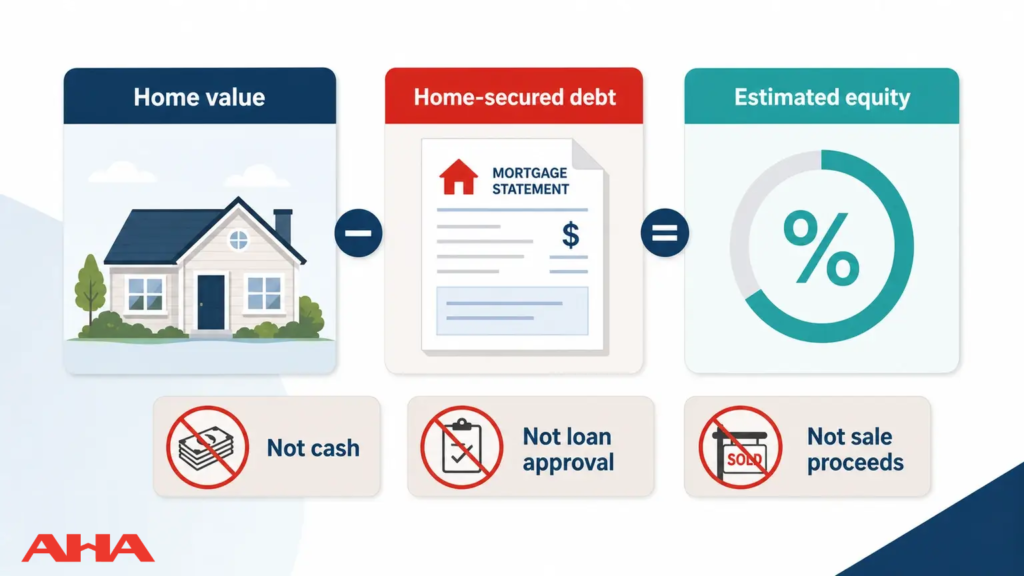
That does not mean the homeowner has that estimated equity ready to spend. It also does not mean a lender would approve a loan based on that number alone. It simply means that, based on those estimated inputs, a portion of the home’s value is not currently covered by the home-secured debt included in the calculation.
A more durable mental model is:
Value estimate -> home-secured debt -> estimated equity dollars -> estimated equity percentage -> verification before action.
That order matters. If the value estimate changes, the percentage changes. If the payoff balance changes, the percentage changes. If there is a second mortgage, home equity line, lien, or other home-secured debt not included in the simple view, the percentage may not be telling the full story.
Equity percentage is not the same as appraised value or borrowing power
These ideas often get mixed together, but they are not the same.
Equity is the estimated gap between home value and debt secured by the home. It is a position check.
Appraised value is a professional opinion of value used for a specific purpose, often tied to a loan, sale, refinance, or other transaction. It may not match an online estimate or the number you had in mind.
Borrowing power is what, if anything, a lender may be willing to offer after reviewing the property, loan type, borrower, existing debt, credit profile, income documentation, applicable rules, and the lender’s own standards. It is not the same as total equity.
Here is what this can look like in real life:
A homeowner sees a strong equity percentage after several years of mortgage payments and rising nearby sale prices. They begin planning around that number. But when they apply for a home equity product, the lender uses a different valuation, includes an existing home equity line in the calculation, and reviews the homeowner’s broader debt picture. The homeowner may still have options, but the dashboard number was only the first clue, not the answer.
Watch Out: Do not build a renovation budget, debt payoff plan, sale decision, or refinance assumption around one equity estimate. Use it to start the conversation, then verify value, payoff balances, loan rules, and transaction costs that may apply to your situation.
Why lender ratios can tell a different story
Homeowners usually talk about equity percentage. Lenders often talk about loan-to-value ratios. If you want a broader grounding in mortgage terms, AHA’s home loan basics guide can help keep the vocabulary straight.
Loan-to-value, often shortened to LTV, compares the loan amount with the property value used for the loan decision. Combined loan-to-value, or CLTV, may account for more than one loan secured by the home. Home equity combined loan-to-value, or HCLTV, can account for certain home-equity exposure, including HELOC-related considerations. Fannie Mae’s Selling Guide distinguishes these lender-facing concepts, including LTV, CLTV, HCLTV, and subordinate financing.
The point is not to memorize the acronyms. The point is that a lender may look at your home-secured debt differently than a simple equity-percentage display does.
For example, a basic equity estimate may compare one mortgage balance with one home-value estimate. A lender’s review may consider a first mortgage, a second mortgage, a HELOC, whether a HELOC balance is drawn or available, and the lender’s required valuation method. Different loan types and lenders may apply different rules, so there is no single national percentage that automatically means yes or no.
A homeowner-friendly translation:
- Your equity percentage tells you about ownership position.
- LTV-style ratios help lenders evaluate loan risk.
- CLTV and HCLTV concepts may matter when more than one home-secured debt or HELOC exposure is involved.
- None of these ratios, by themselves, guarantee approval, terms, or available cash.
What to verify before treating the number as usable money
Before you treat an equity percentage as money you can use, slow the process down into a short verification sequence.
First, check the value source. Is the number coming from an online estimate, a lender estimate, a recent appraisal, a tax assessment, a listing opinion, or something else? These numbers can be useful, but they are not interchangeable.
Second, check all debt secured by the home. Your first mortgage may not be the whole picture. A second mortgage, HELOC, or other lien can affect how much equity is actually available for a sale, refinance, or borrowing decision.
Third, check the payoff amount, not just the balance you remember. Loan balances change, and payoff figures can differ from the number you see in a routine statement because they are calculated for a specific payoff date.
Fourth, check the purpose. Checking progress, borrowing, refinancing, selling, planning a repair, and making a tax assumption are different questions. The same equity percentage can lead to different next steps depending on what you are trying to decide.
Fifth, check affordability beyond approval. A lender’s willingness to offer a product does not automatically mean the payment fits your household comfortably. You will want to understand payment changes, repayment timing, whether payments may vary, and what happens if your income or expenses change.
Sixth, check sale or transaction assumptions. If you are thinking about selling, your equity percentage is not the same as your final proceeds. A sale may involve payoff amounts, transaction costs, negotiated credits, taxes, moving expenses, or other facts that vary by location and situation. This article is not estimating those costs; it is simply a reminder that equity and net proceeds are different.
A simple homeowner practice is to keep a one-page “equity check” note once or twice a year:
- Estimated home value and where it came from
- Current mortgage payoff estimate or balance
- Any second mortgage, HELOC, or other home-secured debt
- Reason you are checking equity
- Questions to ask before acting
That record turns a vague number into a more useful planning habit.
Where home equity loans and HELOCs fit
A home equity percentage often leads to a borrowing question, but it does not answer that question by itself.
The CFPB describes a home equity loan as borrowing a specific amount using home equity as collateral. A HELOC is different: it is an open-end line of credit that lets a homeowner borrow against home equity (HELOC = home equity line of credit), often with a draw period and repayment period. Both are secured by the home, which means missed payments can put the home at risk.
That is enough product detail for interpreting the percentage. If your real question is whether a HELOC makes sense, see AHA’s HELOC guide. If your question is broader – what home equity is and what homeowners can do with it – start with AHA’s home equity pillar guide.
For this article, the key point is simpler: seeing an equity percentage does not tell you which product, if any, is appropriate.
When tax, loan, or local professional guidance may matter
Some equity questions are routine. You can often start by reviewing your mortgage statement, checking whether an estimate is automated or appraised, and reading basic loan information.
Other situations deserve qualified help before you make a move.
Talk with a lender or mortgage professional when you are comparing refinance options, home equity loans, HELOCs, or other loan products. The rules, documentation, valuation method, and loan structure can vary. Ask how the lender is calculating value, what debts are included, whether any HELOC exposure is counted, and what could change before closing.
Talk with a tax professional when you are making tax assumptions. Home equity loan or HELOC interest should not be treated as automatically deductible. Current IRS guidance says treatment can depend on how borrowed funds are used and other mortgage-interest rules and limits. If tax deductibility matters to your decision, check current IRS guidance and get advice based on your own return.
Talk with a local real estate or legal professional when property records, liens, sale proceeds, divorce, inheritance, title issues, or local transfer rules may affect the answer. These issues can vary by state, county, and individual property history.
The dividing line is simple: routine estimates are fine for planning, but decisions that involve borrowing, taxes, legal rights, sale proceeds, or title questions deserve confirmation from someone qualified to review your actual documents.
How to keep an equity estimate in perspective
Your equity percentage is most useful when you treat it as a starting point, not a finish line.
A higher number may mean you have more ownership position than before. That can be encouraging. It may also create more options to explore, such as selling, refinancing, or borrowing. But it does not automatically mean those options are wise, affordable, available, or tax-advantaged.
A lower number does not mean you have failed as a homeowner. Early in a mortgage, in a changing market, after a recent purchase, or after adding home-secured debt, the percentage may simply reflect where you are in the ownership timeline. It is information, not a grade.
The clearest way to use the number is to pair it with a question:
- “Am I just checking my progress?”
- “Am I considering borrowing?”
- “Am I thinking about selling?”
- “Am I trying to understand my refinance options?”
- “Am I making a tax assumption I need to verify?”
Your next step is simple: write down the equity percentage you saw, where it came from, the home value used, and the debt number behind it. Then decide what question you are actually trying to answer before you treat that percentage as money, approval, or advice.